In 1989 I happily ditched the five-and-dime ad agency I had helped keep afloat for ten years and opened my own company.

Thankfully, most of what I produced back then has been lost to history, but you can find one example here, if you’re so inclined.
As luck would have it, in the early ’90s I had a couple of cash cow clients for whom I wrote catalogue copy. One was Bits and Pieces (“Your Puzzle Authority”), whose marketing philosophy at the time boiled down to “All the puns that fit, we print.” Alas, no longer.
The other was international travel company Saga Holidays, which had established a Boston branch a decade earlier.
In their wisdom, the sages at Saga decided I should be compensated for my labors with complimentary travel accommodations. Soon thereafter the Missus and I were off on a worldwind tour of London, Vienna, Salzburg, and Munich.
First stop was St. James’s Hotel in the Mayfair section of London. Sounds swank, but what the Missus and I discovered over time was that virtually all London hotels – The Cumberland, The Waldorf, St. James’s – were essentially the Strand Palace (“Preferred by four out of five UK soccer hooligans”), only with higher room rates.
I don’t recall much of what we did in our couple of London days, but I’m pretty sure we visited Leighton House in Kensington.
(By then we had been to London so many times, the Missus was deep into Page 3 of the Google search for London cultural attractions, except there was no Google in those days. The Missus did it all by hand.)
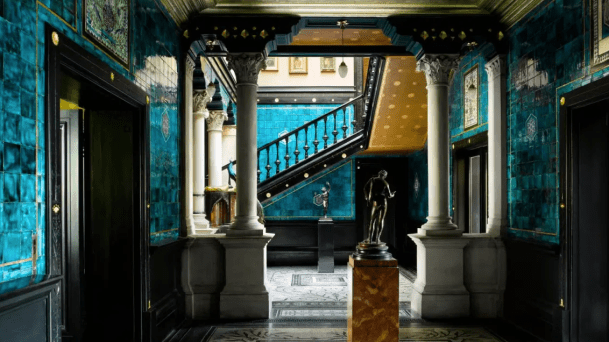
From its first construction in the 1860s up until shortly before [Frederic, Lord] Leighton’s death, his studio-house on the edge of Holland Park was a constant preoccupation. Absorbing large amounts of his time, money and effort, the house combined spaces for living, working and entertaining and the display of Leighton’s collections. Regularly featured in the press, his home came to embody the idea of how a great artist should live.
The Leighton House collections of paintings, sculptures, photographs, drawings, and furnishings were equally impressive. Afterward, we headed to the High Street Kensington tube station, where we watched a train pull in to the opposite platform with a rampaging gang of street thugs punching, kicking, and slamming the heads of passengers against the car windows.
And then they were streaming down the stairs of the station, possibly headed up to our platform to wreak more havoc.
The Missus and I crouched behind a booth halfway down the platform and hoped for the best, which amazingly was what we got: The thugs never did come our way. Regardless, we were more than happy to exit London and head for the continent.
• • • • • • •

I don’t recall which Vienna hotel we stayed in, but I remember that Wolfgang the desk clerk (Vulfie to the Missus) was extremely helpful in our exploration of the city, which looked like this back then.
We especially gravitated toward the Kärntner Strasse (around 12:10 here), where we went to a cafe for lunch upon our arrival. As we surveyed the sandwiches and salads on display, I did my best to muster up enough German to place our order, but failed miserably. The Missus stood by, remarkably patient but extremely hungry, until a kindly waitress took pity on us and said “point.” And so we did.
We returned to the Kärntner Strasse that night for dinner at a restaurant where the theme from The Third Man was playing as we entered.
Excellent!
We also took in all the attractions that the Missus had Vienna-fingered for us, starting with the obligatory Lipizzaner Stallions. (We actually caught a rehearsal – the regular show was a bit pricey for us.)
We also dutifully attended a Vienna Mozart Concert in Historical Costumes at the Musikverein.

Soak up Vienna’s rich music culture with a performance from the Vienna Mozart Orchestra at the Musikverein. Take your seat in the historic venue and travel back to the 18th century, as the orchestra performs Mozart’s famous works while dressed in period costumes.
As best I can recall, we either a) fell asleep at the performance, or b) left early so we would not fall asleep at the performance. (We’ve come to appreciate Mozart far more nowadays.)
The Missus:
Two things of note here. First, 1991 was the 200th anniversary of Mozart’s death and Vienna was all Mozart, all the time. Everywhere we went we were offered little chocolates with wrappers featuring colorful depictions of the genius composer who sadly died age 35. Men in period costumes also seemed to appear out of nowhere on the streets handing out brochures featuring the numerous events celebrating the year of his death. (Is celebrating someone’s death really such a good idea?) Second, we were still suffering from jet lag having had to rise at the crack of dawn in London for our flight to Vienna – another reason we were nodding off. Apologies to Mozart.
Next stop was the Vienna State Opera House.
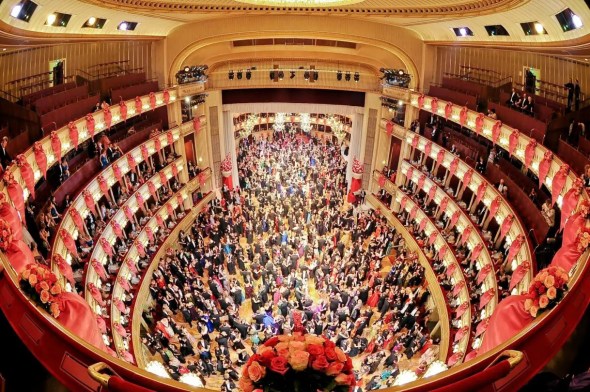
Vienna State Opera, German Staatsoper, theatre in Vienna, Austria, that is one of the world’s leading opera houses, known especially for performances of works by Richard Wagner, Wolfgang Amadeus Mozart, and Richard Strauss. The original theatre, located on the Ringstrasse, was built in 1869 to house the expanded operations of the Vienna Court Opera (Hofoper), by which name it was originally known. Particularly famed during the conductorship of Hans Richter (artistic director 1880–96) were productions of Wagner’s cycle Der Ring des Nibelungen. The directorship of the composer Gustav Mahler (1897–1907) was one of the artistic high points of the opera’s history . . .
Wartime bombing destroyed the building in 1945. Its reconstruction, completed in 1955, was financed by taxes, contributions, and U.S. Marshall Plan aid.
We definitely wanted to see the renovated interior, but decidedly did not want to take the costly tour. So we bought a couple of $3 tickets to the standing room section behind the third balcony.
The Missus:
Amazingly, while tickets to attend the opera cost hundreds of dollars, I read in a guidebook you could buy standing room for only a few dollars. (That’s still true today.) What the guidebooks didn’t say was buying those shockingly discounted tickets was a three-hour ordeal going from a slow-to-open box-office line, to two different corralled waiting areas before you were let in.
It was first-come first-stood, so we got there early and the Missus staked our claim by tying her scarf around the padded railing in front of the nosebleed ghetto, the same way the other cheapskates had reserved their spots.
Then we wandered around on our own tour of the Opera House.

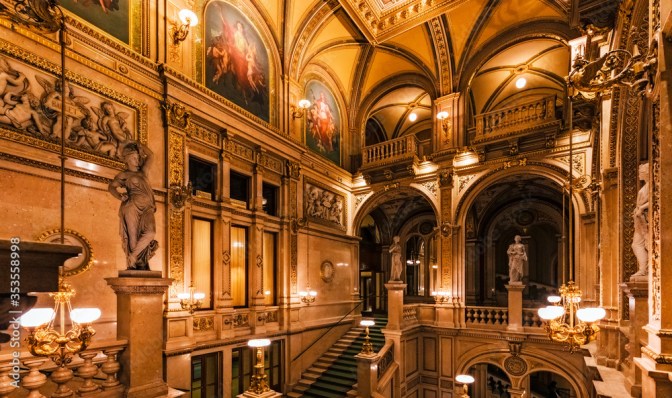
The whole place was luminous, beauteous, glorious.
We returned to the nosebleed section, where 1) a kindly standee told the Missus that “someone tried to nick your scarf” but she had warded the thief off, and 2) we listened to the overture to The Barber of Seville while channeling Bugs Bunny (a.k.a. The Rabbit of Seville).
After which, we left.
The Missus:
Ok – another two things. First, we were trying really hard not to giggle when we immediately recognized the Bugs Bunny connection – yes, we were Warner Brothers versus Opera aficionados – and didn’t want to offend the music lovers next to us. Second, we were starving, having originally assumed we could buy the standing room tickets and go get something to eat prior to the performance. We hadn’t known once you enter the cheap ticket line you aren’t allowed to leave the theatre. Lesson learned and apologies to any opera fans we have offended.
The next day the Missus and I visited the magnificent Schönbrunn Palace.

Schönbrunn Palace is one of Europe’s most beautiful Baroque complexes and has been in the possession of the Habsburgs since 1569. The wife of Emperor Ferdinand II, Eleonore von Gonzaga, had a pleasure palace built on the site in 1642 and called the property “Schönbrunn” for the first time. The palace and garden complex created from 1696 onwards following the siege of Vienna was complete redesigned under Maria Theresa after 1743. Today, due to its historical significance, its unique layout and magnificent furnishings, the palace is a UNESCO World Heritage site.
Indeed, the interior is quite spectacular.
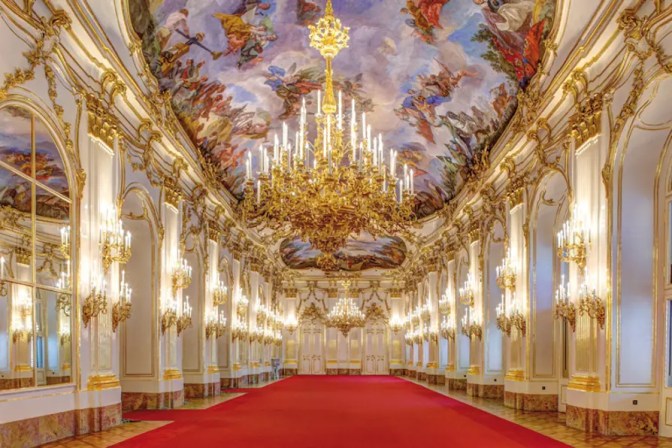
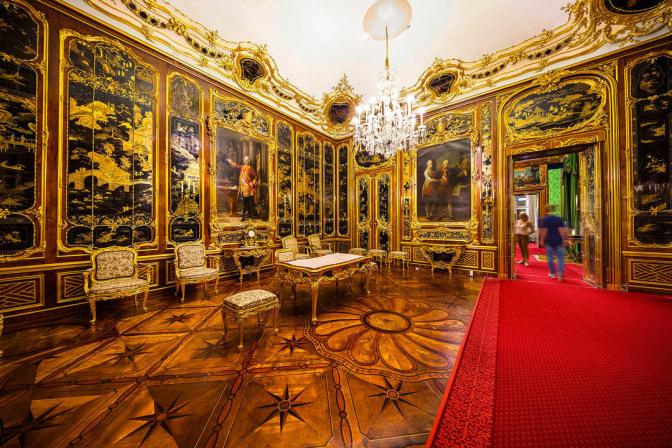

After we toured the palace, we had a lovely lunch at its outdoor cafe. As we waited for the check, we tossed pieces of bread to the ducks hovering nearby, which drew disbelieving looks from the other patrons. We had no idea the cafe charged for each of the rolls the waiter had blithely delivered to our table when we sat down.
We knew better next time.
The Missus:
Thus fortified – and a bit poorer – we took a walk through the beautiful palace gardens to the fabulous Tiergarten Schönbrunn, the oldest working zoo in the world. Who knew? Created in 1752 by the husband of Empress Maria-Theresa, Hapsburg‘s only female ruler and mother of Marie Antoinette, the menagerie was arranged in a huge circle with pathways radiating out from a charming octagonal pavilion in the center. When touring the palace, we learned that the Empress (who reigned for 40 years and had 16 children!) ate her breakfast in the pavilion most mornings, sitting at a different window each day so she could enjoy all the assorted animals in turn. The original circular design and Octagon building are still intact.
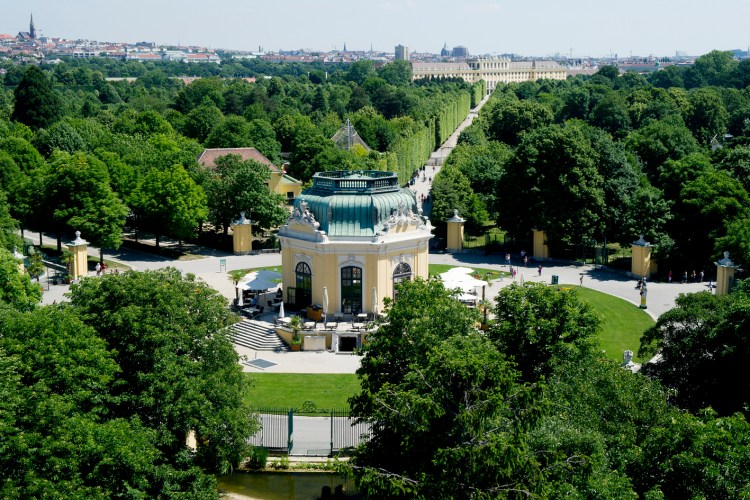
What’s new is the amazing assortment of well-cared-for animals – over 700 species – most in their own habitats. Elephants made their first appearance in 1770, shortly followed by polar bears, lions and kangaroos, with giraffes strolling the grounds by 1828.
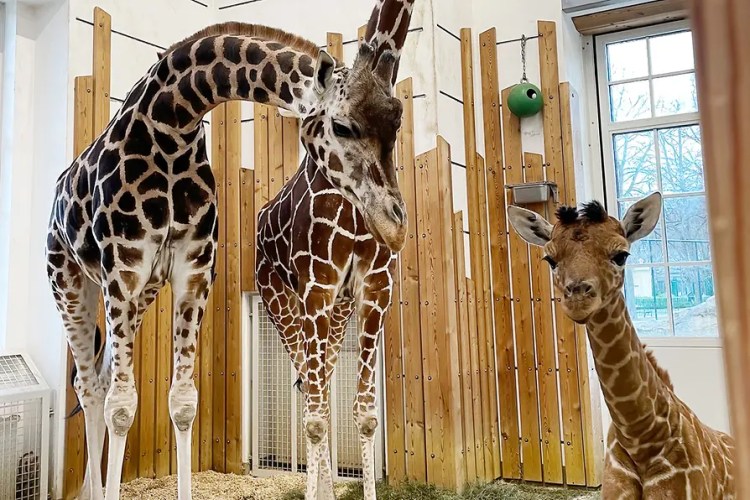
Today the Giant Pandas and koala bears are visitor favorites.

Walking around the magnificent palace, stunning grounds and spectacular zoo, you can see why 14-year-old Marie Antoinette was reluctant to leave home as the politcal pawn in her mother’s negotiations for marriage with the Dauphin of France. Of course Versailles was nothing to sneeze at, but we all know how that turned out in the end.
While in Vienna we also visited The Prater, home of the giant ferris wheel immortalized in – wait for it – The Third Man.
Here it is today.

The Giant Ferris Wheel in the Prater is one of Vienna’s symbols. Almost 65 meters tall, it offers a breathtaking view of the city. Since very recently, the particularly courageous have been able to get an extraordinary shot of adrenalin here.
According to the unwritten rule for all visitors to Vienna, if you haven’t done a round on the Giant Ferris Wheel, you haven’t been in Vienna. The Giant Ferris Wheel was erected in 1897 to mark the 50th year of Emperor Franz Joseph‘s accession to the throne. It has been an enduring features of the city’s skyline ever since.
Unwritten rule or not, we were in Vienna even though we did not get to “do a round” on the Giant Ferris Wheel, given that The Prater was closed the day we were there.
Rain check, yeah?
The Missus:
As I am terrified of heights, John would have been on his own had the Ferris Wheel been open. I would instead be one of the “dots” on the ground that Orson Welles would have been happy to make disappear for the right price.
As our short stay in Vienna was sadly up, we moved on to our next destination, Salzburg.
• • • • • • •
Here’s what Salzburg looked like back then.
I totally remember our hotel in Salzburg – the Hotel Pitter – because it had a decidedly Behind the Iron Curtain vibe to it.
From the January, 1990 edition of Ski Magazine.

Since then, apparently, they’ve gussied up the place quite a bit.
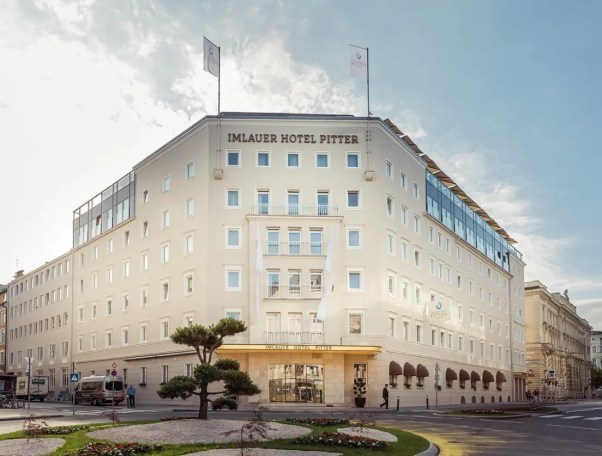
The IMLAUER Hotel PITTER welcomes you in the heart of the city of Salzburg.
Here, you can feel the pulse of this town of Mozart and of the famous festival.
This family-run, 4-star superior hotel has a long tradition, and yet is in tune with modern times.
They’ve also goosed up their room rates quite a bit. (Fifty-five dollars in 1990 equals $130 now, while 210 euros now equals $221, for those of you keeping score at home.)
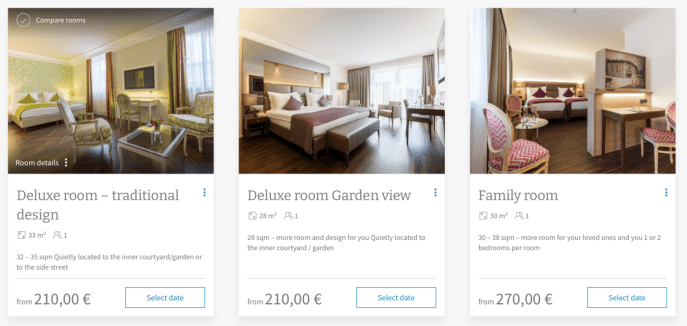
During our time in Salzburg, budget was indeed the operative word, especially after our first night when we encountered severe sticker shock at a neighborhood restaurant where a salad cost the equivalent of $20, which was real money back then ($47 today). After that, it was all Pizza Hut all the time. Added bonus: Pizza Hut menus were printed in German and French, a language we actually understood, we knew what we were ordering.
The Missus:
Before we left on our trip, I had read that Salzburg was then the most expensive city in Europe. I found that hard to believe, but figured since our hotel and transportation were already paid for, I wasn’t planning on doing any shopping, and we always dined at neighborhood rather than upscale eateries, how bad could it be? Turns out, pretty bad. The salad John mentions above was basically just greens, although a lot of them. But since the total calorie count was under 100, we were starving and had already spent over $60 including wine, we declined to order anything else, tipped and left.
Wandering down the street we came across a Pizza Hut – the kind of American chain we normally avoided – and with stomachs growling, eagerly went inside.
Our non-dining activities began at Hohensalzburg Fortress, home to the legendary archbishop immortalized as The Turnip.
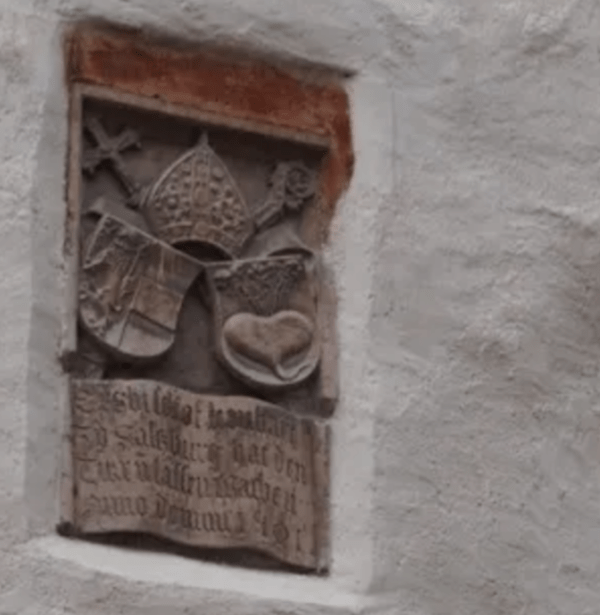
In the 1500s, the castle began to take its modern shape, and gained a very strange coat of arms – depicting a lion holding a turnip. There are two explanations for the choice of vegetable: and both relate to Archbishop Keutschach, who commissioned the construction of much of the fortress between 1495 and 1520.
According to popular legend, the turnip symbolises an important moment in Keutschach’s life: when he was a boy, he shied from working in the fields, which prompted someone to lob a turnip at him. It’s said that the turnip knocked him on the head – and knocked some sense of social responsibility into him.
It’s a nice story, but it’s more likely that the turnip represents the agricultural heritage of the Keutschach family.
There are two ways to get to the castle – by foot (not fun) or funicular (totally fun). The Missus and I chose the latter.

Here’s an engaging tour of the fortress (interiors here) if you’re so inclined.
Less majestic but a lot more fun was Hellbrunn Palace & Trick Fountains.

Salzburg’s prince-archbishop Markus Sittikus planned Hellbrunn Palace as a never-before-seen oasis of enjoyment and leisure. This summer residence sprang up in virtually record-setting time, with construction taking only from 1612 until 1615. Master architect Santino Solari, who was also given the commission for Salzburg Cathedral, created one of the most magnificent Late Renaissance buildings north of the Alps . . .
The idyllic location in the south of Salzburg was ideal in many regards: The teeming waters flowing down from Hellbrunn mountain essentially predestined water to become a central design element. At the heart of the ground are the Mannerist “Trick Fountains”, which are quite unparalleled in the world today.
Representative interior . . .

When we were there, our tour guide seemed to take a shine to the Missus, repeatedly referring to her as “young lady” and directing several streams of water in her direction. It was all very third-grade-during-recess.
(Here’s how the Trick Fountains normally work.)
The Missus:
Unlike many tourists, I try to pay rapt attention to guides and ask a lot of questions as it’s a great way to find out fun or surprising stories. That particular guide clearly found this unusual as most of our group were chattering among themselves or admiring the scenery. Unfortunately in this case, the elderly gentleman directed both his talk and trick fountain displays at me.
But it was worth getting wet as I learned the most fun fact. Prince-archbishop Markus Sittikus turned out to be a bit of a sadist. His dinner guests, presumably being honored by the invitation, were each seated on stone chairs with narrow slats in the middle. Unbeknownst to them, Sittikus had levers at his head-of-the-table throne that made spurts of water shoot up through the chairs on command. As protocol demanded that no one get up before the Archbishop, he found it highly amusing to have all his dining companions forced to endure unexpected squirts throughout the meal. That brings a whole new meaning to “wet” one’s appetite.
In our less liquid Salzburg moments, we also dropped by Mozart’s birthplace, where we definitely did not fall asleep.

W.A. Mozart was born in 1756 in the “Hagenauer Haus” at No. 9 Getreidegasse in Salzburg. Today, Mozart’s Birthplace is one of the most visited museums in Austria and is an absolute highlight, above all for Mozart fans.
One certain house in the Getreidegasse always draws particular attention: No. 9, the house in which Wolfgang Amadeus Mozart was born. Salzburg’s most famous son came into this world on 27 January 1756. His family actually lived here for 26 years, from 1747 on, occupying an apartment on the third floor. With parents Leopold and Anna Maria as well as sister “Nannerl”, Mozart spend his childhood and much of his youth there. In 1773, the family moved to the house we know today as the “Mozart Residence”, on the Makartplatz Square.
(Feel free to roam around inside if you like.)
From that modest home we ascended to the spectacular Mirabell Palace and Gardens.
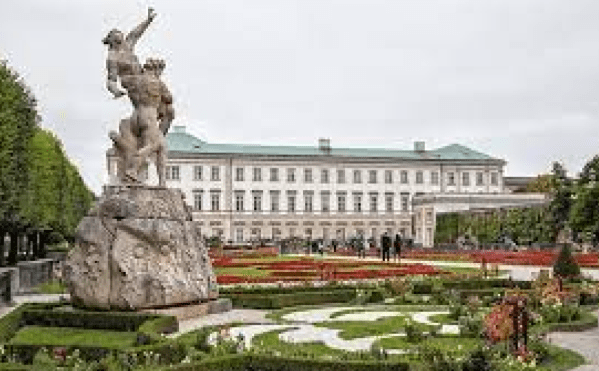
Mirabell Palace was built in 1606 by prince-archbishop Wolf Dietrich for his beloved Salome Alt. Today, it serves as the backdrop for the most romantic weddings you could possibly imagine . . .
The Marble Hall, the former banquet hall of the prince-archbishops, is generally regarded as one of the “most beautiful wedding halls in the world”. In former times, the likes of Leopold Mozart and his children, Wolfgang and Nannerl, made music here. Nowadays, it regularly hosts weddings, conferences and awards ceremonies. The Marble Hall also provides an atmospheric venue for the SchlossKonzerteMirabell concerts. The “Angel Staircase”, which leads up to the Marble Hall, is decorated with numerous cherubs.
The interiors are indeed fabulous, as are the gardens.
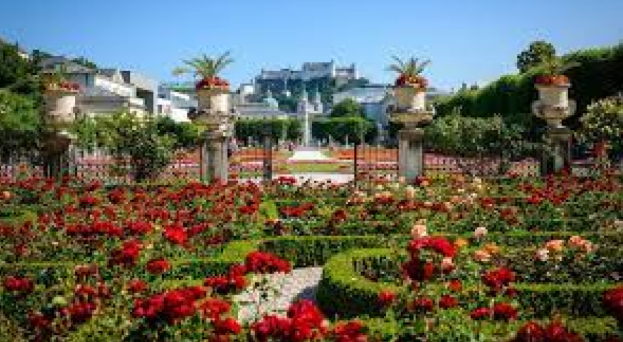
The Mirabell Gardens were completely redesigned under archbishop Johann Ernst von Thun in 1690. The underlying geometrical form, which is typical for the Baroque period, is still clearly recognizable. The visual orientation towards the cathedral and fortress adds to the grandeur of the gardens – simultaneously incorporating them into the overall historical ensemble of the city.
On that note, the Missus and I left The Turnip behind and headed to Munich.
• • • • • • •
Here’s what the town of München looked like when we arrived there by train.
Our first stop, of course, was the fabulously extravagant Residenz München.
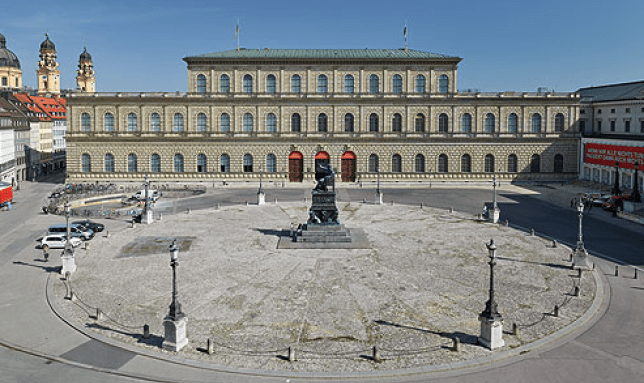
The Munich Residence served as the seat of government and residence of the Bavarian dukes, electors and kings from 1508 to 1918. What began in 1385 as a castle in the north-eastern corner of the city (the Neuveste, or new citadel), was transformed by the rulers over the centuries into a magnificent palace, its buildings and gardens extending further and further into the town.
The rooms and art collections spanning a period that begins with the Renaissance, and extends via the early Baroque and Rococo epochs to Neoclassicism, bear witness to the discriminating taste and the political ambition of the Wittelsbach dynasty.
Much of the Residence was destroyed during the Second World War, and from 1945 it was gradually reconstructed. Today, with the museums of the Bavarian Palace Administration (the Residence Museum itself, the Treasury and the Cuvilliés Theatre) along with other cultural institutions, this is one of the largest museum complexes in Bavaria.
Not to mention one of the most spectacular museums we had ever seen. Here’s a smart guided tour from a few years ago.
I’m not sure why we went straight from the Residenz to The Hofbräuhaus, site of Adolf Hitler’s failed 1923 beer hall putsch, but it was definitely a passage from the sublime to the ridiculous.
For starters, the Hofbräuhaus was crowded with men of all ages waving around huge steins filled with watery yellow beer that I’d rather not characterize further. Once we’d settled into a table, I noticed a waitress passing by with a weizen glass of dark amber lager, so I ordered one of those while the Missus asked for a glass of white wine. At that point our waitress gave us a very strange look, but we figured she just thought we were a couple of average dopey Americans.
We underestimated ourselves: Apparently no one ever ordered white wine in the beer hall, and the weizen glasses were solely for female customers, who seemed smartly allergic to steins.
We felt even more out of place when the assembled masses started singing, probably not the outlawed Nazi anthem Horst Wessel Song, but a Teutonic tune nonetheless. Beyond that, whenever large numbers of Germans begin acting in unison, we’ve found it more than a little . . . disconcerting (as the Missus is Jewish and I’m Jewish by attraction). So we made a hasty exit from what hands down was our least favorite place in Europe.
Early the next morning we ventured out to visit Neuschwanstein Castle, the mothership of Mad King Ludwig. The desk clerk at our hotel told us we didn’t need to make a reservation (no Vulfie she), but the Missus in her wisdom ignored her.
The Missus:
In several guidebooks I purchased (remember, this was before the internet), they all said to make sure you make a reservation for the Neuschwanstein Castle tour as it always books up. Since we didn’t speak German, I had asked the desk clerk to please make the phone reservation for us. She declined – not because she was too busy or wasn’t nice – but as she assured me that on a weekday they’re never full. I tried to talk her into phoning to play it safe, but she just kept smiling and repeating we shouldn’t worry.
Nice as she was, I didn’t believe her. So I insisted we get up at the crack of dawn and arrive at the bus not the required half-hour ahead of time, but over an hour early. (John was a real sport about this.)
Sure enough, when we arrived at 7:00 AM, the tour director said they were already fully booked, but if two people didn’t show up, we were first on the waiting list. This was our last day in Munich and every guide said Neuschwanstein was unmissable. I spent the next hour miserably watching ticket holders show up and board the bus.
Five minutes before departure, the tour operator told me there were indeed two openings left. I was over the moon – not so much John when he saw we weren’t being led to the nice cushioned seats with wonderful views, but rather two tiny openings on the hard bench in the very back of the bus between the aforementioned rotund, man-spreading tourists. I didn’t care. Yes we were uncomfortably squashed, but we were going to Neuschwanstein!
Arriving at the castle – which is spectacular even from the outside – we got in line for the inside tour. While waiting, I took out a few pages that I had cut out of the giant Frommer guide on Germany, detailing what we were about to see. As I started reading to John, a young guy in front of me suddenly began yelling at his girlfriend while pointing at me: “Look – she was fine with cutting those pages out of their guide book. But you wouldn’t let me. Now I have to lug this ridiculously heavy book around all day.” The girlfriend glared at me, like this was all my fault.
Then the two turned their backs on each other, fuming. Not my monkey, not my circus, though I did hope the guide book, rather than the couple, would end up permanently ripped apart.
The Missus was right. The seat discomfort and lack of view was well worth it to take in the magnificent castle Ludwig built.

Ludwig II, King of Bavaria since 1864, addressed the following lines to the man he so greatly admired, Richard Wagner:
«It is my intention to rebuild the old castle ruin of Hohenschwangau near the Pöllat Gorge in the authentic style of the old German knights’ castles, and I must confess to you that I am looking forward very much to living there one day (in 3 years); there will be several cosy, habitable guest rooms with a splendid view of the noble Säuling, the mountains of Tyrol and far across the plain; you know the revered guest I would like to accommodate there; the location is one of the most beautiful to be found, holy and unapproachable, a worthy temple for the divine friend who has brought salvation and true blessing to the world.
It will also remind you of “Tannhäuser” (Singers’ Hall with a view of the castle in the background), “Lohengrin’” (castle courtyard, open corridor, path to the chapel); this castle will be in every way more beautiful and habitable than Hohenschwangau further down, which is desecrated every year by the prose of my mother; they will take revenge, the desecrated gods, and come to live with Us on the lofty heights, breathing the air of heaven».
Pretty heady stuff, no?
It didn’t come together overnight, though. “The foundation stone of the ‘New Castle’ was laid on 5 September 1869. The Gateway Building was constructed first, and Ludwig II lived here for a number of years. The topping-out ceremony for the Palas was not until 1880, and the king moved in in 1884.”
Neuschwanstein Castle was, to say the least, well worth the wait, as its official video briskly details.
More of the inside story . . .
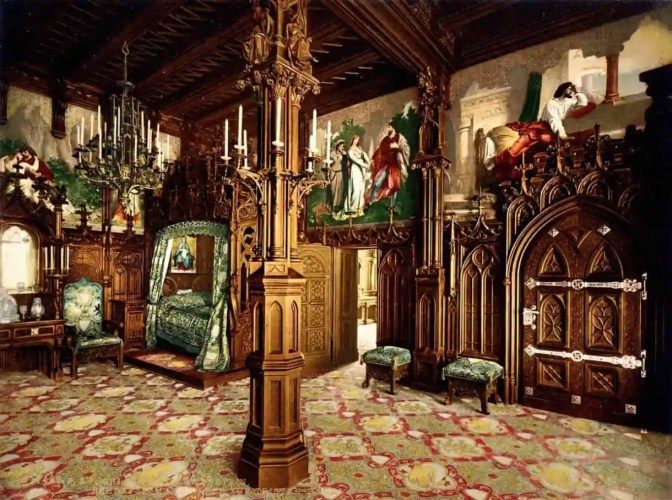
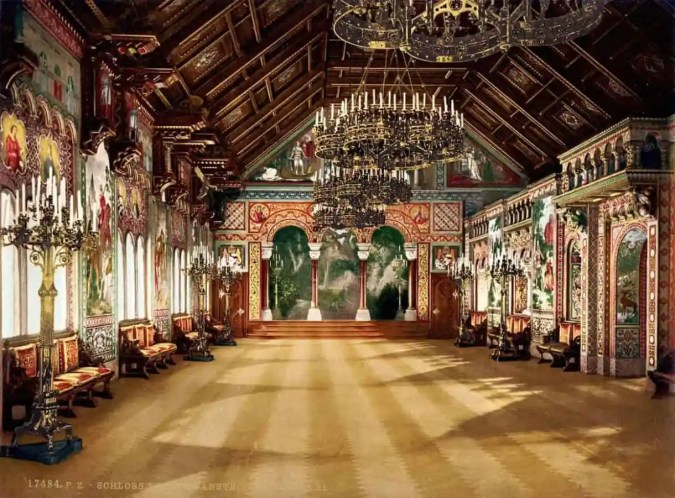

Totally fantastic.
The Missus:
Touring the nothing-succeeds-like-excess interiors, you can see why Ludwig was nicknamed “The Fairytale King,” although it turned out to be more Grimm than Disney. By 1885, the profligate monarch could no longer pay his debts to foreign banks that were threatening to seize all his properties, resulting in the government having him declared insane. He was then illegally deposed and quickly interned in Berg Palace. The worst was yet to come, as detailed here by England’s Cambridge University Library.
The day after his imprisonment, Ludwig II was found dead in Lake Starnberg. He disappeared while out for a walk with his physician Dr. Gudden and his corpse was discovered a few hours later. The death was officially declared to be suicide by drowning, but the circumstances of his death remain open to question. Ludwig was a strong swimmer, the water was less than waist-deep where his body was found and there was no water found in his lungs at the autopsy. Nor does the suicide theory explain the mysterious death of Dr. Gudden.
King Ludwig II was often quoted saying: “I wish to remain an eternal enigma to myself and to others.” Unfortunately, that was true in life and death.
Back at the hotel, we turned on the TV and there was the movie Tootsie, dubbed in German. The Missus, who had seen the film umpteen times, started echoing the dialogue in English, so I went down to the bar to have a beer and read that day’s International Herald Tribune.
Bright and early the next morning, the Missus and I ended that worldwind tour.
 Travels With The Missus
One thought on “The Saga of Our Bartered European Holiday”