(Previously on Travels With The Missus: As I said earlier, I have no idea why the Missus and I ventured so infrequently to the Big Town in the first half of the 2010s. Regardless, I know we tried to make up for it in subsequent years, with decidedly mixed results.)
The Missus and I were back in the city in July of 2015, and there was plenty on display for us to take in. We started at the Fashion Institute of Technology’s Global Fashion Capitals exhibit, which “explores the history of the established fashion capitals—Paris, New York, Milan, and London—and the emergence of 16 new fashion cities.”
Also new at the time: The Whitney Museum of American Art’s fancy-schmancy digs in the trendy Meatpacking District.
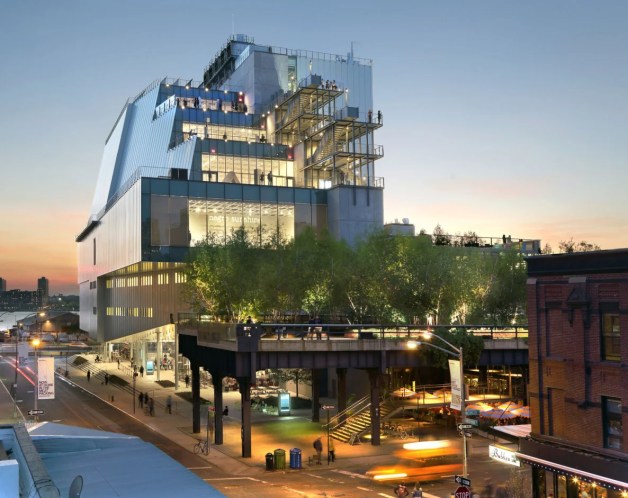
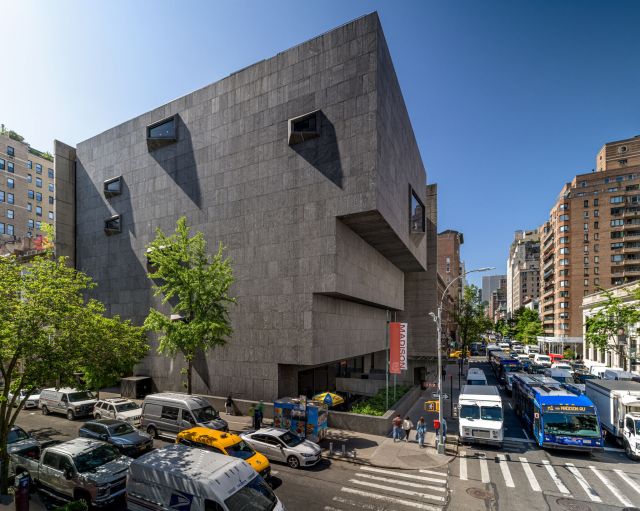
A far cry from the museum’s former Breuer building home at 75th and Madison, eh?
The showcase exhibit at the fancy-schmancy Whitney was America Is Hard to See (which was funny because we found the new building sort of hard to find).
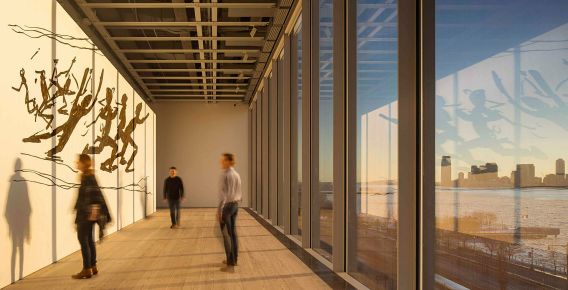
Drawn entirely from the Whitney Museum of American Art’s collection, America Is Hard to See takes the inauguration of the Museum’s new building as an opportunity to reexamine the history of art in the United States from the beginning of the twentieth century to the present. Comprising more than six hundred works, the exhibition elaborates the themes, ideas, beliefs, and passions that have galvanized American artists in their struggle to work within and against established conventions, often directly engaging their political and social contexts. Numerous pieces that have rarely, if ever, been shown appear alongside beloved icons in a conscious effort to unsettle assumptions about the American art canon.
At 600 works it was hard to see it all, but we did our best.
Wending our way uptown, we caught Sinatra: An American Icon at Lincoln Center’s New York Public Library for the Performing Arts (great quote from Bing Crosby: “Frank Sinatra is a singer who comes along once in a lifetime, but why did he have to come in mine?”); The Hirschfeld Century: The Art of Al Hirschfeld at the New-York Historical Society; Revolution of the Eye: Modern Art and the Birth of American Television at the Jewish Museum; and Everything Is Design: The Work of Paul Rand at the Museum of the City of New York. (Fun fact to know and tell: Rand always presented just one concept to his clients. You want other solutions, he would say, talk to other designers.)
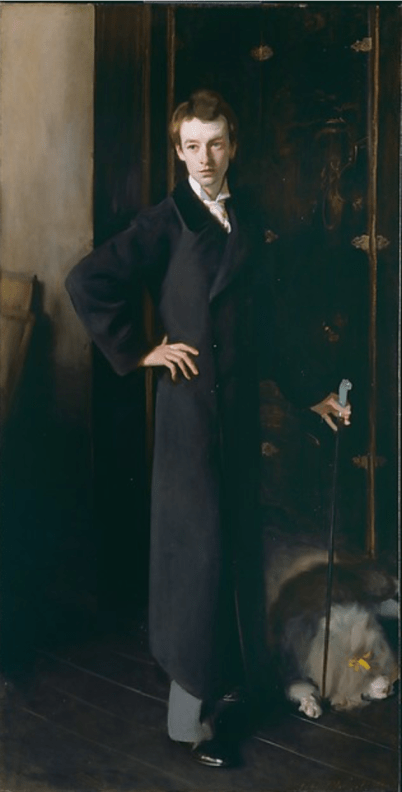
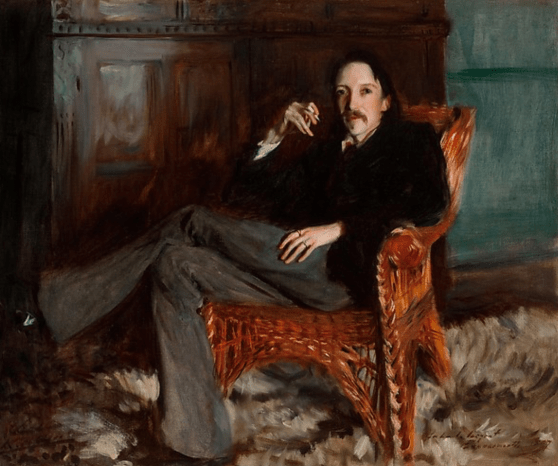
The blockbuster exhibits in the Big Town then were at The Met. First was Sargent: Portraits of Artists & Friends, which “brings together ninety-two of the artist’s paintings and drawings of members of his impressive artistic circle. The individuals seen through Sargent’s eyes represent a range of leading figures in the creative arts of the time such as artists Claude Monet and Auguste Rodin, writers Robert Louis Stevenson and Henry James, and the actor Ellen Terry, among others.”
Our favorites included this portrait of British illustrator W. Graham Robertson (“When [Robertson] objected to wearing an overcoat during the summer, Sargent replied, ‘But the coat is the picture.'”) . . .
. . . and Robert Louis Stevenson in decline.
The main attraction, though, was China: Through the Looking Glass, a knee-buckling exhibit that occupied parts of three floors of the museum and presented an almost hallucinogenic survey of Chinese-inspired fashion. Roll your own, if you’re so inclined.
(We saw almost a dozen other exhibits around town on that trip, as I painstakingly chronicled here.)
Back at Lincoln Center, we went to see Patti LuPone in Douglas Carter Beane’s Shows for Days, a largely forgettable production outside of one unforgettable act.
Last night, Tony winner and theater grande dame Patti LuPone took it upon herself, during Act II of Shows for Days at Lincoln Center Theater, to remove a cellphone from a texting-addicted theatergoer. LuPone subsequently issued this statement about her heroic actions: “We work hard on stage to create a world that is being totally destroyed by a few, rude, self-absorbed and inconsiderate audience members who are controlled by their phones… I am so defeated by this issue that I seriously question whether I want to work on stage anymore.”
Before the following night’s performance, Ms. LuPhone delivered this curtain speech, which certainly rang true with the audience.
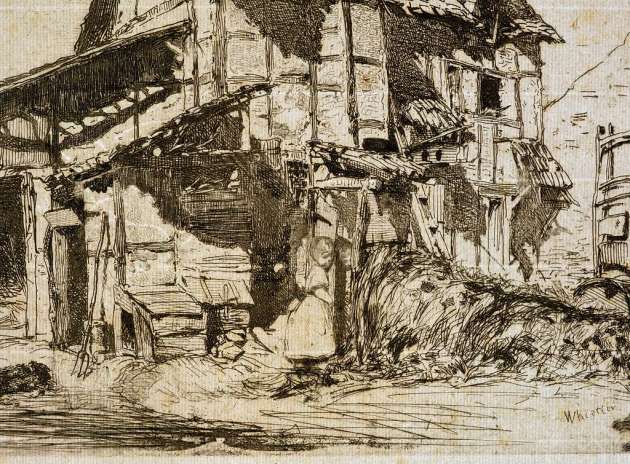
On the way back to Boston we swung by the Yale University Art Gallery for the last day of Whistler in Paris, London, and Venice, “three of his earliest and most innovative sets of etchings, the so-called French, Thames, and Venice Sets.”
From the French Set . . .
From the Thames Set . . .

From the Venice Set . . .
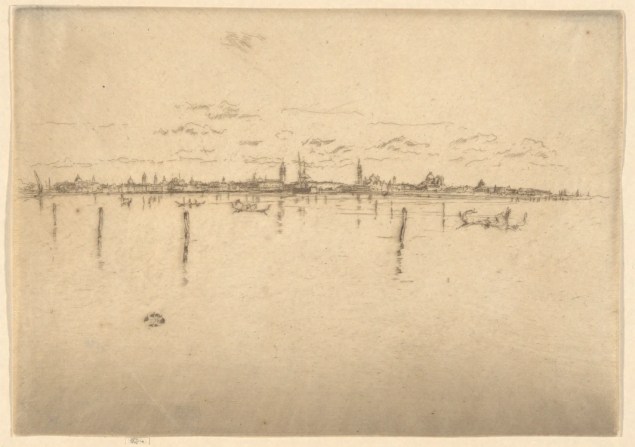
As I wrote when we got home, “Whistler qualifies as one of the greatest etchers in history, and this exhibit showed why. It also featured etchings by some of Whistler’s contemporaries – his brother-in-law Francis Seymour Haden, Mortimer Menpes, Joseph Pennell – but with all of them the Missus and I had the same reaction: ‘Too many details.’”
A few days later, the Yale exhibit’s curator, Heather Nolin, gave a terrific lecture – Tomatoes, Buckwheat Pancakes, and Art for Art’s Sake: James Abbott McNeill Whistler in London – at Boston’s Museum of Fine Arts.
A fitting coda to our whirlwind weekend of art.
• • • • • • •
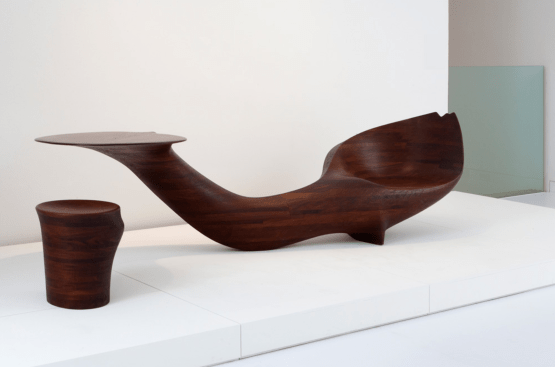
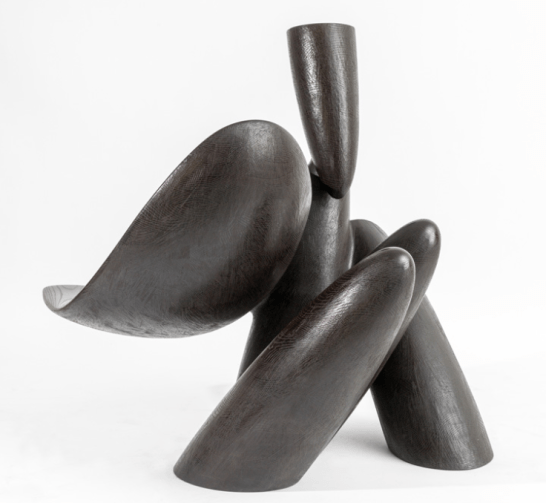
Five months later we were back for our annual holiday schlepping spree. The first place the Missus and I went was the Museum of Arts and Design to see Wendell Castle Remastered, “the first museum exhibition to examine the digitally crafted works of Wendell Castle, acclaimed figure of the American art furniture movement.”
Please, have a seat.

Next we wandered from Columbus Circle up to Lincoln Square to catch Art Brut in America: The Incursion of Jean Dubuffet at the American Folk Art Museum.
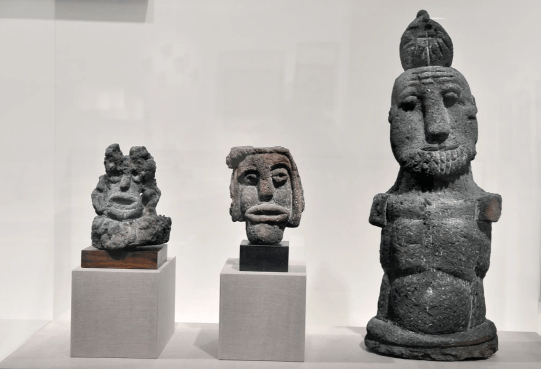
Art Brut in America: The Incursion of Jean Dubuffet is the first major U.S. exhibition to explore the introduction of art brut to America. The nearly two hundred works of art on view, by both canonical and lesser-known art brut figures, were amassed and identified as art brut by French artist Jean Dubuffet, beginning in 1945. The selection is drawn exclusively from the renowned Collection de l’Art Brut in Lausanne, Switzerland, where Dubuffet donated his collection in 1971.
The website also noted this: “The presentation highlights Dubuffet’s passionate belief in a new art paradigm that was non-Western and non-hierarchical, and that championed creators who are ‘uncontaminated by artistic culture.'”
I’m still not sure what that means, but the exhibit was very Dubuffetish. Except it didn’t include any of his work, just his collection. Brut-al disappointment.
That evening we hied ourselves to Studio 54 to see the Roundabout Theatre Company’s production of Thérèse Raquin, with Keira Knightley in the title role based on Émile Zola’s buzzkill novel.
New York Times critic Ben Brantley was also a buzzkill in his review: “Happiness is never in the cards in this tale of murder and adultery. And that’s as true for audiences at this Roundabout Theater Company production, directed by Evan Cabnet, as it is for our gal Thérèse.”
As I noted back then, the Missus and I aren’t as smart as Ben Brantley, so we liked it.
Bright and (way too) early the next morning, we headed out to the Museum of Modern Art to see the blockbuster Picasso Sculpture.
Over the course of his long career, Picasso devoted himself to sculpture wholeheartedly, if episodically, using both traditional and unconventional materials and techniques. Unlike painting, in which he was formally trained and through which he made his living, sculpture occupied a uniquely personal and experimental status for Picasso. He approached the medium with the freedom of a self-taught artist, ready to break all the rules. This attitude led him to develop a deep fondness for his sculptures, to which the many photographs of his studios and homes bear witness. Treating them almost as members of his household, he cherished the sculptures’ company and enjoyed re-creating them in a variety of materials and situations.
Sounds like they got way better treatment than the women in his life.
While we were there, we checked out the excellent exhibit Joaquín Torres-García: The Arcadian Modern, “one of the most complex and important artists of the first half of the 20th century . . . [whose] work opened up transformational paths for modern art on both sides of the Atlantic.”
For example, Construction in Black and White from 1938.
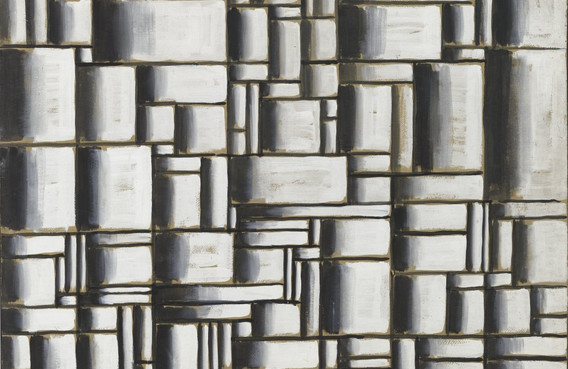
Not to mention Torres-Garcia’s key role in movements from Catalan Noucentismo to Cubism, Ultraism-Vibrationism, and Neo-Plasticism.
Yeah – our heads exploded too. If yours has not, here’s a gallery tour.
Also at MoMA at the time: Soldier, Spectre, Shaman: The Figure and the Second World War, which was kind of interesting, and Jackson Pollock: A Collection Survey, 1934–1954, which was kind of meh.
After that we drifted up to the Jewish Museum (free for the goyim on Saturday, although there is a shabbes elevator for the observant) to take in The Power of Pictures: Early Soviet Photography, Early Soviet Film.
From early vanguard constructivist works by Alexander Rodchenko and El Lissitzky, to the  modernist images of Arkady Shaikhet and Max Penson, Soviet photographers played a pivotal role in the history of photography. Covering the period from the 1917 Bolshevik Revolution through the 1930s, this exhibition explores how early modernist photography influenced a new Soviet style while energizing and expanding the nature of the medium — and how photography, film, and poster art were later harnessed to disseminate Communist ideology. The Power of Pictures revisits this moment in history when artists acted as engines of social change and radical political engagement, so that art and politics went hand in hand.
The photography was riveting, as was the screening of Aelita: Queen of Mars, which we watched for 45 headscratching minutes. Here’s the full two hours if you want to take a crack at it. (The Tower of Radiant Energy alone is worth the price of admission.)
Back on planet earth, we moved on to Becoming Jewish: Warhol’s Liz and Marilyn.
The public personas of Elizabeth Taylor and Marilyn Monroe were constructed, but when they converted to Judaism, the change for both women was personal and profound. Becoming Jewish: Warhol’s Liz and Marilyn draws parallels between the actresses’ identities as Jewish women and Warhol’s exploration of their celebrity through his image-making.
“Marilyn was a myth,” wrote the journalist Max Lerner in 1962. “And Liz is a legend.” Andy Warhol’s iconic portraits of Marilyn Monroe and Elizabeth Taylor reflect this sentiment. Elizabeth and Marilyn enthralled him: they were beauty, success, and fame personified.
All due respect, double meh.
We also saw Valeska Soares’ Time Has No Shadows (weird and wonderful) and Unorthodox (weird and creepy).
Then we shuffled down to the Roundabout Theatre Company’s revival of Harold Pinter’s Old Times. Here’s what I wrote back then about the production, which featured Clive Owen, Eve Best, and Kelly Reilly.
The set was fairly hallucinogenic: A bee-hived dome with horizontal striations, constantly pulsating, strobing, circling – just like the characters constantly circling each other, and the play constantly circling itself, and the entire set constantly circling sometimes quickly sometimes slowly . . .
It was altogether dizzying. And quite exhilarating.
But not for Sunshine Ben Brantley . . .
The dyspeptic New York Times critic had issues.

This “Old Times” . . . might be described as an example of Pinter for the Hard of Understanding (i.e., Americans), or for audiences who might otherwise be bored by dialogue in which characters seldom say — or know — what they mean, and spend a lot of time saying nothing at all. Those celebrated Pinter pauses, which classically loom like a purpose-devouring black hole, are in this version plugged with electronic music by Radiohead’s Thom Yorke . . .
This is Pinter with apocalyptic special effects, “Old Times: Armageddon.” And at 70 minutes, it’s far shorter than your average end-of-the-world movie.
Not to get technical about it, but the play ran more like 60 minutes, making it our first Dollar-Fifty-a-Minute Drama. Then again, the folks sitting next to us paid two dollars a minute for the same experience, so we didn’t feel quite so bad in the end.
Our final stop on that trip was the Metropolitan Museum of Art, where we first took in Jacqueline de Ribes: The Art of Style, which featured a countess who said she just wanted to be comfortable when she was backstage organizing ballets and charity events and TV shows and . . . whatever.
Whatever.
After that we checked out Kongo: Power and Majesty, which really nailed the artistic traditions of Central Africa’s Kongo civilization, and the mega-exhibit Ancient Egypt Transformed: The Middle Kingdom, which we sort of mailed in.
The exhibit we absolutely loved, though, was The Luxury of Time.
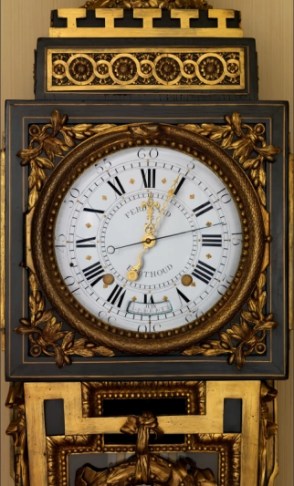 This exhibition explores the relationship between the artistry of the exterior form of European timekeepers and the brilliantly conceived technology that they contain. Drawn from the Museum’s distinguished collection of German, French, English, and Swiss horology from the sixteenth through the nineteenth century, the extraordinary objects on view show how clocks and watches were made into lavish furniture or exquisite jewelry.
The creation of timekeepers required that clockmakers work with cabinetmakers, goldsmiths and silversmiths, enamelers, chasers and gilders, engravers, and even those working in sculpture and porcelain. These craftsmen were tasked with accommodating internal mechanisms by producing cases that, in both shape and function, adapted to timekeeping technologies. Their exteriors are often as complicated as the movements they house. Examining the dialogue between inside and out, adornment and ingenuity, The Luxury of Time reveals the complex evolution of European clockmaking and the central place of timekeepers in the history of decorative arts.
Punch in here and here for very cool videos of clocks in motion.
Our personal favorite? The African Princess clock, created by Jean-Baptiste-André Furet (French, ca. 1720–1807).
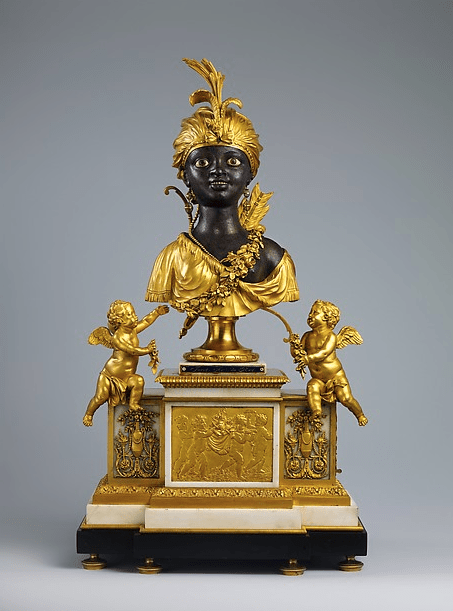
This bust of an African princess is one of the most remarkable clocks in the Museum’s collection. The marble plinth contains a musical movement: a tiny pipe organ. On the hour, music would play and the figure’s eyes would open, showing the hour in roman numerals in her right eye and the minutes in arabic numerals in her left. By pulling her left earring, her eyes could be opened at any time—a feature that remains functional today.
An eye-opening way to end that time in the Big Town.
• • • • • • •
Now’s as good a time as any to talk about New York coffee shops. Not the trendoid types like the East Village’s Mudspot (“where the downtown set—and NYU freshman—can hang out and dish”) or East Harlem’s Teranga (“a perfect spot for working or a coffee date”).
No – I’m talking about traditional coffee shops, the kind Bernard Brussel-Smith depicted in this 1940 etching.
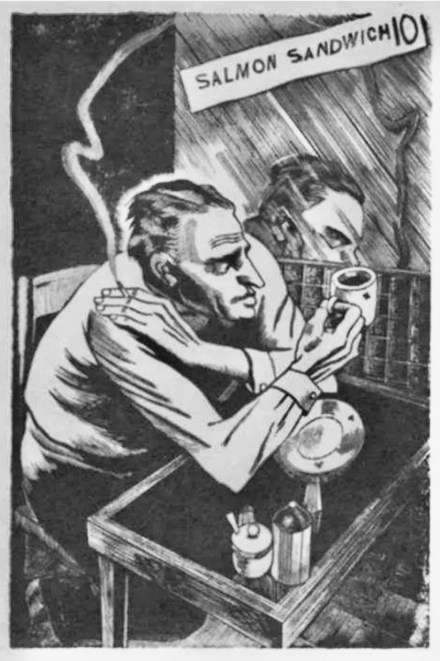
The Missus and I are longtime habitués of the coffee shops that pepper – sorry – Madison Avenue on the Upper East Side. One of our favorites was Gardenia Café and Restaurant, which closed in 2007 after 30 years as “a budget diner on a luxury block,” as this New York Times piece by Anthony Ramirez put it.
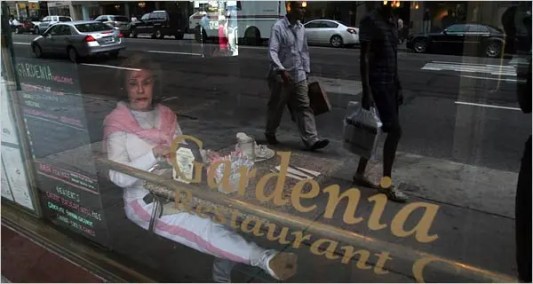
Along a stretch of Madison Avenue in Manhattan, Chanel and Jimmy Choo share pride of address with a Greek diner called Gardenia, where an attention-seeking fan once lifted a French fry off Joe DiMaggio’s plate and where, at the counter, the “Lonely Guys Club” regularly convened between wives.
Lately, though, its clientele has been woebegone: Gardenia is closing in a few weeks. Although the brownstone that houses Gardenia is owned by the same extended family that owns the restaurant, the relatives in Greece who own the building plan to renovate and lease it to a single top-dollar tenant.
And so Gardenia, established in 1977 and one of the oldest restaurants on the Upper East Side, will yield to that supreme leveler, the New York real estate market.
Dorothy Fernandez, a sales executive at Marina Rinaldi, an Italian apparel designer, eats at Gardenia four times a week. “I don’t want to spend a fortune to eat,” she said. “Just because it’s Madison Avenue and because it’s posh-posh, so? People still need to eat!”
Yeah – they just needed to eat elsewhere.
Gardenia was only one of the 21st Century coffee-shop casualties in the Big Town, as Steve Cuozzo noted in a 2015 New York Post article: “Since 2007, three Madison Avenue diners have closed: the Gardenia, where Joe DiMaggio took many a meal in his waning years, Soup Burg and Viand — a favorite of former Mayor Mike Bloomberg’s, and of Robert B. Parker’s fictional PI, Spenser.”
Cuozzo listed six Madison Avenue survivors, although one of them – the 3 Guys Restaurant at 89th – closed a few years after his piece ran. (The 3 Guys at 96th, which he inexplicably did not list, closed last March.) The sole remaining 3 Guys Restaurant is the one between 75th and 76th, which, sad to say, has long been our least favorite coffee shop of all.
Cuozzo’s other four Madison Avenue survivors included Viand (no relation to the one that closed) at 61st; Nectar Cafe at 79th (which according to Yelp is now closed); Nectar of 82nd, which is wildly overpriced, the better to fleece the daily Met set; and New Amity at 84th, which is just around the corner from St. Ignatius Loyola grammar school where I toiled in relative obscurity for nine long years, and which has also closed.
So now there are three.
We ate in all of them over the years, almost always for lunch. For dinner we tended to eat in actual restaurants, La Bonne Soupe on West 56th and Pergola Des Artistes in the theater district being our regular spots. Eventually, though, the former grew too pricey and the latter too hectic, so on theater nights we would eat dinner at the Red Flame on West 44th.
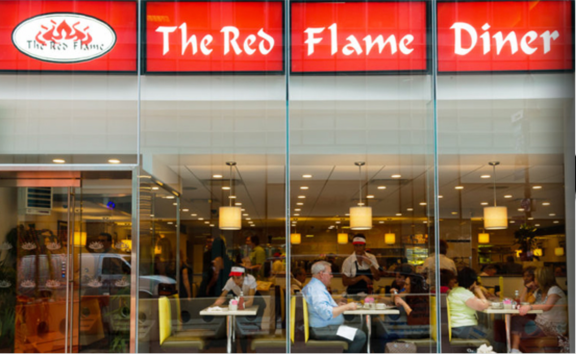
It was friendly, reliable, tasty, and affordable (although our go-to Chicken Souvlaki now costs about 33% more than last time we were there). Regardless . . .
The headline on Steve Cuozzo’s Post piece had it right: You’re going to miss these diners when they get priced out of NYC. And they all will, probably sooner rather than later.
• • • • • • •
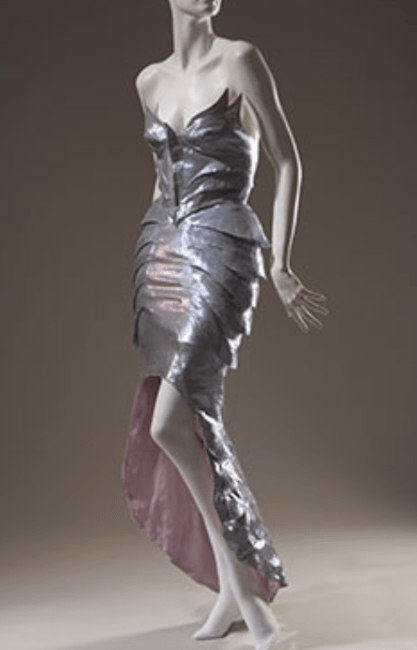
The Missus and I were back in the Big Town in April of 2016 and, as we often did, headed first to the Fashion Institute of Technology, where Fairy Tale Fashion was on display. The exhibit “attempts to bridge the gap between the significance of dress within fairy tales and the use of the term ‘fairy tale’ in fashion journalism and photography.”
Case in point: These two cloaks interpreting Little Red Riding Hood – one from the late 18th century, the other from Comme des Garçons in 2015.

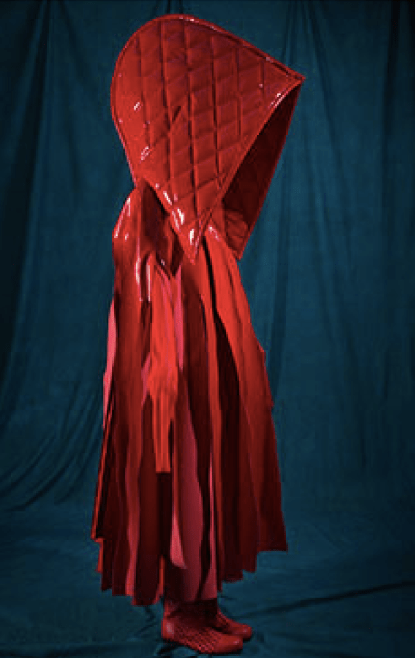
The whole exhibit – from Manish Arora’s Alice in Wonderland . . .
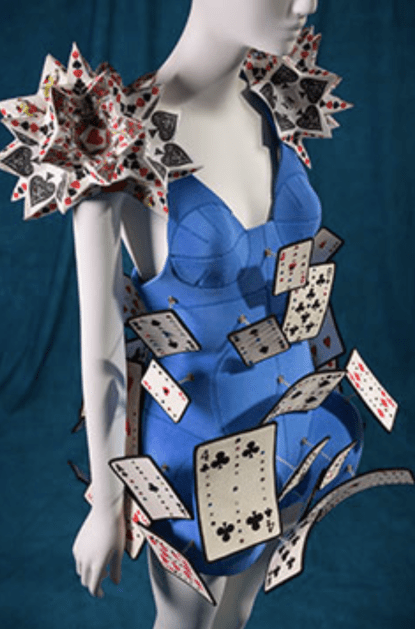
. . . to Thierry Mugler’s The Little Mermaid – was a hoot.
From there we moseyed up to the Museum of Arts and Design to see Studio Job MAD HOUSE.
Studio Job MAD HOUSE is the first American solo museum exhibition of the work of collaborators Job Smeets (Belgian, b. 1970) and Nynke Tynagel (Dutch, b. 1977), who established their atelier, Studio Job, in Antwerp in 2000. Since then, they have developed a distinctive body of highly expressive and opulent work, characterized by pattern, ornament, humor, and historical, sociocultural, and personal narrative.
How personal? Check out “Train Crash,” a table the pair designed in 2015 to reflect the derailment of their romantic relationship.
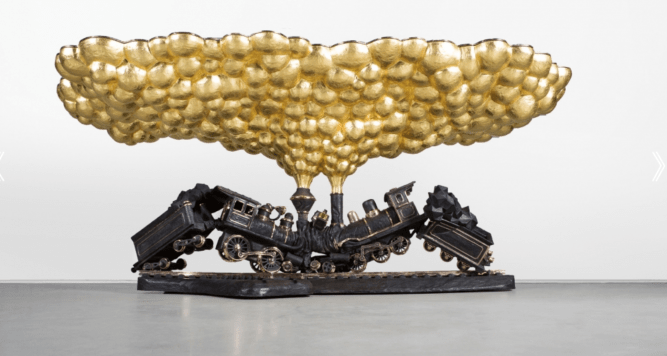
Luckily for us, their professional relationship stayed on track. Here’s their version of Chartres Cathedral flipped on its side and turned into a cabinet.
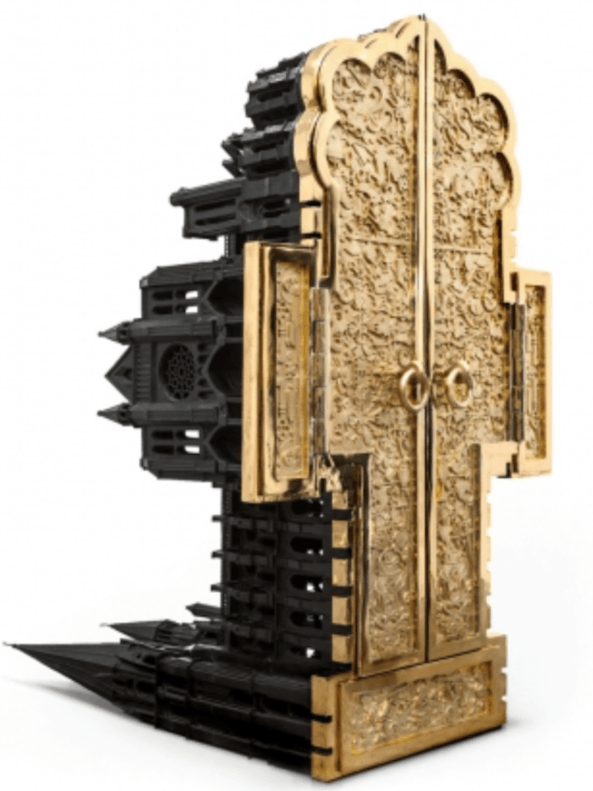
Divine!
Then it was on to the Walter Kerr Theatre for the revival of Arthur Miller’s The Crucible with Saoirse Ronan, Ben Whishaw, Ciarán Hinds, and Sophie Okonedo.
As I noted back then, it was a unique theater experience for the Missus and me – not the play, but the audience.
We were sitting in the first row of the mezzanine, where the woman of a certain age next to the Missus decided to take her shoes off and plop her feet on the railing in front of us. She proceeded to wiggle her tootsies, give herself a foot massage, and generally insert her feet into every scene of the play. I half expected her to get a mani-pedi sometime during Act Two.
Anyway, we thought Saoirse Ronan was very good, Ben Whishaw was kind of squishy, and the production overall was interesting but not compelling.
New York Times theater critic Ben Brantley, on the other hand, thought it was fabulous, while Wall Street Journal theater critic Terry Teachout declared it dreadful.
So go figure.
Next day we started off at the Museum of Modern Art’s exhibit Edgar Degas: A Strange New Beauty.
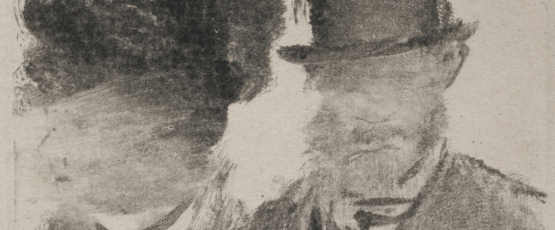
Edgar Degas is best known as a painter and chronicler of the ballet, yet his work as a printmaker reveals the true extent of his restless experimentation. In the mid-1870s, Degas was introduced to the monotype process—drawing in ink on a metal plate that was then run through a press, typically resulting in a single print. Captivated by the monotype’s potential, he immersed in the technique with enormous enthusiasm, taking the medium to radical ends. He expanded the possibilities of drawing, created surfaces with a heightened sense of tactility, and invented new means for new subjects, from dancers in motion to the radiance of electric light, from women in intimate settings to meteorological effects in nature.
A master of a different medium had the spotlight at The Frick Collection: Van Dyck: The Anatomy of Portraiture.
Anthony van Dyck (1599–1641), one of the most celebrated and influential portraitists of all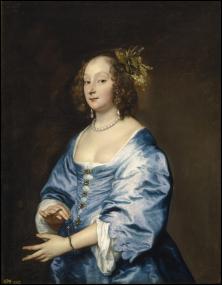 time, enjoyed an international career that took him from his native Flanders to Italy, France, and, ultimately, the court of Charles I in London. Van Dyck’s supremely elegant manner and convincing evocation of a sitter’s inner life — whether real or imagined — made him the favorite portraitist of many of the most powerful and interesting figures of the seventeenth century . . . Through approximately one hundred works, the exhibition explored the astounding versatility and inventiveness of a portrait specialist, the stylistic development of a draftsman and painter, and the efficiency and genius of an artist in action.
Some of those one hundred works are here, and this video provides a splendid overview.
The Missus and I never expected to like the show as much as we did, but we did.
Isaac Mizrahi: An Unruly History at the Jewish Museum, on the other hand, we knew would be a gas. His clothing designs are invariably a delight, as the exhibit generously demonstrated.
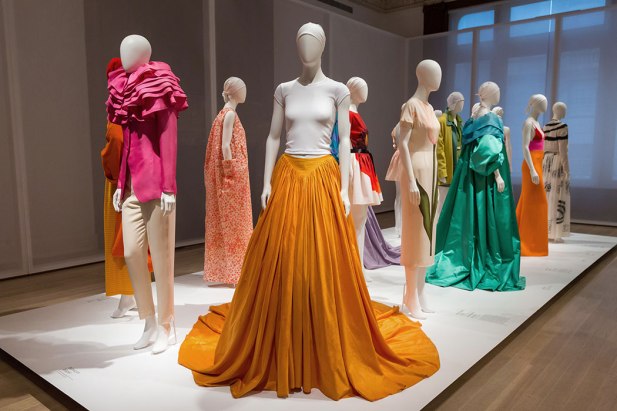

The irrepressible Mizrahi is an equally colorful interview subject. His dialogue/discourse with choreographer Mark Morris at the Jewish Museum was a thoroughly amusing ping-pong match of a conversation.
Nomination for Isaac Mizrahi’s self-epitaph: “Style makes you feel great because it takes your mind off the fact that you’re going to die.”
That night we took in the Roundabout Theatre Company’s revival of Eugene O’Neill’s Long Day’s Journey Into Night featuring Gabriel Byrne and Jessica Lange, who won the 2016 Tony Award for Best Actress in a Play. Here and here tell you why.
Lange was absolutely riveting throughout the production, and thankfully, there were no bare feet nearby to distract us.
Next morning the Missus and I moseyed up to the Metropolitan Museum of Art for Vigée Le Brun: Woman Artist in Revolutionary France, which was a total knockout.
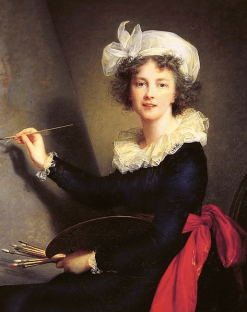 Elisabeth Louise Vigée Le Brun (French, 1755–1842) is one of the finest 18th-century French painters and among the most important of all women artists. An autodidact with exceptional skills as a portraitist, she achieved success in France and Europe during one of the most eventful, turbulent periods in European history . . ,
She was remarkable not only for her technical gifts but for her understanding of and sympathy with her sitters. This is the first retrospective and only the second exhibition devoted to Vigée Le Brun in modern times. The 80 works on view include paintings and a few pastels from European and American public and private collections.
Vigée Le Brun painted more than 600 portraits and became the most famous female artist in Europe. Here’s a short preview of the exhibit (more of her work from the exhibit is here).
At that point we went from the sublime to Crime Stories: Photography and Foul Play, which “explores the multifaceted intersections between photography and crime, from 19th-century ‘rogues’ galleries’ to work by contemporary artists inspired by criminal transgression” – but you’ll have to investigate that one on your own.
From the Met mothership we wandered down to The Met Breuer, née the Old Whitney at 75th and Madison, to finish our grand tour with Unfinished: Thoughts Left Visible.
This exhibition addresses a subject critical to artistic practice: the question of when a work of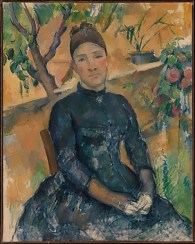 art is finished. Beginning with the Renaissance masters, this scholarly and innovative exhibition examines the term “unfinished” in its broadest possible sense, including works left incomplete by their makers, which often give insight into the process of their creation, but also those that partake of a non finito—intentionally unfinished—aesthetic that embraces the unresolved and open-ended. Some of history’s greatest artists explored such an aesthetic, among them Titian, Rembrandt, Turner, and Cézanne.
Lots of other examples here, along with one more short preview for your consideration.
And that – wait for it – finished that particular trip to the Big Town.
• • • • • • •
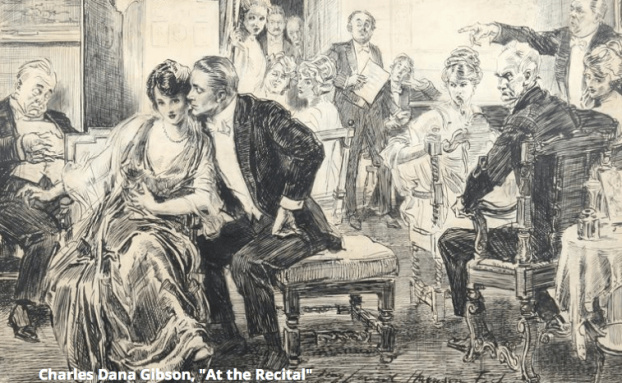
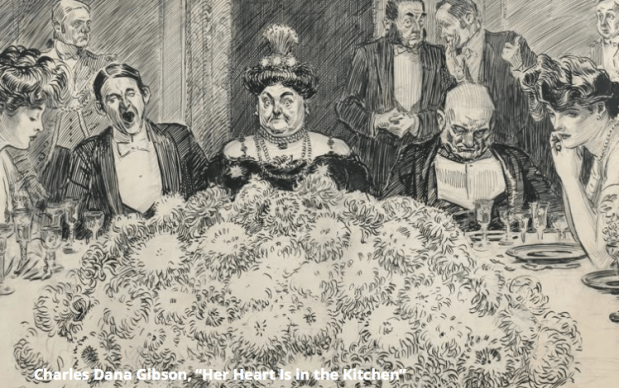
After another extended absence, the Missus and I returned to the city in September of 2017. One of our first stops was the Society of Illustrators at 63rd & Lex to catch FASHION AND SATIRE: The Drawings Of Orson Byron Lowell And Charles Dana Gibson.
The exhibit pairs a collection of satirical illustrations with Gilded Age fashion pieces and accessories. Focusing on the life of “high society” in New York City, the illustrations invite the viewer to understand fashion as a vehicle for representing and interpreting societal ideals in the Gilded Age.
Orson Byron Lowell and Charles Dana Gibson were two of the most influential illustrators of the late 19th and early 20th century, working from about 1890 to 1930. They created fashion-filled compositions that linked dress and witty social commentary. Their observations about people in society and their foibles were artfully represented in popular publications like The Saturday Evening Post, Ladies Home Journal, Vogue and the original Life magazine.
Representative samples:

Then we shuffled up to the Met Breuer to catch Ettore Sottsass: Design Radical.
A seminal figure in 20th-century design, the Italian architect and designer Ettore Sottsass (1917–2007) created a vast body of work, the result of an exceptionally productive career that spanned more than six decades. This exhibition reevaluates Sottsass’s career in a presentation of key works in a range of media—including architectural drawings, interiors, furniture, machines, ceramics, glass, jewelry, textiles and pattern, painting, and photography.
The 177 objects in the exhibition are here, but Sottsass’s most key work was the Olivetti Valentine portable typewriter, of which he said “I worked sixty years of my life, and it seems the only thing I did is this fucking red machine.”
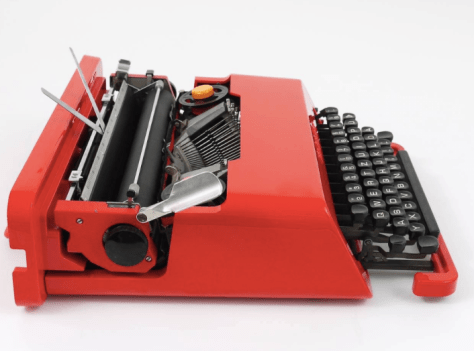
This video helps to fill in the blanks.
Then it was off to the Jewish Museum for an exhibit featuring one of our favorite artists: Florine Stettheimer: Painting Poetry.
The artist Florine Stettheimer (1871–1944) is an icon of Jazz Age New York. Born to a wealthy Jewish family in Rochester, she studied at the Art Students League in New York City and then in Europe, where she encountered two profound influences: the Symbolist painters and poets and, on the eve of the Great War, the Ballets Russes. Returning to Manhattan, she hosted an elite salon together with her sisters Carrie and Ettie and their mother, Rosetta,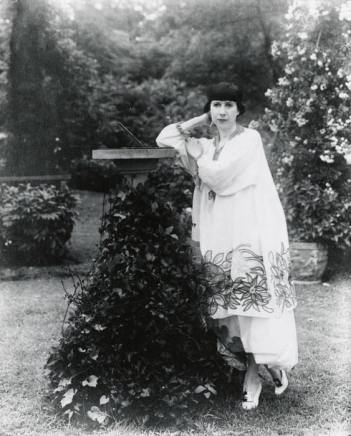 attracting many of the leading lights of the artistic vanguard. Her circle included Alfred Stieglitz, Carl Van Vechten, Georgia O’Keeffe, Elie Nadelman, Gaston Lachaise, and many others. Among her intimate friends was Marcel Duchamp.
Through over 50 paintings and drawings, a selection of costume and theater designs, photographs and ephemera, as well as critically acclaimed poems, the Jewish Museum will offer a timely reconsideration of this important American artist, revealing Stettheimer’s singular and often satiric vision and significant role in American modern art. The exhibition highlights the artist’s distinctly personal style of painting, Stettheimer’s position amidst New York’s artistic elite and avant-gardes, and her continued influence on artistic practice today.
Spring Sale at Bendel’s . . .

. . . and a couple of self-portraits.

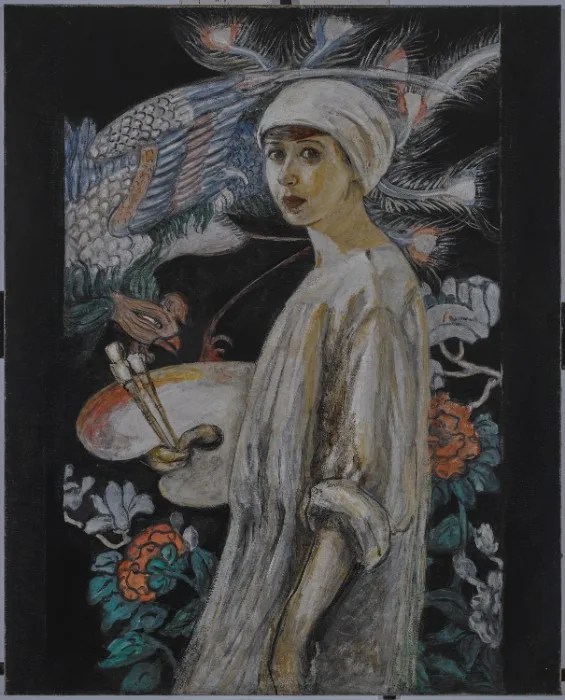
And some poetry.
NEW YORK
At last grown young
with noise
and color
and light
and jazz
dance marathons and poultry shows
soulsavings and rodeos
gabfeasts and beauty contests
sky towers and bridal bowers
speakeasy bars and motor cars
columnists and movie stars
One last stanza: “Art is spelled with a Capital A/And Capital also backs it—/Ignorance also makes it sway/The chief thing is to make it pay.”
Irony alert: Stettheimer rarely sold her art, saying at one point “letting people have your paintings is like letting them wear your clothes.” Beyond that, according to Helen Holmes in The Observer, “at the end of her life, she directed her sister to burn all of the artwork she ever produced, an order that her sister fortunately did not follow.”
Very fortunately. You don’t have to take my word for it, though. Check out Christopher Benfey’s excellent NYRB review, The Bruegel of Bendel’s, for further details.
Also at the Jewish Museum, the work of another favorite artist – Modigliani Unmasked.
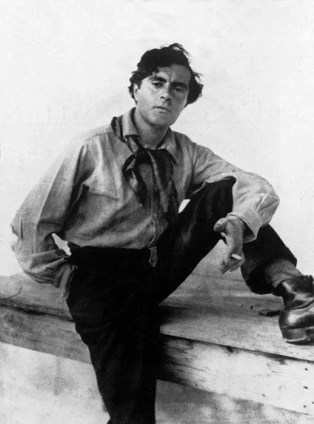 Modigliani Unmasked considers the celebrated artist Amedeo Modigliani (Italian, 1884-1920) shortly after he arrived in Paris in 1906, when the city was still roiling with anti-Semitism after the long-running tumult of the Dreyfus Affair and the influx of foreign emigres. Modigliani’s Italian-Sephardic background helped forge a complex cultural identity that rested in part on the ability of Italian Jews historically to assimilate and embrace diversity. The exhibition puts a spotlight on Modigliani’s drawings, and shows that his art cannot be fully understood without acknowledging the ways the artist responded to the social realities that he confronted in the unprecedented artistic melting pot of Paris. The drawings from the Alexandre collection reveal the emerging artist himself, enmeshed in his own particular identity quandary, struggling to discover what portraiture might mean in a modern world of racial complexity.
Some of what Modigliani discovered . . .
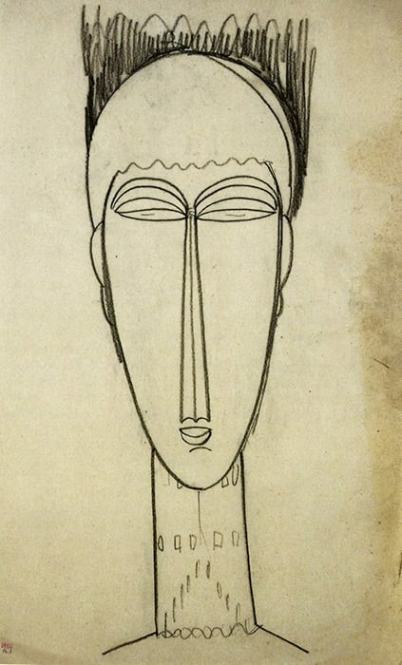
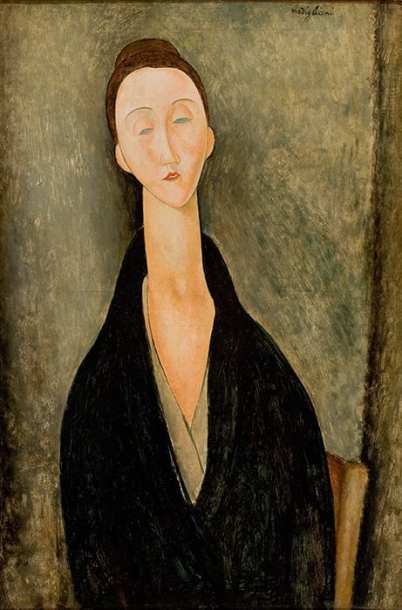
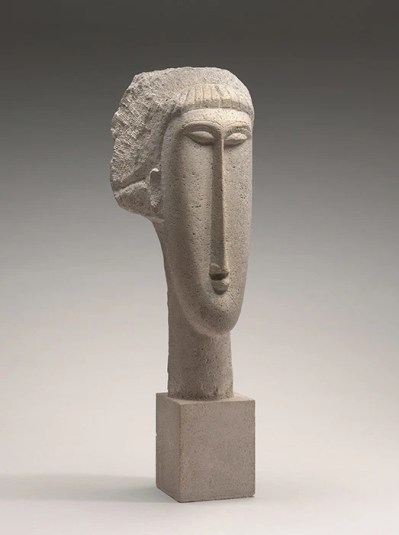
Much more in this video, so don’t give us that long face.
That night the Missus and I headed over to the American Airlines Theatre for the Roundabout Theatre Company production of J.B. Priestley’s Time and the Conways starring Elizabeth McGovern. I remember exactly nothing about the play, although I did write at the time that McGovern gave a splendid performance, adding this: “It’s that rare play that grows more and more interesting as it unfolds, with a satisfying, if unsettling, ending.”
I’ll take my word for it.
The next morning we drifted by The Metropolitan Museum of Art, where we poked around Sara Berman’s Closet.
 The meticulously organized, modest closet in which Sara Berman (1920–2004)—an immigrant who traveled from Belarus to Palestine to New York—kept her all-white apparel and accessories both contained her life and revealed it. Inspired by the beauty and meaning of Berman’s closet, the artists Maira and Alex Kalman (who are also Berman’s daughter and grandson) have recreated the closet and its contents as an art installation.
This exhibition represents Berman’s life from 1982 to 2004, when she lived by herself in a small apartment in Greenwich Village. In her closet Berman lovingly organized her shoes, clothes, linens, beauty products, luggage, and other necessities. Although the clothing is of various tints—including cream, ivory, and ecru—it gives the impression of being all white.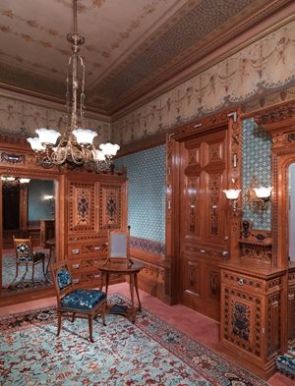
With its neatly arranged stacks of starched and precisely folded clothing, the closet is presented as a small period room in dialogue with The Met’s recently installed Worsham-Rockefeller Dressing Room from 1882, which features clothing from the 1880s of the type that Arabella Worsham, a wealthy art patroness, might have worn. Despite vast differences of scale and ornament, and the separation of 100 years, the two rooms show there were similarities between the life stories of Berman and Worsham (c. 1850–1924). Both began as women of limited means who, by their own ingenuity, created new lives for themselves in New York.
It was all quite engaging, as was Adrián Villar Rojas’s The Theater of Disappearance on the Met’s Roof Garden.

Argentinian artist Adrián Villar Rojas has transformed the Cantor Roof with an intricate site-specific installation that uses the Museum itself as its raw material. Featuring detailed replicas of nearly 100 objects from The Met collection, The Theater of Disappearance encompasses thousands of years of artistic production over several continents and cultures, and fuses them with facsimiles of contemporary human figures as well as furniture, animals, cutlery, and food. Each object—whether a 1,000-year-old decorative plate or a human hand—is rendered in the same black or white material and coated in a thin layer of dust.
Sound crazy? It was a knockout, as this short video suggests.
Then the Missus and I disappeared from the Big Town for the next six months.
– to be continued –
 Travels With The Missus