For several years after our disastrous initial trip to London and Paris (see here for the gory details), I resisted any suggestion by the Missus that we revisit the City of Light, where I had so badly botched our first visit.
“That’s a bad idea,” I would say about a return trip. “Paris is not a place for us.”
In reality, I was eager to go back there, and soon enough I [checks notes] agreed to a second London/Paris voyage.
For which the Missus did all the planning, much to the relief of both of us.
And I’m sure she had us visit multiple swell historical attractions in London; ungrateful wretch that I am, though, I don’t remember any of them
(We had done the Greatest Hits – Buckingham Palace, the National Gallery, the British Museum, and etc. – on our first trip there. I think maybe we branched out to Windsor Castle and Hampton Court on our second visit, although I could be wrong. I often am.)
The Missus:
In many travel guides, the books open with a list of various itineraries depending on the length of your trip, e.g. if you only have three days, do this; if you have five days do this; and so forth. As Clifton Webb said in the 1946 film The Razor’s Edge, “All Americans are born tourists;” so who was I to argue with taking in the acknowledged top attractions? On our first trip to London we happily filled our days with the city’s greatest hits, but now we had time to venture out and enjoy the gorgeous British countryside, castles and delusions of grandeur estates – more later. . .
I do remember, however, that we stayed at the Strand Palace, which – despite its lofty moniker – seemed to be the preferred hotel of British soccer hooligans, who thanks to an antiquated local regulation were able to keep the Strand Palace bar open all night prior to a big match at Wembley Stadium, much to the dismay of the establishment’s non-hooligan guests.
Then again, the hotel did offer a free breakfast buffet to take the edge off.
The Missus:
Tip for checking into a hotel in London when you arrive early: don’t be too nice or accept the first room. I pride myself in being a quiet, polite American, always saying please and thank you. So when we arrived early morning at the (laughably named) Strand Palace after our overnight flight, I was totally understanding when the desk clerk said no clean rooms were available. He instructed us to check our luggage and come back at 10:30. Since we could barely keep our eyes open, we went to get some coffee and toast (served cold for some reason – the bread, not the coffee) and wandered sleepily nearby.
Returning at 10:30, we waited on line again at reception, only to hear that there were still no clean rooms available and we should come back at noon. We dejectedly moved away from the front desk and looked around for comfy lobby chairs where we could possibly nap. Suddenly we heard a man who had been behind us bellowing at the top of his lungs demanding a room pronto! He immediately got a key and was on his way.
I waited on line again and politely asked if I screamed like the man before me, would a room magically open up for us as well? A bellman was quickly called to retrieve our luggage and escorted us to what turned out to be a closet-size room resembling a World War I bunker. It was like the old Groucho Marx line: “The room was so small you had to leave to change your mind.” I sweetly turned to the bellman and asked if this was the typical Strand guest room. He seemed equally appalled and said, “No indeed Ma’am.” I tipped him well and asked if he would please wait while I returned to the front desk where I calmly asked the reception clerk if he would like spending the night in the room he gave us. Without saying a word, swish, click and new keys were printed for a lovely, large room. A friend who was a Maitre D once told me he only sits really nice people at the crummy table near the kitchen because he figures they won’t complain. Hotels too.
I also remember several places the Missus and I ate. Our go-to dining establishment was the then-affordable Ponti’s in Covent Garden. where we first encountered Chicken Kiev . . .
The Missus:
Unlike most visitors to Europe, we couldn’t care less about food. I know – this is sacrilege. But while tourists often spend gleeful days planning restaurant menus and reservations, I spend an equal amount of time researching museums, art exhibits, theater tickets and under-looked attractions. (You wouldn’t believe the pet cemetery on the outskirts of Paris!) So we choose to eat where locals dine, the kind of places that don’t even take reservations. (Rules – below – was an exception because I’ve always been fascinated by Lillie Langtry.)
This is a long-winded introduction to Ponti’s, a super casual eaterie where you order at a counter from uniformly surly staff and receive your choices plunked on a tray. The food was actually very tasty, until the Chicken Kiev debacle. If we were foodies eating in a high-end establishment, our Chicken Kiev would be brought to the table and carefully sliced by the waiter to let the melted butter run out. Food rubes that we are, we didn’t know that. So as I cut into my entree, melted butter squirted out all over my pricey, elegant sweater (we were going to the theater), whereupon I dashed to the ladies room in an ill-fated attempt to blot the damage. (It had to be tossed.) But here’s the worst part: My unflailingly sympathetic and well-mannered husband had waited for me to return before beginning to eat. As I glumly took my seat he cut into his Chicken Kiev, and the exact same thing happened. Now we were both covered in butter stains. Somehow, our stupidity actually amused us and we just had to laugh.
Our one upscale culinary experience was dinner at Rules, the oldest restaurant in London. It specializes in traditional British food, which is to say bland and expensive.
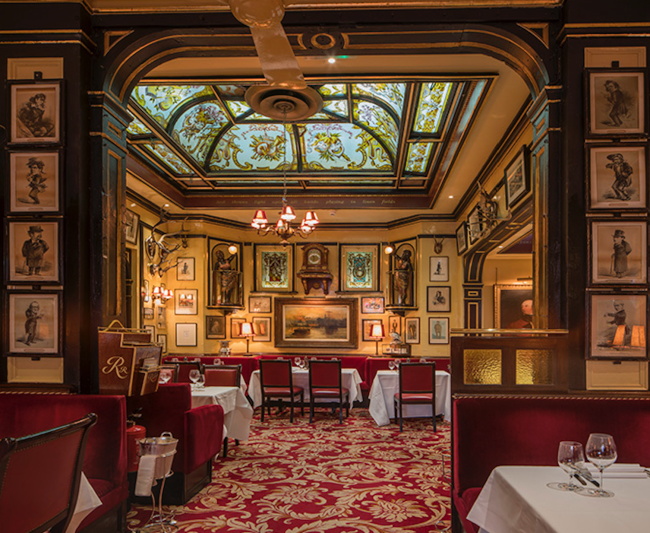
As we were leaving the dining room, we sought out the table from which, as The Independent’s John Walsh noted, “Edward VII, when still Prince of Wales, used to heave his royal tumtum up a secret staircase and romance Lily [sic] Langtry.”
Tum-ta-tum-tum, yeah?
It was a West End pub, though, that became our regular hangout in London for years to come.
After attending some theatre production or other – maybe The Mystery of Edwin Drood – the Missus and I wandered into the Opera Tavern, where we fatefully encountered pub manager John Pucci and his operatic wife, Nina.
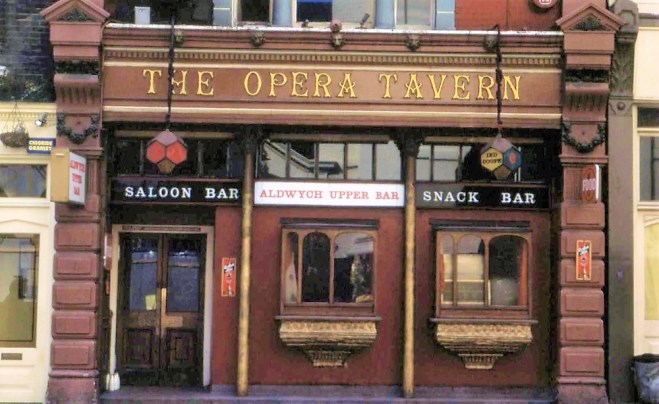
(Rest assured that the current incarnation of the pub is far more posh than the one we encountered.)
Since World War I, in order to ensure that workers made it into the factories on time in the morning, pubs in Britain had to close at 11 pm. Except they sort of didn’t in many cases, as pubs throughout the land held after-hours gatherings for select patrons.
One of those cases was the Opera Tavern, where John and Nina held nightly revels with a group of regulars that came to include me and the Missus.
There was always a prodigious amount of drinking involved, and unfortunately very little food beyond bags of variously flavored crisps, which led to some unseemly results.
The Missus:
Unseemly refers to our post-theater dining plan going awry when we stopped by the Opera Tavern for just one drink. Yeah right. Drinking on an empty stomach with only sour cream potato chips as an appetizer had disastrous bathroom consequences and the worst hangover I ever experienced. Lesson learned.
For myself, the most regrettable incidents were fueled by my participation in endless rounds of spoof, “a game of chance often played in a pub to establish who buys the next round. It has the quirky character that it is a game without a winner, just a loser.”
Sadly, I was most often that loser, which led to mornings-after that sometimes stretched beyond noon. One of them featured a chambermaid who knocked on our hotel door around 2:30 to tidy up the room, only to be met by a clearly discombobulated me declaring, “The Missus isn’t feeling well, so can we just have some fresh towels?”
“Oh, it’s the Missus not feeling well, is it,” she replied tartly.
Point taken.
As if on cue, the phone rang. I picked up and heard John Pucci chirp, “Fancy a drink, John?”
Clearly, it was time to pack up and head to Paris.
Thanks to the excellent planning of the Missus, though, we took our sweet time getting there.
The Missus:
Since the Chunnel didn’t exist at that time, I thought why not rent a car and drive to Portsmouth where we had tickets for an overnight boat trip to Le Havre, France? (A train from there takes you directly to Paris.) That would give us a chance to visit several of England’s noteworthy historic sites on the way.
Number one on my hit parade was Stonehenge, which my father said was mesmerizing when he visited. Since we only had one day for our drive, I checked out what was nearby, discovering Longleat. As the Farcroft Restorations Blog attests, “As English stately homes go, Longleat House in Wiltshire is about the most remarkable you could hope to find. . . . The house was the first home built specifically to impress the then monarch Queen Elizabeth I, the first stately home to open its doors to the public and is the site of the first drive-through safari park worldwide outside of Africa. Besides all this, it also boasts lavish interiors and impressive collections of books, fine art and other collectables.”

That is actually an understatement. While we didn’t have time to explore the wonderful animal park – giraffes, zebras, lions and tigers, oh my – our tour of the “house” was jaw-dropping. It wasn’t just the size – 128 rooms – but the mind-boggling luxury of all the immaculately preserved architectural details, furnishings, lush textiles, art, hand-painted ceilings, and historically significant 17th century antiques. Then there’s “one of the largest private collections of books in Europe,” according to Farcroft, “with more than 40,000 across its seven libraries.”

We’ve visited a lot of delusions-of-grandeur mansions/castles in our time, but this still ranks as one of the most amazing. And I haven’t even mentioned the ornate Capability Brown-designed landscape and gardens.

Stonehenge proved more problematic. We arrived late in the afternoon, only to be told by the lone guard (no one else was there) that the monument was now closed. Incredulous, I asked, “What are you going to do, put a tarp over it?” The guard looked at me quizzically, so I changed tactics and started to beg. “We’re Americans who will never be here again. My father visited Stonehenge when he was a soldier during the war (true) and this is a memorial trip to him (also true). Please, please, please give us just 5 minutes.” That did the trick and we communed alone with Stonehenge, unheard of today, and it was as mysterious and eerie as one can imagine.

That wasn’t the last of my begging for the day. After we visited Salisbury Cathedral with Great Britains’s tallest spire, largest (and earliest-built) choir stalls, oldest working clock, and best preserved copy of the Magna Carta (that’s a lot of ‘ests), followed by a way-too-leisurely dinner at one of the historic Red Lion Inns, we arrived at Portsmouth’s rental car return lot just in time for our late-night departure to France. However, the ship wasn’t in walking distance as we had been led to believe, but a 10-minute drive. We asked a kindly policeman if we could call a cab, and he said it would take at least a half hour for one to show up and we would have missed the boat, as they say. I asked if he could take pity on two pathetic American tourists and see his way to driving us there himself, and surprisingly, he immediately said, “Right-O”! Clearly, had we been on the French side looking to get to England, this would never have happened. Thanks to kindly Brits, we ended a lovely day and boarded the packed ship with a few minutes to spare. Whew.
• • • • • • •
Here’s the lede of the Adweek column I wrote upon our return from the London/Paris trip.
As the splendid editor of this fine publication probably told you, the Missus and I took the Big Ride a couple of weeks ago and went abroad, although I never use that term around her. We went to London to soak up a little moisture and a few pubs, and then we sortied over to France, to give Paris its first last chance.
Paris, you see, has never been a favorite of the Missus. She says the reason the French invented servis compris (service included) on their restaurant tabs is that otherwise, they’d have fewer tips than the O’Neill family. It’s true. The official French slogan ought to be “Liberté, égalité, difficulté.”
Then there was the matter of our hotel rooms on the trip.
I will never again in my life believe a hotel ad. They talk about luxury and comfort and what have you, but when you finally check in, the body copy is nowhere to be seen. Take the Strand Palace in London. It seems that the Missus and I arrived just in time for the V-E Day special: 1945 was a good year, but not for hotel rooms.
And at the Hotel St. Louis in Paris, we were blessed with the room where Toulouse-Lautrec failed to grow up. Not to mention the bathtub. The five-foot ceilings left me in perfect shape to visit the cathedral of Notre Dame.
Indeed, we went for a second time to Cathédrale Notre-Dame de Paris – who wouldn’t? – which at the time still stood in all its centuries-long glory.
Now, of course, it’s all about the race to complete the cathedral’s $865 million restoration in time for the 2024 Olympic Games in Paris.
Bonne chance!
We also went to Sainte-Chapelle for the second time on a cloudy day in the hope that Paris’s everlasting overcast sky might brighten, which it did not. So it wasn’t until several years later that we saw the Gothic chapel in all its sunlit splendor.
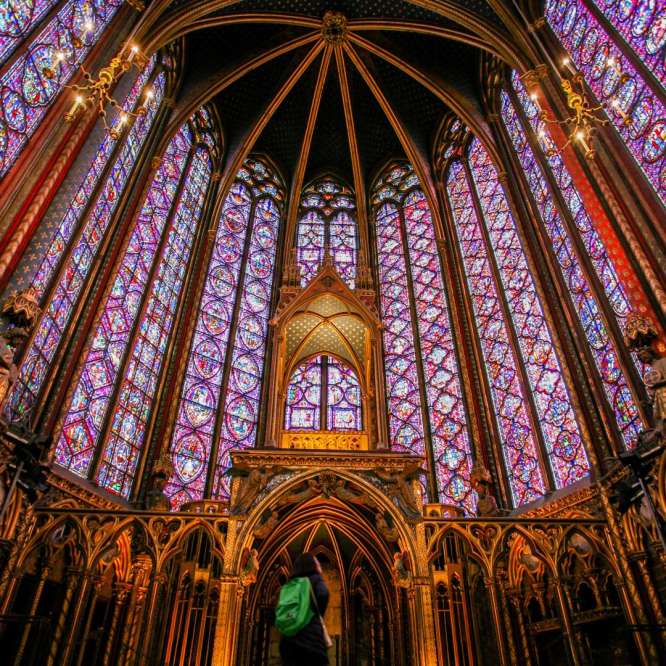
Well worth the wait, the Missus and I agreed.
Back during our second Paris trip, we visited – for the first time – the Musée d’Orsay, that fabulous converted railway station across the Seine from The Louvre. We arrived just in time to catch Chicago : the Birth of a Metropolis (1872-1929).
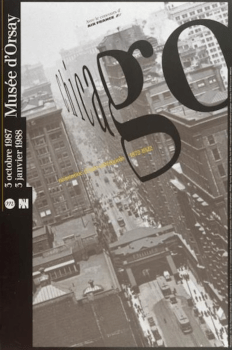 Organised jointly by the Art Institute of Chicago, the Musée d’Orsay and the Deutsches Architektur Museum in Frankfort, the exhibition opened on the great fire which, in 1871, completely destroyed Chicago. In little time, the city arose from its ashes. Its economic importance, the steady growth of its population forced architects to innovate in order to build quickly and with as little expense as possible, commercial buildings.
The first sky-scrapers soon appeared with the metallic armature of buildings which made the universal fame of the Chicago school.
The exhibition presented architectural drawings, objects and pieces of furniture, paintings, and photographs by personalities who made the glory of Chicago, such as Louis Sullivan, Franck Lloyd Wright or Daniel Burnham.
Some years later we took a river tour of Chicago’s skyscrapers, which was more, well, watery than the d’Orsay exhibit. The rest of the museum – which contained at the time, according to this Chicago Tribune piece, “2,300 paintings, 1,500 sculptures, 1,100 objects (furniture to enamels), 13,000 photographs and a film collection that people [were] flocking to see” – we found endlessly fascinating.
For that reason, we revisited the Musée d’Orsay just about every time we returned to Paris, which was a lot over the next 25 years.
Our second Paris trip, however, featured another first: A visit to Centre Pompidou, the architecturally inside-out museum that was a scandal at its opening in 1977 and a fixture ten years later when we went there.

Unfortunately, we did not get to the Pompidou in time to see its Otto Dix exhibit, advertised with this poster depicting his 1926 “Portrait de la Sylvia von Harden.”

We were also too late for the Pompidou’s 10th anniversary retrospective, L’Epoque, La Mode, La Morale, La Passion: Aspects De L’art D’aujourd’hui, 1977-1987, which was advertised with this Keith Haring poster.

I’m guessing we mostly visited the museum’s permanent collection our first time there, but I do know this: The Pompidou itself was – and is – something to see.
The Missus:
The Pompidou is indeed something to see – both inside and out. In fact we were actually lucky there was no blockbuster exhibit when we first visited or we would have been exhausted long before taking in their sensational collection of modern and contemporary art, the largest in Europe. Not sure what the word for blockbuster is in French, but the Pompidou doesn’t fool around as we learned on later visits. Their fabulous Dubuffet exhibit, for example, had so many incredible works we had never seen, it took almost half a day to get through. When they have two or more such exhibitions, you’ll collapse long before hitting the permanent galleries.
Our favorite floors were bursting with stellar works by Braque, Picasso, Matisse, Modigliani, Derain, Dufy, Vlaminck, Jawlensky, Gontcharova, Delaunay – both Sonia and Robert – Gris, Léger, Lipchitz, Chagall, Soutine, both Arps, the German Expressionists and on and on and on.
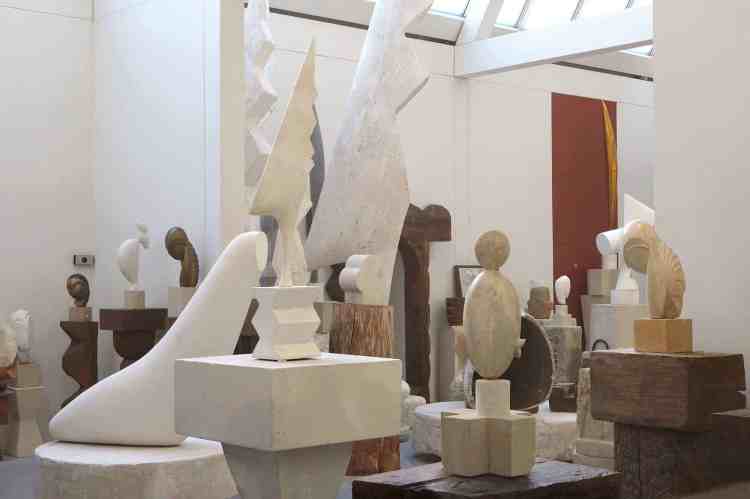
And the Atelier Brancusi, a separate glass-enclosed building outside, is the ground-breaking sculptor’s actual studio bequeathed to the French state after his death. It perfectly preserves the artist’s workshop as he left it, chock full of both his most iconic pieces and works in progress. No matter how many times we visit, we are always astounded.
Then there’s the Pompidou’s inside-out architecture designed by star-chitect Renzo Piano. As you ascend the glass-enclosed outside escalators, your views of roof-top Paris get more and more breath-taking.

I’m pretty sure we also checked out The Conciergerie, in large part so the Missus could shout out Robespierre!
The Missus:
Funny the things you remember from grade school. I never forgot the story that Robespierre was shot in the mouth prior to his being guillotined so he couldn’t say any last words. Talk about overkill! It turns out the story may have been apocryphal as later history books suggest the shot through his jaw was more likely a suicide attempt.
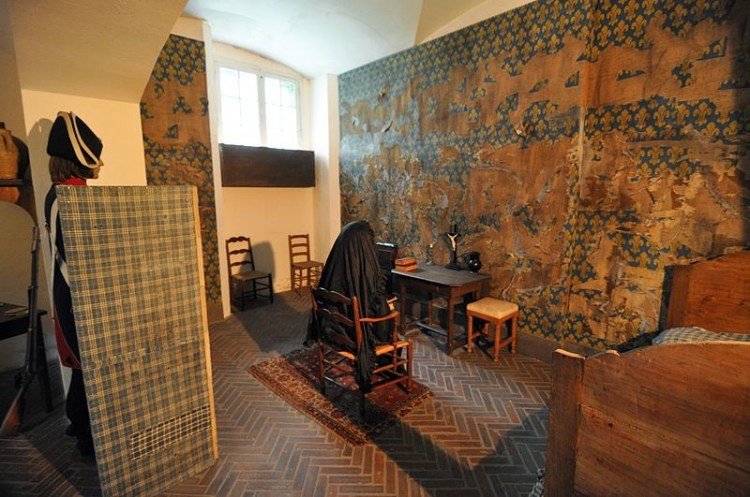
The Conciergerie is memorable for more than stories about that architect of the French Revolution’s Reign of Terror. There are ghoulish scenes of prisoners’ cells and torture devices everywhere, in addition to a recreation of Marie Antoinette’s comparatively luxurious accommodations prior to her execution, complete with a wax figure of the deposed Queen herself. Needless to say, kids love the place.
And with that, our Paris do-over was over.
• • • • • • •
Upon our return home, I filed the requisite Adweek column.
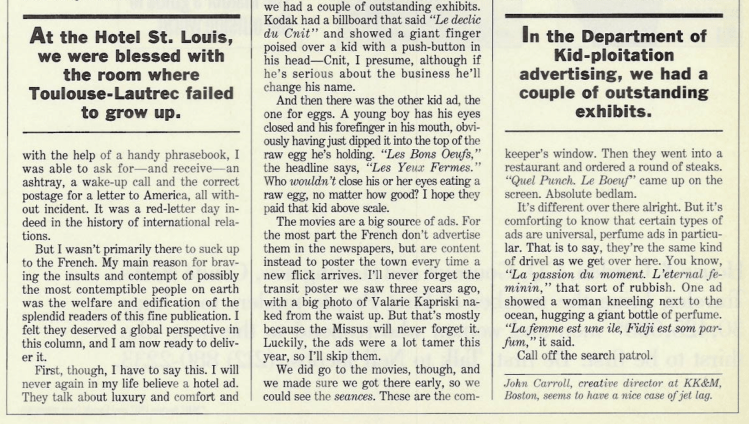
Favorite passage:
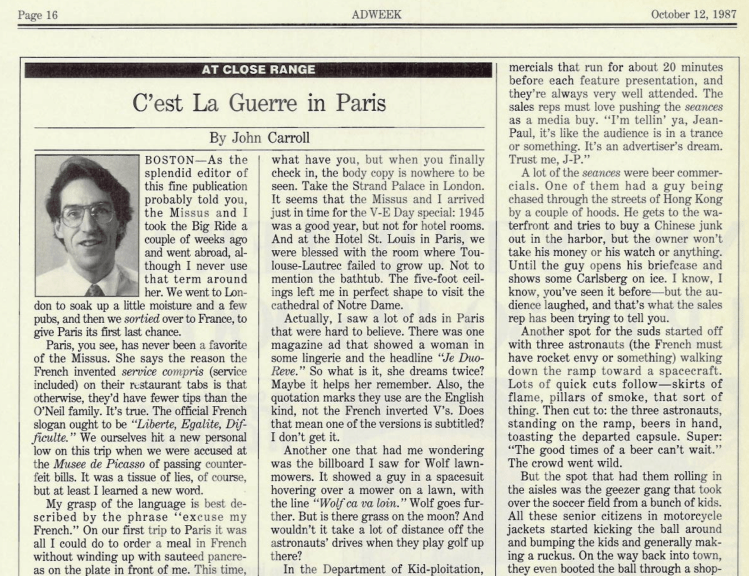
The movies are a big source of ads. For the most part the French don’t advertise them in the newspapers, but are content instead to poster the town every time a new flick arrives. I’ll never forget the transit poster we saw three years ago, with a big photo of Valarie Kapriski naked from the waist up. But that’s mostly because the Missus will never forget it. Luckily, the ads were a lot tamer this year, so I’ll skip them.
We did go to the movies, though, and we made sure we got there early, so we could see the seances. Those are the commercials that run for about 20 minutes before each feature presentation, and they’re always very well attended. The sales reps must love pushing the seances as a media buy. “I’m tellin’ ya, Jean-Paul, it’s like the audience is in a trance or something. It’s an advertiser’s dream. Trust me, J-P.”
It was true: Our reviews of the commercials ranged from “the audience laughed” to “the crowd went wild” to “absolute bedlam.”
Formidable!
 Travels With The Missus