At some point the Missus and I thought we might make a couple of return visits to European cities in which we had spent only a couple of days during previous trips.
First up was Florence, where we’d had un caffè as part of our four-city Italian blitz in 1986. This time the Missus scored a fabulous Alitalia package: Round-trip airfare and six nights hotel for a mere $700.
Eccellente!
Except when we arrived at Logan Airport’s international terminal, one of the perks we had been promised was not forthcoming. The Missus, who had been working at a breakneck pace for many months and was understandably frazzled, got kind of emotional at that point.
The Missus:
“Kind of emotional” is an understatement. A client, who shall remain nameless, had suddenly decided to make unnecessary changes to a completed project requiring me to drive to their office the morning of our flight. Needless to say I was looking at the clock the whole time and freaking out when I hit traffic driving home. Nevertheless, we got to the airport over two hours early, as I had been told that would guarantee confirmation of my booking seats in an exit row with lots of legroom.
But when we checked in, the very polite gentleman at the Alitalia check-in counter told me those rows were always reserved for families with babies. I was so over-tired and over-worked at that point that tears started running down my face. In a very low, trembling voice I said I completely understood the rules but wish the airline booking representative hadn’t misinformed me. Then I really started to cry. I kept trying to stop while profusely apologizing for being so over-emotional, explaining I had just had a bad week. If we could have an aisle and window I’d appreciate it. I barely raised my voice above a whisper the whole time as I didn’t want to seem like an ugly American.
The Alitalian at the check-in counter said “Let me have your tickets” and promptly disappeared for a nail-bitingly long time. Minutes before our flight’s departure, he returned with two first-class boarding passes, at which point the Missus got a different kind of emotional.
Our room at the Hotel Martelli in the heart of the city was almost equally dramatic.

As for Florence itself, it looked like this at the time (via ThamesTV).
We started out with some Greatest Hits reruns, from the stately Cathedral of Santa Maria del Fiore (Duomo di Firenze) to the lavish Pitti Palace, which houses the Palatine Gallery, the Silver Museum, the Museum of Modern Art, the Costume Gallery, the Porcelain Museum and the Museum of Carriages.
Best of all, the Missus, in her infinite wisdom, had purchased advance tickets for the Uffizi Gallery, allowing us to skip the line and gain early entry.
This is what the Botticelli Room normally looks like.

This is what it looked like when the Missus and I waltzed in.
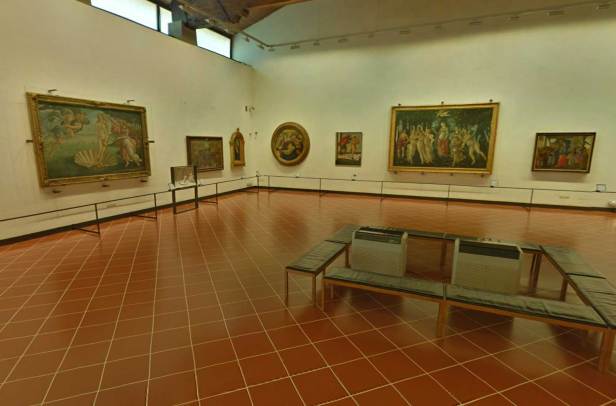
We spent a blissful half-hour alone with the luminous works of Sandro Botticelli, including this one.
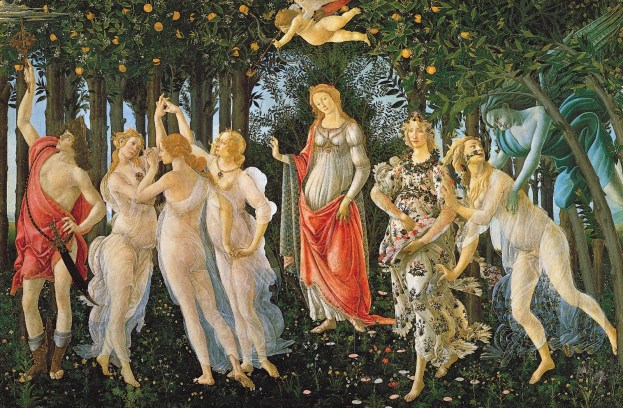
Primo indeed.
In contrast to our soggy Munich encore (details below), it rained all of 90 minutes while we were back in Florence, but we didn’t care because we were inside the marvelous Museo Galileo the entire time.

Since 1930 the seat of the museum is in the old palace, restored several times down the centuries, that takes its name from its last owners, the Castellanis. The museum displays a very accurate and important collection of scientific instruments, the proof that interest of Florence in science from the 13th century onwards was as great as its interest in art.
Representative samples . . .
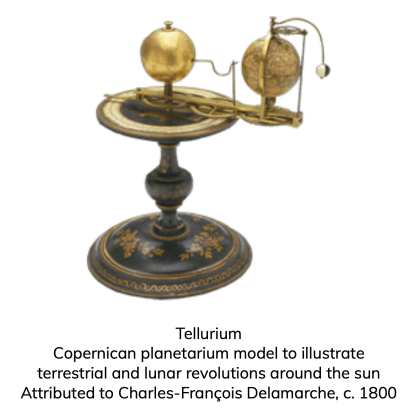

An amazing place (lots of videos here).
The nice weather made our forays into the Tuscan countryside that much more pleasant. In Siena, we sat at a cafe in the sun-drenched Piazza del Campo, just across from the Torre del Mangia (Tower of the Eater – really) and the Palazzo Pubblico (Town Hall).
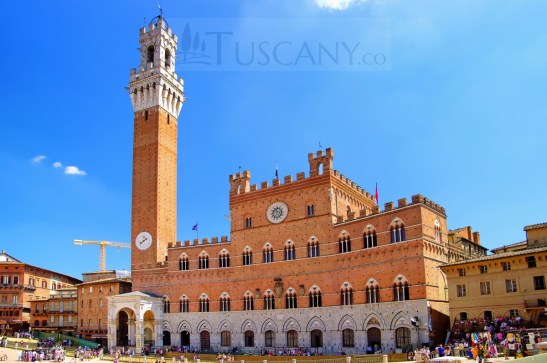
Nearly every major room in the palace contains frescoes. These frescoes are unusual for the time in that they were commissioned by the governing body of the city, rather than by the Church or by a religious fraternity. They are also unusual in that many of them depict secular subjects instead of the religious subjects which are overwhelmingly typical of Italian art of this era.
The most famous of the secular frescoes are three panels in the series on government in the Hall of the Nine (also known as Sala della Pace) by Ambrogio Lorenzetti. These frescoes are collectively known as Allegory and Effects of Good and Bad Government.
Here’s the Allegory of Good Government, for those of you keeping score at home.

Yeah – no idea, then or now.
We also took a day trip to Lucca, “Italy’s most impressive fortress city, encircled by a perfectly intact Renaissance wall,” as Rick Steeves describes it. I recall walking around the walls of the city, but not much else.

Pisa, on the other hand, I remember vividly. And yes, the Missus did take the obligatory trick photo of me holding up the Leaning Tower, which is – thankfully – now lost to history. (The photo, that is, not the Tower, which is – thankfully – still standing.)
Consolation prize: This photo of someone else’s slice of Pisa.

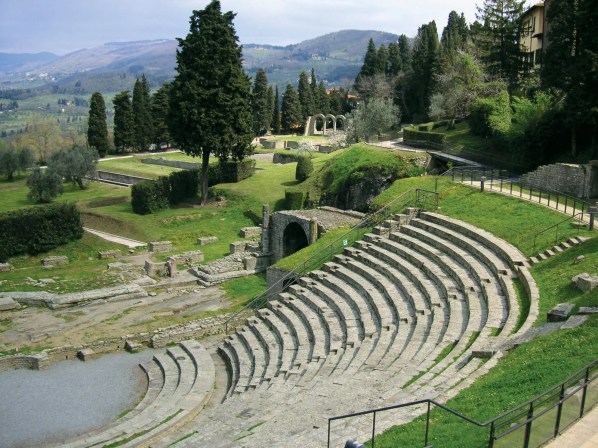
Another journey to the outskirts of Florence took us to the Etruscan town of Fiesole, with its breathtaking views of the city below.

We also stopped by the remains of the Roman amphitheatre there.
Our last foray out of Florence landed us in Charming Medieval San Gimignano.
San Gimignano, a small walled village about halfway between Florence and Siena, is famous for its fascinating medieval architecture and towers that rise above of all the other buildings offering an impressive view of the city from the surrounding valley.
At the height of its glory, San Gimignano’s patrician families had built around 72 tower-houses as symbols of their wealth and power. Although only 14 have survived, San Gimignano still retains its feudal atmosphere and appearance.
We especially wanted to see the fully frescoed Duomo di San Gimignano, which according to Discover Tuscany “has NEVER actually needed ‘restoration’ throughout the centuries. The colors you see are the original ones painted in the 1300s and their vividness and brightness is awe-inspiring.”
Their vividness and brightness is also costly: To actually see the frescoes, you had to keep feeding liras into coin-operated spotlights.

The Missus and I, respectful tourists that we were, allowed others to precede us in triggering the lights.
And then it was time to say, Ciao, Firenze.
Upon our arrival at Amerigo Vespucci Airport to return home, the Missus, in her infinite wisdom, showed the Alitalian at the ticket counter the first-class boarding passes from our flight over there. “They said in Boston you might be able to bump us up again,” she told him sweetly.
And just like that, he did.
Saluti!
• • • • • • •
After the Florence trip, it was back to Bavaria.
During our worldwind tour of four Eurocities in the early ’90s, the Missus and I had a tasse kaffe in Munich, which looked like this when we arrived by train from Salzburg.
We spent our two days in the Bavarian capital immersing ourselves in the fabulously extravagant Residenz München; stopping for a drink – dummkopfs that we were – at The Hofbräuhaus, site of Adolf Hitler’s failed 1923 beer hall putsch; and trundling out to Neuschwanstein Castle, the mothership of King Ludwig II’s mad reign.
Not bad for 48 hours. Some years later, though, we decided to go back for a longer look.
At the time, the Missus had a hairdresser who hailed from Germany, and she told us that the place to stay in Munich was the Schwabing district, which was originally the bohemian quarter of the city but had since been gentrified with all the requisite shops, restaurants, and art galleries that go with the upscaling of urban areas. Adding to the appeal: The Schwabing is home to the Englischer Garten, one of the world’s largest public parks.
The neighborhood is also home, not coincidentally, to the Hotel Gästehaus Englischer Garten, a “lovingly restored historic building next to the English Garden” that the Missus wisely chose for our stay.
We scheduled our trip for August, normally the warmest month of the year in Munich.
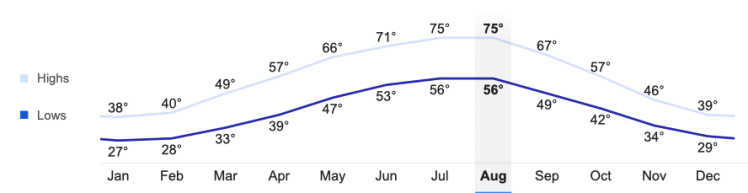
On the other hand, August is also one of the rainiest months there.

We wound up with the worst of both worlds: six days of low-50s, six days of torrential rain. That’s over one-half of Munich’s entire monthly allotment of rainfall in one-fifth of the days, for those of you keeping score at home.
Consequently, the first thing we did after settling into our charming hotel room was to visit one of Schwabing’s smart shops to buy the Missus something warm to wear – a sweater, a shawl, something.
Of course, the Missus and I were back in Munich to soak up more than Biblical downpours, so we set out – umbrellas flapping in the wind – to visit Bayerisches Nationalmuseum, which Inside Munich calls “a true treasure chest of Bavarian Art, Culture and History and even the building itself is breathtaking.”

The “Schatzhaus an der Eisbachwelle” is one of the largest museums in Germany. It displays exceptional art from late antiquity up to art nouveau, and explains European cultural history in Bavaria in a unique way. With the successive renewal of its display collections and exciting special exhibits it creates bridges between the past and the present.
Here’s a quick tour. (The museum’s online collection is here, but forewarned is forearmed: It’s tougher to navigate than the IRS at tax time.) What the video does not include are pieces such as these from the museum’s art nouveau gallery.


Marching forward in time, we wandered over to the Neue Pinakothek, founded in 1853 by King Ludwig I as Europe’s first public museum dedicated solely to contemporary art.
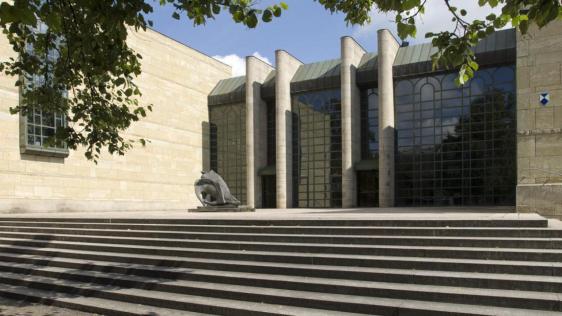
“Rediscover the 19th Century” is the motto of the Neue Pinakothek. A richly varied tour provides an opportunity to view paintings and sculptures of the Neoclassical, Romantic, Impressionist, Art Nouveau and Gründerzeit periods and to encounter masterpieces by major pioneers of Modern art: Max Liebermann, Edouard Manet, Claude Monet, Vincent van Gogh and Paul Cézanne . . .
After its complete destruction during the Second World War, the architect Alexander von Branca was entrusted with the design of the current building, which opened its doors in 1981.
Here are a few examples – by van Gogh, Ernst Ludwig Kirchner, and Wassily Kandinsky – from the museum’s online collection.

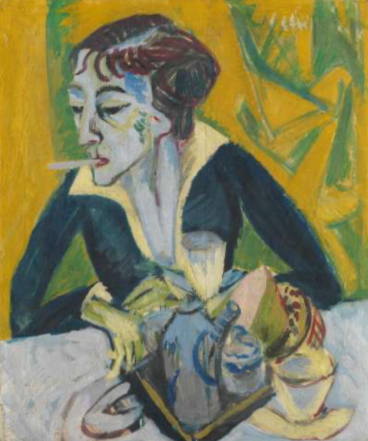

And here’s how the museum looks nowadays.
As much as we appreciated the legacy of Ludwig I, we were even more interested in the lunacy of his heir aberrant, grandson Ludwig II. So we headed off to Linderhof Palace, the country retreat of the mad Bavarian.

Ludwig II, who was crowned king in 1864, began his building activities in 1867/68 by redesigning his rooms in the Munich Residenz and laying the foundation stone of Neuschwanstein Castle.
In 1868 he was already making his first plans for Linderhof. However, neither the palace modelled on Versailles that was to be sited on the floor of the valley nor the large Byzantine palace envisaged by Ludwig II were ever built.
Instead, the new building developed around the forester’s house belonging to his father Maximilian II, which was located in the open space in front of the present palace and was used by the king when crown prince on hunting expeditions with his father. Linderhof Palace, the eventual result of a long period of building and rebuilding, is the only large palace King Ludwig II lived to see completed.
The finished product is a total knockout.


Some hunting lodge, eh? (If you’re so inclined, you can take this Haswell Travelled tour of the palace’s equally spectacular grounds.)
It’s Linderhof’s dining room, though, that takes the cake.
This room is famous mainly for its table, known as the “wishing table” after the table that sets itself in the Grimms’ fairy tale, “The Wishing Table, the Golden Ass, and the Cudgel-in-the-Sack.”
By means of a crank mechanism, the table can be lowered downstairs to the kitchen. It is an 18th-century French invention that allowed court society to remain unobserved during their amorous suppers. Ludwig picked up the invention for a different reason. What mattered to the lonely king were not gallantry and erotic adventures but undisturbed reverie when he had his imaginary court society assembled around him.
Theodor Hierneis, one of the king’s cooks, reports on this habit in his memoirs: “He (the king) wants no one around him (at meals). Nevertheless, the dinners and suppers always have to be large enough to serve at least three or four people. This way, although the king always sits down to eat alone, he does not feel alone after all. He believes himself in the company of Louis XIV and Louis XV and their lady friends, Madame Pompadour and Madame Maintenon. He even greets them now and then and carries on conversations with them as though he really had them as his guests at table.”
Talk about your moveable feast . . .
• • • • • • •
The time has come to speak of food in foreign climes – uncharted waters for most tourists, with the notable exception of those who sail only into McDonalds and Pizza Hut (of which there are many).
For everyone else, of course, it all starts with breakfast. According to Mon Panier Latin, the typical French petit déjeuner “consists of a croissant or bread with butter and jam and sometimes a sweet pastry. Fresh fruit juice and hot beverages, like coffee or tea, are also included.”

Our first time in Paris, the Missus and I stayed at Le Régent, a swanky Left Bank hotel where each night we would order room-service breakfast and they’d ask, “Would monsieur and madame like orange juice with that?” – never mentioning that each glass cost an extra 40 francs (equal at that time – April 1985 – to roughly four bucks). So when we checked out, there was a knee-buckling 400 extra francs on la note d’hôtel. You bet I recalled some choice French phrases at that point.
Immediately afterward, we got into a dustup with a cabdriver who arrived at the hotel with 30 francs already on the meter. (We would later learn that when you call for a cab in Paris, the meter starts running right away.) As we argued with the chauffeur de taxi, we also learned that our requested destination – Paris-Orly Airport – didn’t handle international flights. We needed to go to Charles de Gaulle, the driver said as he kicked us and our luggage to the curb. So there we were on rue Dauphine trying to flag a passing taxi, which we only succeeded in doing by hiding the Missus and our bags until one pulled over. That made two ticked-off chauffeurs de taxi in under 30 minutes, for those of you keeping score at home.
As The German Way relates, “a German breakfast consists of hearty Brot (breads) and Brötchen (rolls), decorated with butter, sweet jams and local honey, thinly sliced meats, cheese and even some Leberwurst. Top that off with a pot of coffee or tea, or get fancy with Saft (juice), gekochtes Ei (boiled egg) and yogurt or Quark topped with Obst (fruit) and muesli.”
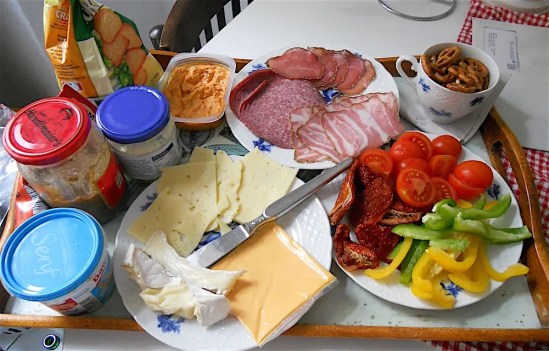
Oy. We felt kind of bad – 90% of what was delivered to our room each morning at the Hotel Gästehaus Englischer Garten, the Missus wouldn’t eat at gunpoint. The other 10% we split before splitting for the day.
And then there was eating out . . .
In Munich, as in Paris, every restaurant meal was an adventure, except for entirely different reasons. For an American in a Parisian bistro, it’s always a coin flip whether the waiter will consider you worth the effort, given that his 15% tip is compris – that is, built into the tab. The answer is usually non. For tourists, Paris might as well be nicknamed the City of Light Service.
The Missus and I rarely passed the waiter’s test, leaving us to endure many long lonely meals interrupted by spasms of surly service. Eventually the Missus fixed that problem by ditching hotel stays in favor of rental apartments, where the dining experience proved vastly superior.
The challenge in Munich was not the waiters but the menus – in particular, which entrée might be chicken, given that German has at least 15 different words for the barnyard basic, depending on the season, the seasoning, and God knows what else. Then again, the waiters and waitresses we encountered around Munich were unfailingly friendly and helpful, a great improvement over the Paris pouters.
That contrast is nicely illustrated by a tale of two dinners.
On one of our early trips to Paris, we went to a small neighborhood restaurant where I navigated the entire dinner in what I thought was passable French. At the end I said to the waiter, “le reçu, s’il vous plaît,” to which he replied with a sneer, “check?” (A few years later, a less contemptuous waiter would tell me, “votre français est brave,” which I took as a compliment, backhanded though it might have been.)
At a small neighborhood restaurant in the Schwabing, by contrast, I stumbled my way through the meal but managed to say at the end, “die rechnung, bitte.” The waiter looked me in the eye and replied, “die rechnung, jawohl!”
Exzellent!
• • • • • • •
During our previous visit to Munich, one thing the Missus and I didn’t have time to explore was the city’s splendid array of churches, so we decided to rectify that by entering every ecclesiastical edifice we encountered upon our return.
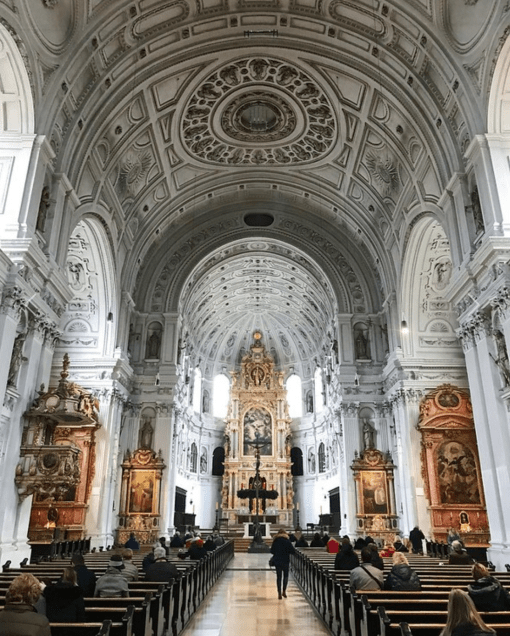
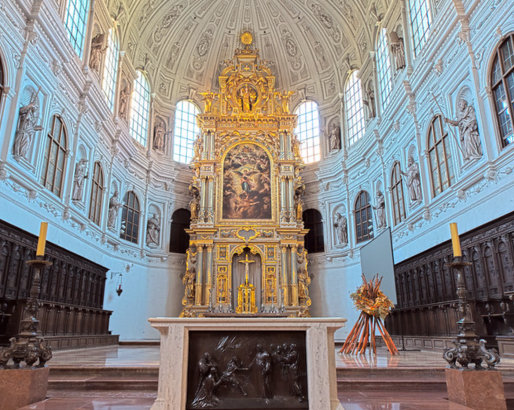
The one I remember best is St. Michael’s Church, here described by Spotting History.
St. Michael’s Jesuit church in Munich is the largest Renaissance church north of the Alps. The style of the building had an enormous influence on Southern German early Baroque architecture.
The church was built by William V, Duke of Bavaria between 1583 and 1597 as a spiritual center for the Counter Reformation. In order to realise his ambitious plans for the church and the adjoining college, Duke William had 87 houses in the best location pulled down, ignoring the protests of the citizens.
Payback of sorts came when “the [church’s] tower . . . collapsed in 1590, destroying the just completed quire. Duke William V took it as a bad omen and so planned to build a much larger church.”
Not sure about the logic there, but it certainly worked out in the end.

The interior is equally impressive.
Even more impressive was Nymphenburg Palace, “one of the best examples in Europe of a synthesis of the arts.”

The decoration of the main palace . . . represents a variety of styles ranging from Baroque and Rococo to Neoclassicism.This long tradition is reflected in the Baroque ceiling paintings from the epoch of the palace’s founder, the apartments decorated with exquisite paintings and furniture . . .


But wait – there’s more: “Among the attractions of Nymphenburg is the famous Gallery of Beauties of King Ludwig I of Bavaria, for which Joseph Stieler painted 36 beautiful women from all sections of society.” (This video gallantly calls the roll of the fairest three dozen in the land.)
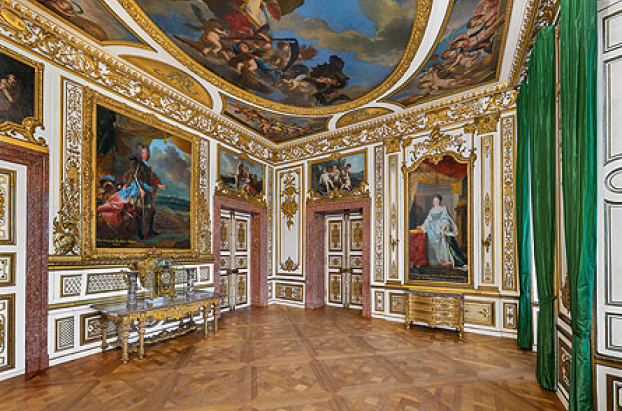
Other rooms at Nymphenburg Palace are beauties in their own right.

We then went from the sublime to the subterranean: The Deutsches Museum’s Mining Exhibit.

Descend into the depths of the earth as the miners once did. In our exhibition, you can experience the extraction, transportation and refinement of raw materials.
So we descended, and here’s some of what we experienced.

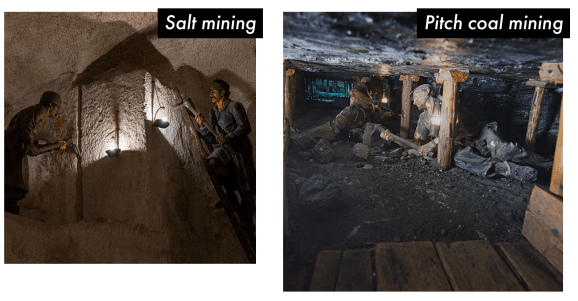
Right about the Pitch Coal section, the Missus and I started to get the willies, because it felt like the mining exhibit was never going to end. And we were kind of right: We still had Bituminious Coal of the 1950s, Processing, and Modern Mining in front of us. So we doubled back through the exhibit and bolted for the street.
A miner meltdown, you might say.
(This intrepid visitor, however, made it all the way through.)
After all that grim ‘n’ grime, the Missus and I needed something more, well, uplifting. So we trundled off to visit Mad Ludwig’s third castle, Herrenchiemsee.
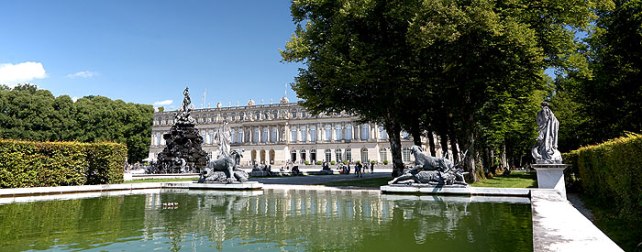
In 1873 King Ludwig II of Bavaria acquired the Herreninsel as the location for his Royal Palace of Herrenchiemsee (New Palace). Modelled on Versailles, this palace was built as a “Temple of Fame” for King Louis XIV of France, whom the Bavarian monarch fervently admired.
The actual building of this “Bavarian Versailles”, which was begun in 1878 from plans by Georg Dollmann, was preceded by a total of 13 planning stages. When Ludwig II died in 1886 the palace was still incomplete, and sections of it were later demolished.
What little remains, though, is a corker, as illustrated by this helpful tour.
Having thus hit the trifecta of Palaces of Ludwig II of Bavaria, the Missus and I returned to our lovely hotel room and started packing for home.
• • • • • • •
Murphy’s Law being what it is, on the day we were to leave Munich, the rains subsided – of course – and the sun emerged in all its glory. Happily, our flight was scheduled for late afternoon, so we moseyed for the first (and last) time into the Englischer Garten, which burst into view like The Wizard of Oz shifting from sepia tones to Technicolor.


As we wandered about, we thought how nice it would have been to sit in the Englischer Garten enjoying our one-tenth of a standard German breakfast each morning. Another lifetime, perhaps.
And with that, we said auf Wiedersehen to Munich and headed back to Boston.
 Travels With The Missus
One thought on “Our Rain-Drenched Return to Munich”