In the process of chronicling our four-plus decades of carefree rambles, the Missus and I have inevitably let some journeys slip through the cracks. So we’ll gather up a few of the leftovers before we say goodbye.
White Knuckles at the Grand Canyon
The Missus, in her entrepreneurial heyday, travelled all across this great land of ours for her many clients in the footwear and fashion industries, forecasting trends and previewing product lines.
From time to time I would join her in my capacity as Chairman of the Board (with, as you might recall, the major responsibility of schlepping luggage through airports both domestic and international).
One such occasion found us in Phoenix, Arizona in August, where the mercury soared to 104° – at night. Upon her successful completion of some sales meeting or other, the Missus and I set off to explore the many natural wonders of the Grand Canyon State.
Our first stop was scheduled to be Sedona, but an hour and a half into the drive we veered off at Montezuma Castle National Monument, home of “the well-preserved living spaces of the Sinagua Indians.”

Like an ancient five-story apartment building, Montezuma Castle towers above the desert below, a stone-and-mortar marvel of early architectural engineering. Experts have determined that the Castle was built over three centuries and provided shelter for the Sinagua Indians during flood seasons. However, contrary to the belief of the European-Americans who discovered the structure, there’s no historical connection to the Aztec emperor for whom it’s named—the structure was abandoned more than 40 years prior to his birth.
Right. So to recap: Not a castle, not Montezuma’s, and you couldn’t go inside. Other than that, it was swell . . . for about ten minutes. Unfortunately for the bus-tour folks standing alongside us (part of the “approximately 350,000 people per year [who] visit the Castle”), they were there for an hour. We, on the other hand, were on our merry way to Red Rock Country.
Upon arriving in Sedona (“Plan to stay more than a day”), we checked into the Matterhorn Motor Lodge (as it was called at the time) for one night. According to its website, “The Matterhorn Inn in Sedona, Arizona offers elegant accommodations with unparalleled views of the red rock mountains, all at budget-friendly rates.”
Half of that was true when we stayed there 30 years ago. On the one hand, elegant the Matterhorn Motor Lodge was not. Case in point: Despite the extreme heat, the pool area was entirely deserted, most likely because the pool itself was half filled with brownish, brackish water. I don’t even want to talk about the hot tub.
On the other hand, the place was budget-friendly. The Missus assured me we were paying far less than 50,000 kronkites for our room. After all, it wasn’t exactly the Schmatterhorn.
As for Sedona, it has a reputation as as a town suffused with a New Agey “vortex vibe,” as Dwight Garner noted in the New York Times some years ago.
There’s a vibe in the air, something not quite audible, a kind of metaphysical dog whistle that calls people out to have a look around and to try to feel something that, if you’re not a committed New-Age pilgrim, is hard to put into words . . .
Sedona is famous for its so-called vortex sites, spots where the earth’s energy is supposedly increased, leading to self-awareness and various kinds of healing. (Think of them as spiritual hot tubs without the water.)
In keeping with the whole vortex thing, we decided to take a Jeep tour of the fabled “red sandstone cliffs and giant red sandstone spires.” And lucky us: Our driver was not only straight out of central casting (Throwback Hippie, circa 1969), he was also – he announced as we set out – psychic and clairaudient (“the supposed faculty of perceiving, as if by hearing, what is inaudible”).
Oddly enough, though, he seemed entirely incapable of hearing the moans and groans of his passengers as the Jeep careened at teeth-rattling speeds across the rugged terrain.
Regardless, the landscape was indeed spectacular. As Dwight Garner wrote, “Nowhere else in this country does a natural setting feel so much like the inside of a soaring pantheistic cathedral.”

• • • • • • •
About hallway between Sedona and Grand Canyon National Park, the Missus and I rumbled into Bedrock City, the purported home of The Flintstones and the longtime home of Raptor Ranch, a tourist trap that can’t even spell its own catchphrase correctly. The current headline on Raptor Ranch’s website is “Yabadabaoo [sic]! Come and Celebrate 50 Years of Iconic Bedrock City,” although they did get the Yabbas right on their sign along the highway.
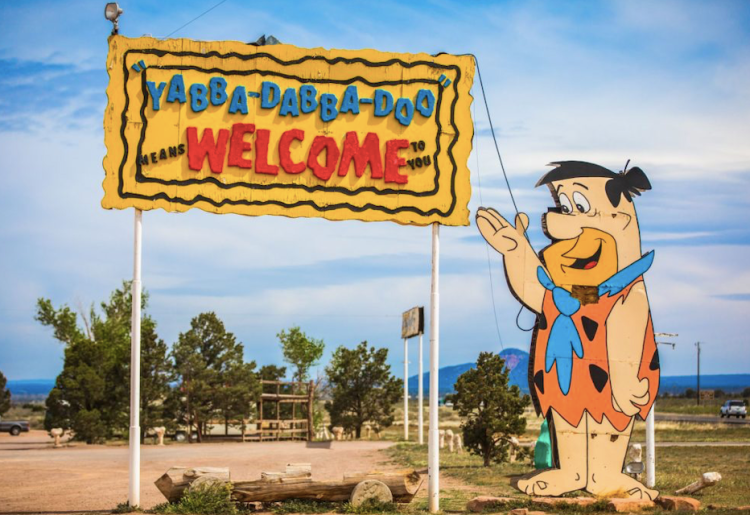
Unsurprisingly, we gave Bedrock the swift, cruising half an hour later into the National Park Service’s Kachina Lodge, which featured all the charm and ambiance of a 1960s cinder-block college dorm.
But, man, location location location.

Sitting directly on the rim of Grand Canyon in the center of the historic Village, this lodge is within close walking distance to restaurants, gifts shops, Kolb Studio, Verkamp’s Visitor Center, and Bright Angel Trailhead.
Kachina Lodge was built in 1968 as part of a plan by the National Park Service to expand services at parks across the country. The tiered design of Kachina Lodge mimics the uppermost layers of rock in Grand Canyon.
Next thing we knew, we ourselves were directly on the rim of the Grand Canyon, and – as I’m sure millions of gawkers have said before – grand doesn’t even come close to describing it.

Also like legions of others before us, we wanted to see the canyon up close. So bright and early the next morning, we headed down the nearest hiking trail. We’d gone maybe a third of a mile when we encountered a sign similar to this one.
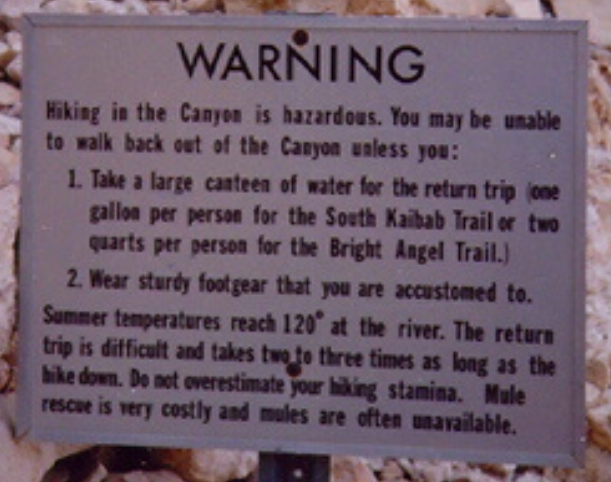
We didn’t have to be told twice. As the Missus and I trudged back up the trail, we encountered several tourists striding briskly toward us.
“Hey, did you go all the way to the bottom?” one asked brightly.
“Oh yeah,” the Missus replied. “Don’t let the sign down there bother you.”
Mind you, the Missus was dressed entirely in white – someone alert Ripley’s, right? – without a speck of trail dirt on her. No sweat stains, either. Regardless, the group continued down as we proceeded up.
(Spoiler alert: They were back at the rim shortly after we were.)
Meanwhile, the Missus and I shifted to Plan B: An airplane tour of the Big Hole. Here’s a short promotional video for one of the canyon tours.
Full disclosure: The couple in the video is way calmer than the Missus and I were during our ride. I truly believe that somewhere in the skies above Arizona, there are two airplane seatbacks that still bear the impressions of our fingers tightly clutching them throughout the flight.
Laugh, clown, laugh. But not long after our Tour of Terror, there was this story in the Tampa Bay Times.
A tour plane carrying passengers over the Grand Canyon apparently lost an engine Monday and crashed while trying to return to the airport.
Eight of the 10 people on board were killed.
The PA-31 Navajo aircraft developed engine trouble shortly after liftoff Monday from Grand Canyon Airport and went down in a ravine as it returned for an emergency landing, said FAA spokesman Fred O’Donnell.
Over all, we were more than happy to drive back to Phoenix.
In yet another personal and professional triumph, the Hotel Booking Goddess had snagged a room at the legendary Frank Lloyd Wright-designed Arizona Biltmore – for $85 per night, a steal even back then.

On February 23, 1929 the Arizona Biltmore opened in grand fashion. Over 600 invitations were sent out, with the thought of only a few hundred attending, but it seemed no one wanted to be left out and the resort had to re-create the opening gala three days in a row to accommodate all 600 people. From that day forward, the Arizona Biltmore has been a private retreat for some of the most influential powerhouses of the time.
“Influential powerhouses” decidedly did not describe the two of us at the time, but we strolled around the place like we owned it nonetheless.
One example of our devil-may-care attitude: Despite the strict prohibition against cutoff jeans in the pool area, I wore mine anyway. For one thing, I didn’t have any other shorts with me; for another, lots of people poolside wore next to nothing, so my transgression went largely unnoticed.
Phoenix wasn’t much of a museum town back then, but we did trundle over to the Heard Museum, “recognized internationally for the quality of its collections [of American Indian art], world class exhibitions, educational programming and unmatched festivals.”
Such as the Hopi Indian Festival, which we found to be aptly named, since it featured exactly one Hopi Indian.
“It’s a corker!” the pleasant white-haired gal at the ticket counter told us, by which of course she meant he’s a corker.
And he sort of was. But no matter – all in all, our Arizona trip was a total hoot.
Postscript: As we traversed the great state of Arizona, we also encountered two of its three major sinkholes back then. These days, apparently, there are a lot more.
Hip Hip . . . Replacement!
The first time the Missus went to England to check out the European fabric shows and divine coming color trends for her footwear clients, I wound up – in a one-time only event – doing a bit of business there myself.
I was preparing to assume my assigned role of corporate arm candy/airport skycap on the trip, when my penny-pinching boss at the ad agency I worked for said, “Say, since you’re going to be in London anyway, you should pop by our client’s headquarters there to generate some good will and collect a few invoice payments.”
I quickly pointed out that our improbable international client – Charnley Limited, founded by John Charnley, the inventor of the modern hip replacement – was headquartered in the city of Leeds, a good four-hour drive from London.
“Excellent,” he replied briskly. “You can take in the countryside along the way.”
So it was that early one morning the Missus and I piled into a rental car and headed toward Leeds. We exited London via the Uxbridge Road, about which I remember two things: 1) The road’s name changed every few miles, making us think we were lost for the first 45 minutes of the trip; and 2) The road took us through the heart of Brixton, which was experiencing one of its periodic race riots protesting police brutality
Other than that, a smooth ride with some lovely countryside along the way.
Here’s the backstory on John Charnley, the company’s namesake, compliments of Yale University Library.
Surgeons’ efforts before the 1960s laid the groundwork for Sir John Charnley to develop his  revolutionary low-friction arthroplasty of the hip. His procedure was the first to consistently achieve predictable and positive outcomes due to the incorporation of a reliable socket replacement. Dr. Charnley’s novel total hip replacement combined a small femoral head in a molded plastic socket with both of these prosthetic components secured in position by fast-setting bone cement. The immediate clinical success of his arthroplasty rapidly became the new gold standard for hip replacement surgery.
Coincidentally, the year before our trip to Leeds, Sammy Davis Jr. had undergone a hip replacement – a Charnley hip, as it happened. So I decided, in all my marketing wisdom, to make an impromptu pitch to the company’s executives in our meeting.
“How about,” I said brightly, “if we get Sammy Davis Jr. to endorse the Charnley replacement, given that he’s got one. We could feature him in an ad with the tagline “The Hip Hip.”
When that failed to get any “hoorays” from the stone-faced execs, I said, “Do you know who Sammy Davis Jr. is?”
One of the underlings hovering in the background quickly handed me a couple of checks and showed me the door. And that was the end of the Great Lost Hip Hip advertising campaign. Also the end of that client for my two-pence ad agency.
The end of Charnley Limited, on the other hand, came 30 years later, when the company was declared insolvent. I’m not saying Sammy Davis Jr. could have forestalled that fate, but you never know, right?
• • • • • • •
On our way back to London, the Missus and I decided to stop off at Warwick Castle, “the finest medieval castle in England” according to this UK advert that was on TV at the time.
Narrator: “If you’ve never seen the Great Wall of China, or journeyed up the Amazon, that’s understandable. But if you live in the heart of England and haven’t seen the splendors of Warwick Castle, well . . . Towering ramparts, breathtaking views, priceless historical treasures, and the unique weekend royal party by Madame Tussaud’s. This is what visitors come thousands of miles to see.”
That was me and the Missus! When we arrived at Warwick Castle, we were the only ones there, except for (wait – what?) the Bishop of Warwick. His name was Keith Arnold, “an English Anglican clergyman who served as the inaugural Bishop of Warwick from 1980 to 1990.”
Why he was roaming around an empty castle on a weekday afternoon is anyone’s guess. But he was extremely cordial to us, so that was lovely.
(Travel Advisory: In the intervening 40 years, Warwick Castle has apparently been turned into a tourist trap that doesn’t quite rival Bedrock’s Raptor Ranch, but seems to be trending in that direction.)
After bidding the bishop goodbye, the Missus and I drove back to London. And then we flew back home.
And We’ll Be in Scotland Afore Ye (Know It)
During one of our myriad sallies to London for the Missus to ferret out future American fashion trends, we nipped up to Scotland for a few carefree days in the great city of Edinburgh.
Once again the Hotel Booking Goddess outdid herself, putting us up at the Dalhousie Castle Hotel, “where history meets modern luxury.”
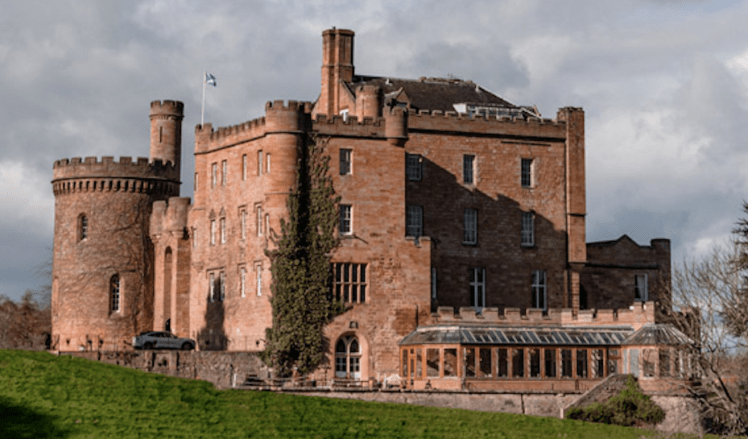
For over 800 years, Dalhousie Castle has witnessed triumphs and tragedies, battles and dungeons, and the enduring legacies of kings and queens . . .
Originally, guests would cross a drawbridge over a dry moat to enter. The moat remains today, and you can still see the holes from the drawbridge mechanisms and the machicolations castle guards would use to drop nasty surprises on invaders below. It’s safe to say, today’s visitors are greeted with a much warmer welcome.
Indeed it was. We were assigned the turreted Room 4, which required ascending multiple staircases. Unfortunately, on a trip to the London suburbs several days earlier, the Missus had suffered a severe ankle sprain while sprinting for a train. Regardless, she gamely – gam-ly? – soldiered up to the spectacular room.
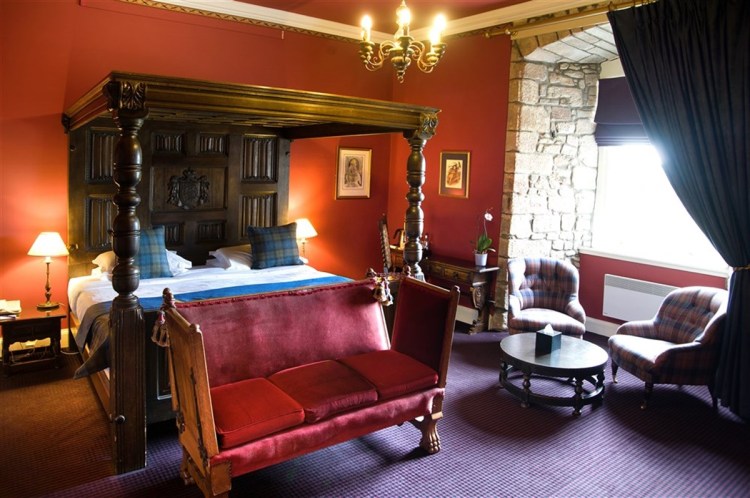
The rest of the hotel was equally dazzling. We sat in the (really) Great Room on a leather-bound sofa large enough that the Missus could stretch out from one end and I could stretch out from the other, and our feet didn’t touch.
The single malt Scotch I sipped on that sofa was equally memorable. As was the lavish dinner the Missus and I savored in the Dalhousie’s dungeon restaurant.
Other than that, our time in Scotland remains a bit hazy after all these years. But I do know we visited Edinburgh Castle, “the most besieged castle in Britain . . . attacked 23 times throughout history.”
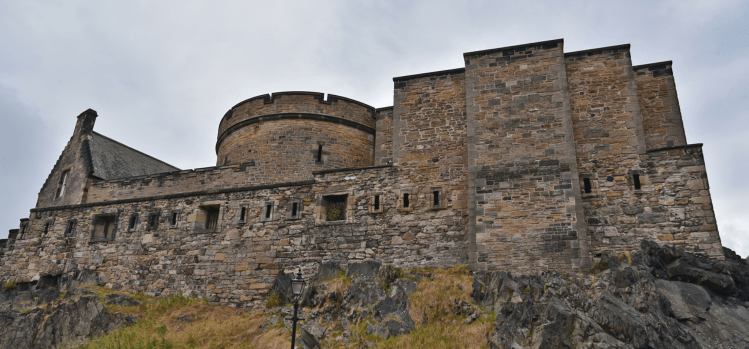
The fortification resides high atop Castle Rock, an extinct volcanic outcrop in the center of Edinburgh. Although the human occupation of Castle Rock dates back to the 2nd century, the oldest portion of the current structure exists from the 12th century during the reign of King David I. In 1093, his mother, Queen Margaret, died at the castle upon hearing her husband, King Malcolm III, was killed in battle. Thereafter, David built St. Margaret’s Chapel to honor his recently deceased mother.
Centuries of murder and mayhem ensued, much of which is detailed here, for those of you keeping score at home.
We also visited the Palace of Holyroodhouse, “the official residence of King Charles the 3rd when he is in Scotland,” although Chuckles was a mere monarch wannabe when we were there in the early ‘90s.
(QE II preferred Balmoral Castle for her Scottish stays, but then she always was more rugged than Sonny Boy.)
Lucky for Chucky, Holyrood has a far less bloody history than Edinburgh Castle.

The ruins still visible on the grounds were once an Augustinian Abbey ordered by King David I of Scotland. The name Holyrood comes from either the legendary vision of the cross witnessed by the King or from a relic of the True Cross, known as the Holy Rood.
After the Union of Scotland and England in 1707, the palace began to fall into disrepair. When Bonnie Prince Charlie moved into the palace, he chose the Duke’s apartments over the unkempt King’s. Neglect continued as the abbey church roof collapsed, leaving it as it currently stands.
George V transformed Holyroodhouse into a 20th-century palace with the installation of central heating and electric lighting, modernising the kitchens and fitting a lift. The palace was selected as the site of the Scottish National Memorial to Edward VII and formally designated as the monarch’s official residence in Scotland.
The Missus and I were especially taken by the Great Gallery, a grand room filled with 110 portraits of Scottish monarchs real and legendary, all created by Dutch artist Jacob de Wet.

(Here’s a quick walkthrough if you’re so inclined.)
We ventured outside of Edinburgh as well, first to the Firth of Forth – partly because it sounded cool, partly because it is cool (actually, frigid that day).
The UK site Cottages and Castles describes it this way.

The Firth of Forth is the estuary, or firth, of the River Forth and opens at the easternmost tip of Stirling, stretching out past Edinburgh and the Kingdom of Fife before connecting up with the North Sea.
It really is the gateway to the rest of Scotland, with its three iconic bridges that allow for easy transport links, and is a worthwhile destination in itself due to the rich history of its islands and the stunning vistas that the three bridges offer.
Those bridges include The Queensferry Crossing . . .

The Forth Road Bridge . . .

and The Forth Bridge.

Each an excellent bridge in its own right.
From the FofF we drove to Stirling Castle, which sits atop a volcanic crag, provides spectacular views of the surrounding countryside, and that day featured weather straight outta King Lear (Blow, winds, and crack your cheeks!).

Stirling Castle, historically and architecturally significant castle, mostly dating from 15th and 16th centuries, in Stirling, Scotland. Dominating major east–west and north–south routes, the fortress’s strategic importance gave it a key role in Scottish history. Standing 250 feet (75 m) higher than the surrounding terrain on the flat top of an ancient extinct volcano above the River Forth and commanding excellent views in every direction, it was the principal royal stronghold of the Stuart kings from the time of Robert II until the union of Scotland and England in 1707. Whoever held Stirling, it was said, had the key to Scotland.
Who had the key to Stirling Castle? Steward Brian Gibson, who worked at the historic site for 22 years, starting shortly after the Missus and I were there.
Here’s his guided tour of the castle, well worth four minutes out of your day.
Of course, we couldn’t depart Scotland without a nod to Greyfriars Bobby, the official Who’s a Good Boy of Edinburgh.
In 1850 a gardener called John Gray, together with his wife Jess and son John, arrived in Edinburgh. Unable to find work as a gardener he avoided the workhouse by joining the Edinburgh Police Force as a night watchman.
To keep him company through the long winter nights John took on a partner, a diminutive Skye Terrier, his ‘watchdog’ called Bobby. Together John and Bobby became a familiar sight trudging through the old cobbled streets of Edinburgh. Through thick and thin, winter and summer, they were faithful friends.
The years on the streets appear to have taken their toll on John, as he was treated by the Police Surgeon for tuberculosis.
John eventually died of the disease on the 15th February 1858 and was buried in Greyfriars Kirkyard. Bobby soon touched the hearts of the local residents when he refused to leave his master’s grave, even in the worst weather conditions.
According to legend, Bobby stood guard over his late master’s grave for 14 years. The headstone on the fountain erected in his memory reads “Greyfriars Bobby – died 14th January 1872 – aged 16 years – Let his loyalty and devotion be a lesson to us all.”
(Then again, not everyone is on board the Bobby Train. Killjoys can read all about Debunking the Myth of Greyfriars Bobby, if you like that sort of thing.)
After that, we took the high rode (a.k.a. British Air) back to Boston.
Postscript: While we were assembling this epilogue, the Missus and I learned of the death of the great travel guru, Arthur Frommer.
Paul Vitello’s New York Times obituary nicely captured Frommer’s underlying approach to visiting Europe when he published his first guidebook in 1957.
 To Mr. Frommer, travel wasn’t just about sightseeing in foreign places; it was about seeing those places on their own terms, removing the membrane that separated them from us. In short, it was about enlightenment. And with the affordability that he could guarantee, it was practically middle-class Americans’ democratic duty, to hear him tell it, to exercise their inalienable right to see London, Paris and Rome.
“This is a book,” he wrote, “for American tourists who a) own no oil wells in Texas, b) are unrelated to the Aga Khan, c) have never struck it rich in Las Vegas and who still want to enjoy a wonderful European vacation.”
The Hotel Booking Goddess found the Frommer’s guides to be an invaluable resource – but just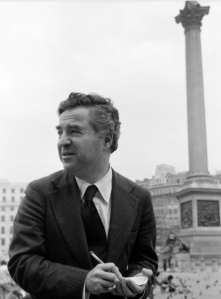 one of many. She grew up in New York, so “Trust but Verify” was a lifelong motto.
The Missus would prowl local bookstores for travel guides and take notes to compare ‘n’ contrast recommendations. She was, in short, the Human Search Engine That Could. (And did, as the previous posts so amply attest.)
Of all the sources the Missus consulted over the years, Frommer’s Travel Guides proved to be the most often verified and most often trustworthy.
Now the author of those guide books has traveled to his final destination. Rest in peace, Arthur Bernard Frommer. Here’s guessing you wound up in a very nice place.
 Travels With The Missus