-
Epilogue: Some Final Snapshots From Our Many Excellent Adventures
In the process of chronicling our four-plus decades of carefree rambles, the Missus and I have inevitably let some journeys slip through the cracks. So we’ll gather up a few of the leftovers before we say goodbye.
White Knuckles at the Grand Canyon
The Missus, in her entrepreneurial heyday, travelled all across this great land of ours for her many clients in the footwear and fashion industries, forecasting trends and previewing product lines.
From time to time I would join her in my capacity as Chairman of the Board (with, as you might recall, the major responsibility of schlepping luggage through airports both domestic and international).
One such occasion found us in Phoenix, Arizona in August, where the mercury soared to 104° – at night. Upon her successful completion of some sales meeting or other, the Missus and I set off to explore the many natural wonders of the Grand Canyon State.
Our first stop was scheduled to be Sedona, but an hour and a half into the drive we veered off at Montezuma Castle National Monument, home of “the well-preserved living spaces of the Sinagua Indians.”

Like an ancient five-story apartment building, Montezuma Castle towers above the desert below, a stone-and-mortar marvel of early architectural engineering. Experts have determined that the Castle was built over three centuries and provided shelter for the Sinagua Indians during flood seasons. However, contrary to the belief of the European-Americans who discovered the structure, there’s no historical connection to the Aztec emperor for whom it’s named—the structure was abandoned more than 40 years prior to his birth.
Right. So to recap: Not a castle, not Montezuma’s, and you couldn’t go inside. Other than that, it was swell . . . for about ten minutes. Unfortunately for the bus-tour folks standing alongside us (part of the “approximately 350,000 people per year [who] visit the Castle”), they were there for an hour. We, on the other hand, were on our merry way to Red Rock Country.
Upon arriving in Sedona (“Plan to stay more than a day”), we checked into the Matterhorn Motor Lodge (as it was called at the time) for one night. According to its website, “The Matterhorn Inn in Sedona, Arizona offers elegant accommodations with unparalleled views of the red rock mountains, all at budget-friendly rates.”
Half of that was true when we stayed there 30 years ago. On the one hand, elegant the Matterhorn Motor Lodge was not. Case in point: Despite the extreme heat, the pool area was entirely deserted, most likely because the pool itself was half filled with brownish, brackish water. I don’t even want to talk about the hot tub.
On the other hand, the place was budget-friendly. The Missus assured me we were paying far less than 50,000 kronkites for our room. After all, it wasn’t exactly the Schmatterhorn.
As for Sedona, it has a reputation as as a town suffused with a New Agey “vortex vibe,” as Dwight Garner noted in the New York Times some years ago.
There’s a vibe in the air, something not quite audible, a kind of metaphysical dog whistle that calls people out to have a look around and to try to feel something that, if you’re not a committed New-Age pilgrim, is hard to put into words . . .
Sedona is famous for its so-called vortex sites, spots where the earth’s energy is supposedly increased, leading to self-awareness and various kinds of healing. (Think of them as spiritual hot tubs without the water.)
In keeping with the whole vortex thing, we decided to take a Jeep tour of the fabled “red sandstone cliffs and giant red sandstone spires.” And lucky us: Our driver was not only straight out of central casting (Throwback Hippie, circa 1969), he was also – he announced as we set out – psychic and clairaudient (“the supposed faculty of perceiving, as if by hearing, what is inaudible”).
Oddly enough, though, he seemed entirely incapable of hearing the moans and groans of his passengers as the Jeep careened at teeth-rattling speeds across the rugged terrain.
Regardless, the landscape was indeed spectacular. As Dwight Garner wrote, “Nowhere else in this country does a natural setting feel so much like the inside of a soaring pantheistic cathedral.”

• • • • • • •
About hallway between Sedona and Grand Canyon National Park, the Missus and I rumbled into Bedrock City, the purported home of The Flintstones and the longtime home of Raptor Ranch, a tourist trap that can’t even spell its own catchphrase correctly. The current headline on Raptor Ranch’s website is “Yabadabaoo [sic]! Come and Celebrate 50 Years of Iconic Bedrock City,” although they did get the Yabbas right on their sign along the highway.
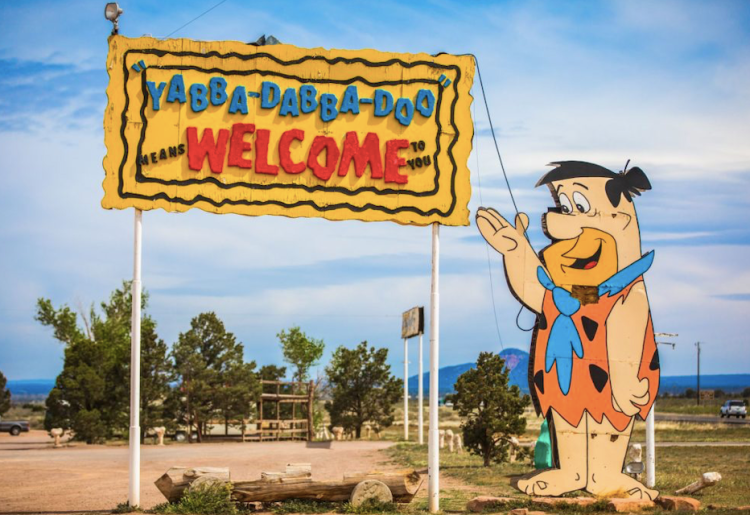
Unsurprisingly, we gave Bedrock the swift, cruising half an hour later into the National Park Service’s Kachina Lodge, which featured all the charm and ambiance of a 1960s cinder-block college dorm.
But, man, location location location.

Sitting directly on the rim of Grand Canyon in the center of the historic Village, this lodge is within close walking distance to restaurants, gifts shops, Kolb Studio, Verkamp’s Visitor Center, and Bright Angel Trailhead.
Kachina Lodge was built in 1968 as part of a plan by the National Park Service to expand services at parks across the country. The tiered design of Kachina Lodge mimics the uppermost layers of rock in Grand Canyon.
Next thing we knew, we ourselves were directly on the rim of the Grand Canyon, and – as I’m sure millions of gawkers have said before – grand doesn’t even come close to describing it.

Also like legions of others before us, we wanted to see the canyon up close. So bright and early the next morning, we headed down the nearest hiking trail. We’d gone maybe a third of a mile when we encountered a sign similar to this one.

We didn’t have to be told twice. As the Missus and I trudged back up the trail, we encountered several tourists striding briskly toward us.
“Hey, did you go all the way to the bottom?” one asked brightly.
“Oh yeah,” the Missus replied. “Don’t let the sign down there bother you.”
Mind you, the Missus was dressed entirely in white – someone alert Ripley’s, right? – without a speck of trail dirt on her. No sweat stains, either. Regardless, the group continued down as we proceeded up.
(Spoiler alert: They were back at the rim shortly after we were.)
Meanwhile, the Missus and I shifted to Plan B: An airplane tour of the Big Hole. Here’s a short promotional video for one of the canyon tours.
Full disclosure: The couple in the video is way calmer than the Missus and I were during our ride. I truly believe that somewhere in the skies above Arizona, there are two airplane seatbacks that still bear the impressions of our fingers tightly clutching them throughout the flight.
Laugh, clown, laugh. But not long after our Tour of Terror, there was this story in the Tampa Bay Times.
A tour plane carrying passengers over the Grand Canyon apparently lost an engine Monday and crashed while trying to return to the airport.
Eight of the 10 people on board were killed.
The PA-31 Navajo aircraft developed engine trouble shortly after liftoff Monday from Grand Canyon Airport and went down in a ravine as it returned for an emergency landing, said FAA spokesman Fred O’Donnell.
Over all, we were more than happy to drive back to Phoenix.
In yet another personal and professional triumph, the Hotel Booking Goddess had snagged a room at the legendary Frank Lloyd Wright-designed Arizona Biltmore – for $85 per night, a steal even back then.

On February 23, 1929 the Arizona Biltmore opened in grand fashion. Over 600 invitations were sent out, with the thought of only a few hundred attending, but it seemed no one wanted to be left out and the resort had to re-create the opening gala three days in a row to accommodate all 600 people. From that day forward, the Arizona Biltmore has been a private retreat for some of the most influential powerhouses of the time.
“Influential powerhouses” decidedly did not describe the two of us at the time, but we strolled around the place like we owned it nonetheless.
One example of our devil-may-care attitude: Despite the strict prohibition against cutoff jeans in the pool area, I wore mine anyway. For one thing, I didn’t have any other shorts with me; for another, lots of people poolside wore next to nothing, so my transgression went largely unnoticed.
Phoenix wasn’t much of a museum town back then, but we did trundle over to the Heard Museum, “recognized internationally for the quality of its collections [of American Indian art], world class exhibitions, educational programming and unmatched festivals.”
Such as the Hopi Indian Festival, which we found to be aptly named, since it featured exactly one Hopi Indian.
“It’s a corker!” the pleasant white-haired gal at the ticket counter told us, by which of course she meant he’s a corker.
And he sort of was. But no matter – all in all, our Arizona trip was a total hoot.
Postscript: As we traversed the great state of Arizona, we also encountered two of its three major sinkholes back then. These days, apparently, there are a lot more.
Hip Hip . . . Replacement!
The first time the Missus went to England to check out the European fabric shows and divine coming color trends for her footwear clients, I wound up – in a one-time only event – doing a bit of business there myself.
I was preparing to assume my assigned role of corporate arm candy/airport skycap on the trip, when my penny-pinching boss at the ad agency I worked for said, “Say, since you’re going to be in London anyway, you should pop by our client’s headquarters there to generate some good will and collect a few invoice payments.”
I quickly pointed out that our improbable international client – Charnley Limited, founded by John Charnley, the inventor of the modern hip replacement – was headquartered in the city of Leeds, a good four-hour drive from London.
“Excellent,” he replied briskly. “You can take in the countryside along the way.”
So it was that early one morning the Missus and I piled into a rental car and headed toward Leeds. We exited London via the Uxbridge Road, about which I remember two things: 1) The road’s name changed every few miles, making us think we were lost for the first 45 minutes of the trip; and 2) The road took us through the heart of Brixton, which was experiencing one of its periodic race riots protesting police brutality
Other than that, a smooth ride with some lovely countryside along the way.
Here’s the backstory on John Charnley, the company’s namesake, compliments of Yale University Library.
Surgeons’ efforts before the 1960s laid the groundwork for Sir John Charnley to develop his
 revolutionary low-friction arthroplasty of the hip. His procedure was the first to consistently achieve predictable and positive outcomes due to the incorporation of a reliable socket replacement. Dr. Charnley’s novel total hip replacement combined a small femoral head in a molded plastic socket with both of these prosthetic components secured in position by fast-setting bone cement. The immediate clinical success of his arthroplasty rapidly became the new gold standard for hip replacement surgery.
 Coincidentally, the year before our trip to Leeds, Sammy Davis Jr. had undergone a hip
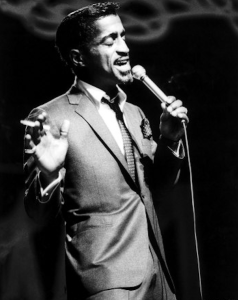 replacement – a Charnley hip, as it happened. So I decided, in all my marketing wisdom, to make an impromptu pitch to the company’s executives in our meeting.
“How about,” I said brightly, “if we get Sammy Davis Jr. to endorse the Charnley replacement, given that he’s got one. We could feature him in an ad with the tagline “The Hip Hip.”
When that failed to get any “hoorays” from the stone-faced execs, I said, “Do you know who Sammy Davis Jr. is?”
One of the underlings hovering in the background quickly handed me a couple of checks and showed me the door. And that was the end of the Great Lost Hip Hip advertising campaign. Also the end of that client for my two-pence ad agency.
The end of Charnley Limited, on the other hand, came 30 years later, when the company was declared insolvent. I’m not saying Sammy Davis Jr. could have forestalled that fate, but you never know, right?
• • • • • • •
On our way back to London, the Missus and I decided to stop off at Warwick Castle, “the finest medieval castle in England” according to this UK advert that was on TV at the time.
Narrator: “If you’ve never seen the Great Wall of China, or journeyed up the Amazon, that’s understandable. But if you live in the heart of England and haven’t seen the splendors of Warwick Castle, well . . . Towering ramparts, breathtaking views, priceless historical treasures, and the unique weekend royal party by Madame Tussaud’s. This is what visitors come thousands of miles to see.”
That was me and the Missus! When we arrived at Warwick Castle, we were the only ones there, except for (wait – what?) the Bishop of Warwick. His name was Keith Arnold, “an English Anglican clergyman who served as the inaugural Bishop of Warwick from 1980 to 1990.”
Why he was roaming around an empty castle on a weekday afternoon is anyone’s guess. But he was extremely cordial to us, so that was lovely.
(Travel Advisory: In the intervening 40 years, Warwick Castle has apparently been turned into a tourist trap that doesn’t quite rival Bedrock’s Raptor Ranch, but seems to be trending in that direction.)
After bidding the bishop goodbye, the Missus and I drove back to London. And then we flew back home.
And We’ll Be in Scotland Afore Ye (Know It)
During one of our myriad sallies to London for the Missus to ferret out future American fashion trends, we nipped up to Scotland for a few carefree days in the great city of Edinburgh.
Once again the Hotel Booking Goddess outdid herself, putting us up at the Dalhousie Castle Hotel, “where history meets modern luxury.”

For over 800 years, Dalhousie Castle has witnessed triumphs and tragedies, battles and dungeons, and the enduring legacies of kings and queens . . .
Originally, guests would cross a drawbridge over a dry moat to enter. The moat remains today, and you can still see the holes from the drawbridge mechanisms and the machicolations castle guards would use to drop nasty surprises on invaders below. It’s safe to say, today’s visitors are greeted with a much warmer welcome.
Indeed it was. We were assigned the turreted Room 4, which required ascending multiple staircases. Unfortunately, on a trip to the London suburbs several days earlier, the Missus had suffered a severe ankle sprain while sprinting for a train. Regardless, she gamely – gam-ly? – soldiered up to the spectacular room.
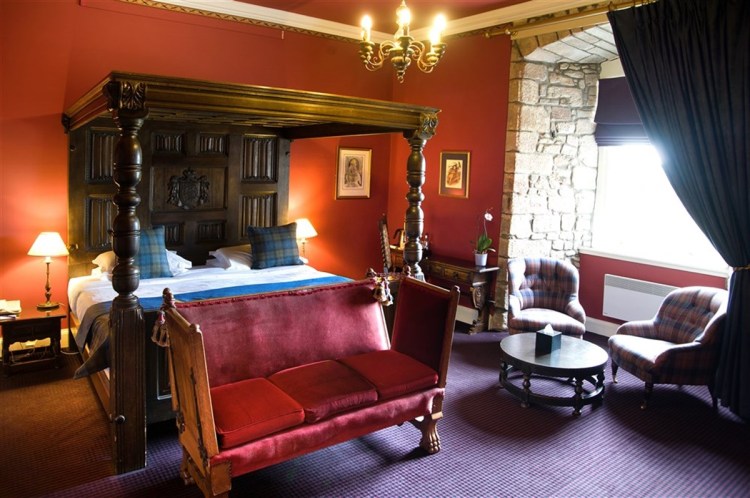
The rest of the hotel was equally dazzling. We sat in the (really) Great Room on a leather-bound sofa large enough that the Missus could stretch out from one end and I could stretch out from the other, and our feet didn’t touch.
The single malt Scotch I sipped on that sofa was equally memorable. As was the lavish dinner the Missus and I savored in the Dalhousie’s dungeon restaurant.
Other than that, our time in Scotland remains a bit hazy after all these years. But I do know we visited Edinburgh Castle, “the most besieged castle in Britain . . . attacked 23 times throughout history.”
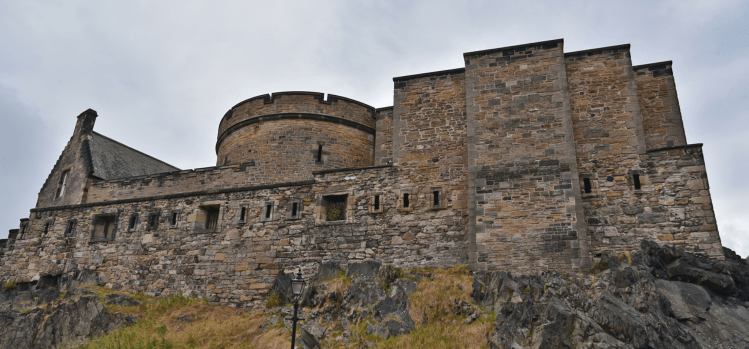
The fortification resides high atop Castle Rock, an extinct volcanic outcrop in the center of Edinburgh. Although the human occupation of Castle Rock dates back to the 2nd century, the oldest portion of the current structure exists from the 12th century during the reign of King David I. In 1093, his mother, Queen Margaret, died at the castle upon hearing her husband, King Malcolm III, was killed in battle. Thereafter, David built St. Margaret’s Chapel to honor his recently deceased mother.
Centuries of murder and mayhem ensued, much of which is detailed here, for those of you keeping score at home.
We also visited the Palace of Holyroodhouse, “the official residence of King Charles the 3rd when he is in Scotland,” although Chuckles was a mere monarch wannabe when we were there in the early ‘90s.
(QE II preferred Balmoral Castle for her Scottish stays, but then she always was more rugged than Sonny Boy.)
Lucky for Chucky, Holyrood has a far less bloody history than Edinburgh Castle.

The ruins still visible on the grounds were once an Augustinian Abbey ordered by King David I of Scotland. The name Holyrood comes from either the legendary vision of the cross witnessed by the King or from a relic of the True Cross, known as the Holy Rood.
After the Union of Scotland and England in 1707, the palace began to fall into disrepair. When Bonnie Prince Charlie moved into the palace, he chose the Duke’s apartments over the unkempt King’s. Neglect continued as the abbey church roof collapsed, leaving it as it currently stands.
George V transformed Holyroodhouse into a 20th-century palace with the installation of central heating and electric lighting, modernising the kitchens and fitting a lift. The palace was selected as the site of the Scottish National Memorial to Edward VII and formally designated as the monarch’s official residence in Scotland.
The Missus and I were especially taken by the Great Gallery, a grand room filled with 110 portraits of Scottish monarchs real and legendary, all created by Dutch artist Jacob de Wet.

(Here’s a quick walkthrough if you’re so inclined.)
We ventured outside of Edinburgh as well, first to the Firth of Forth – partly because it sounded cool, partly because it is cool (actually, frigid that day).
The UK site Cottages and Castles describes it this way.

The Firth of Forth is the estuary, or firth, of the River Forth and opens at the easternmost tip of Stirling, stretching out past Edinburgh and the Kingdom of Fife before connecting up with the North Sea.
It really is the gateway to the rest of Scotland, with its three iconic bridges that allow for easy transport links, and is a worthwhile destination in itself due to the rich history of its islands and the stunning vistas that the three bridges offer.
Those bridges include The Queensferry Crossing . . .

The Forth Road Bridge . . .

and The Forth Bridge.

Each an excellent bridge in its own right.
From the FofF we drove to Stirling Castle, which sits atop a volcanic crag, provides spectacular views of the surrounding countryside, and that day featured weather straight outta King Lear (Blow, winds, and crack your cheeks!).

Stirling Castle, historically and architecturally significant castle, mostly dating from 15th and 16th centuries, in Stirling, Scotland. Dominating major east–west and north–south routes, the fortress’s strategic importance gave it a key role in Scottish history. Standing 250 feet (75 m) higher than the surrounding terrain on the flat top of an ancient extinct volcano above the River Forth and commanding excellent views in every direction, it was the principal royal stronghold of the Stuart kings from the time of Robert II until the union of Scotland and England in 1707. Whoever held Stirling, it was said, had the key to Scotland.
Who had the key to Stirling Castle? Steward Brian Gibson, who worked at the historic site for 22 years, starting shortly after the Missus and I were there.
Here’s his guided tour of the castle, well worth four minutes out of your day.
Of course, we couldn’t depart Scotland without a nod to Greyfriars Bobby, the official Who’s a Good Boy of Edinburgh.
In 1850 a gardener called John Gray, together with his wife Jess and son John, arrived in Edinburgh. Unable to find work as a gardener he avoided the workhouse by joining the Edinburgh Police Force as a night watchman.

To keep him company through the long winter nights John took on a partner, a diminutive Skye Terrier, his ‘watchdog’ called Bobby. Together John and Bobby became a familiar sight trudging through the old cobbled streets of Edinburgh. Through thick and thin, winter and summer, they were faithful friends.
The years on the streets appear to have taken their toll on John, as he was treated by the Police Surgeon for tuberculosis.
John eventually died of the disease on the 15th February 1858 and was buried in Greyfriars Kirkyard. Bobby soon touched the hearts of the local residents when he refused to leave his master’s grave, even in the worst weather conditions.
According to legend, Bobby stood guard over his late master’s grave for 14 years. The headstone on the fountain erected in his memory reads “Greyfriars Bobby – died 14th January 1872 – aged 16 years – Let his loyalty and devotion be a lesson to us all.”
(Then again, not everyone is on board the Bobby Train. Killjoys can read all about Debunking the Myth of Greyfriars Bobby, if you like that sort of thing.)
After that, we took the high rode (a.k.a. British Air) back to Boston.
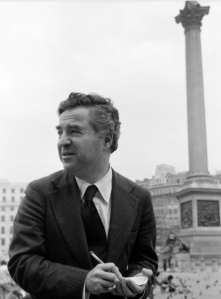
Postscript: While we were assembling this epilogue, the Missus and I learned of the death of the great travel guru, Arthur Frommer.
Paul Vitello’s New York Times obituary nicely captured Frommer’s underlying approach to visiting Europe when he published his first guidebook in 1957.
 To Mr. Frommer, travel wasn’t just about sightseeing in foreign places; it was about seeing those places on their own terms, removing the membrane that separated them from us. In short, it was about enlightenment. And with the affordability that he could guarantee, it was practically middle-class Americans’ democratic duty, to hear him tell it, to exercise their inalienable right to see London, Paris and Rome.
“This is a book,” he wrote, “for American tourists who a) own no oil wells in Texas, b) are unrelated to the Aga Khan, c) have never struck it rich in Las Vegas and who still want to enjoy a wonderful European vacation.”
The Hotel Booking Goddess found the Frommer’s guides to be an invaluable resource – but just
 one of many. She grew up in New York, so “Trust but Verify” was a lifelong motto.
The Missus would prowl local bookstores for travel guides and take notes to compare ‘n’ contrast recommendations. She was, in short, the Human Search Engine That Could. (And did, as the previous posts so amply attest.)
Of all the sources the Missus consulted over the years, Frommer’s Travel Guides proved to be the most often verified and most often trustworthy.
Now the author of those guide books has traveled to his final destination. Rest in peace, Arthur Bernard Frommer. Here’s guessing you wound up in a very nice place.
-
The Arts Seen in New York City (Act Three)
When the Missus and I finally got back to the city in March of 2018, our first stop was the Whitney Museum to catch Grant Wood: American Gothic and Other Fables. As I noted back then, here’s what 99% of the people who know about Grant Wood, know about Grant Wood.
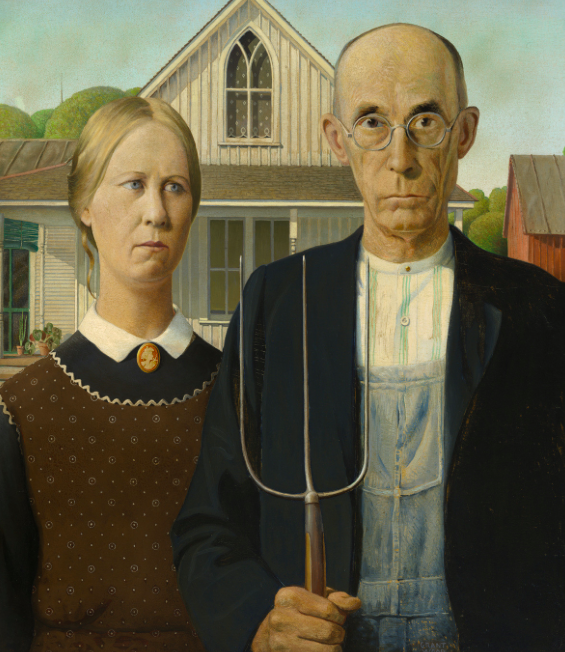
As the Whitney exhibit illustrated, though, there’s more to the artist than one painting of what’s routinely referred to as a Midwestern couple but was really meant to depict a father and daughter (in real life it was Wood’s sister and his dentist).
Grant Wood’s American Gothic—the double portrait of a pitchfork-wielding farmer and a woman commonly presumed to be his wife—is perhaps the most recognizable painting in 20th century American art, an indelible icon of Americana, and certainly Wood’s most famous
 artwork. But Wood’s career consists of far more than one single painting. Grant Wood: American Gothic and Other Fables brings together the full range of his art, from his early Arts and Crafts decorative objects and Impressionist oils through his mature paintings, murals, and book illustrations. The exhibition reveals a complex, sophisticated artist whose image as a farmer-painter was as mythical as the fables he depicted in his art. Wood sought pictorially to fashion a world of harmony and prosperity that would answer America’s need for reassurance at a time of economic and social upheaval occasioned by the Depression. Yet underneath its bucolic exterior, his art reflects the anxiety of being an artist and a deeply repressed homosexual in the Midwest in the 1930s. By depicting his subconscious anxieties through populist images of rural America, Wood crafted images that speak both to American identity and to the estrangement and isolation of modern life.
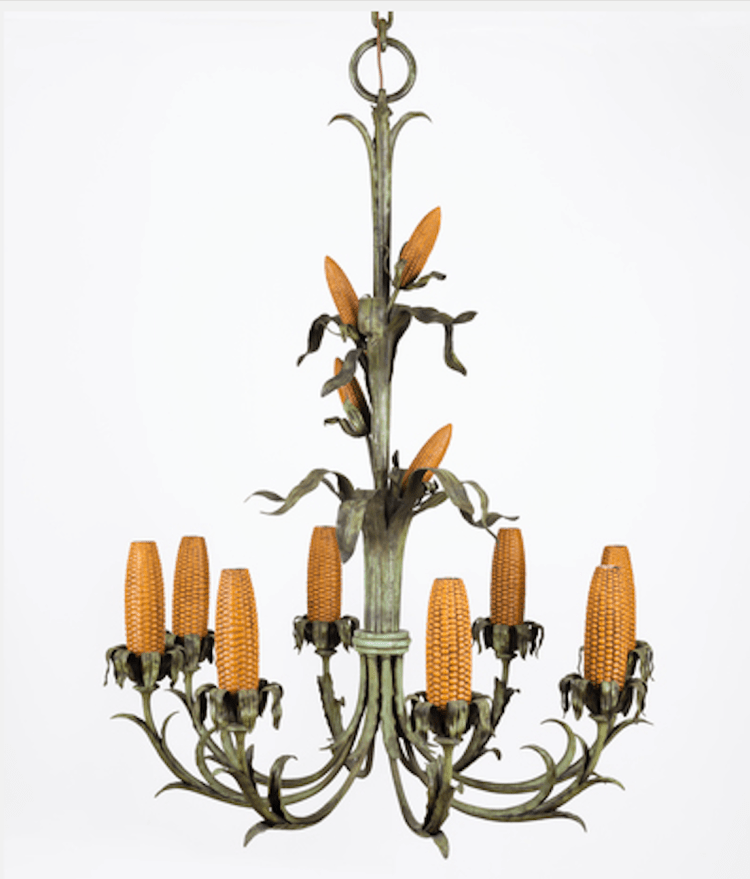
You’ll find lots more of Wood’s work – from decorative arts to drawing to murals and more – here. The Missus and I kind of liked this admittedly corny chandelier he designed for a number of hotels . . .
. . . and got a kick out of his Lilies of the Alley series.

The New Yorker’s Peter Schjeldahl, for his part, was far less kind.
[Wood] was a strange man who made occasionally impressive, predominantly weird, sometimes god-awful art in thrall to a programmatic sense of mission: to exalt rural America in a manner adapted from Flemish Old Masters. “American Gothic”. . . made Wood, at the onset of his maturity as an artist, a national celebrity, and the attendant pressures pretty well wrecked him. I came away from the show with a sense of waste and sadness.
To each his own Grant Wood, yeah?
From there the Missus and I moseyed up to The Museum at FIT, which featured Norell: Dean of American Fashion, a smart retrospective tracing the career of Norman Norell, “one of the greatest fashion designers of the mid-twentieth century . . . best remembered for redefining sleek, sophisticated, American glamour.”
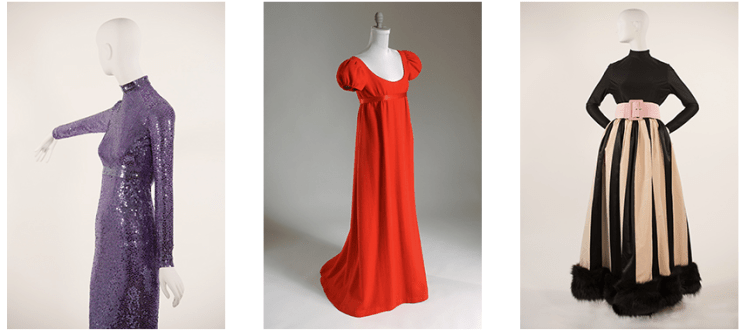
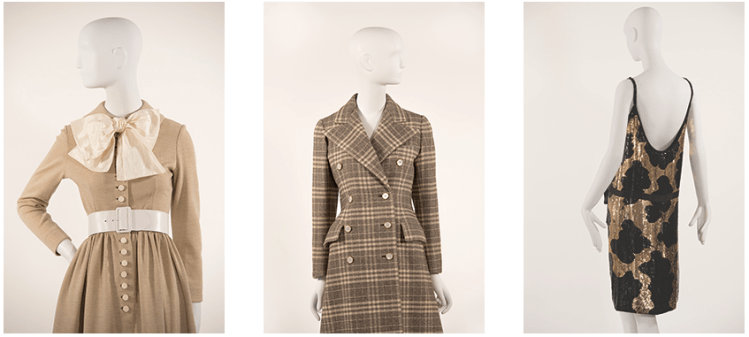
Very glamourous, indeed.
Less glam but more fun was Pockets to Purses: Fashion + Function. Our favorite was this Rod Keenan chapeau from 2006.
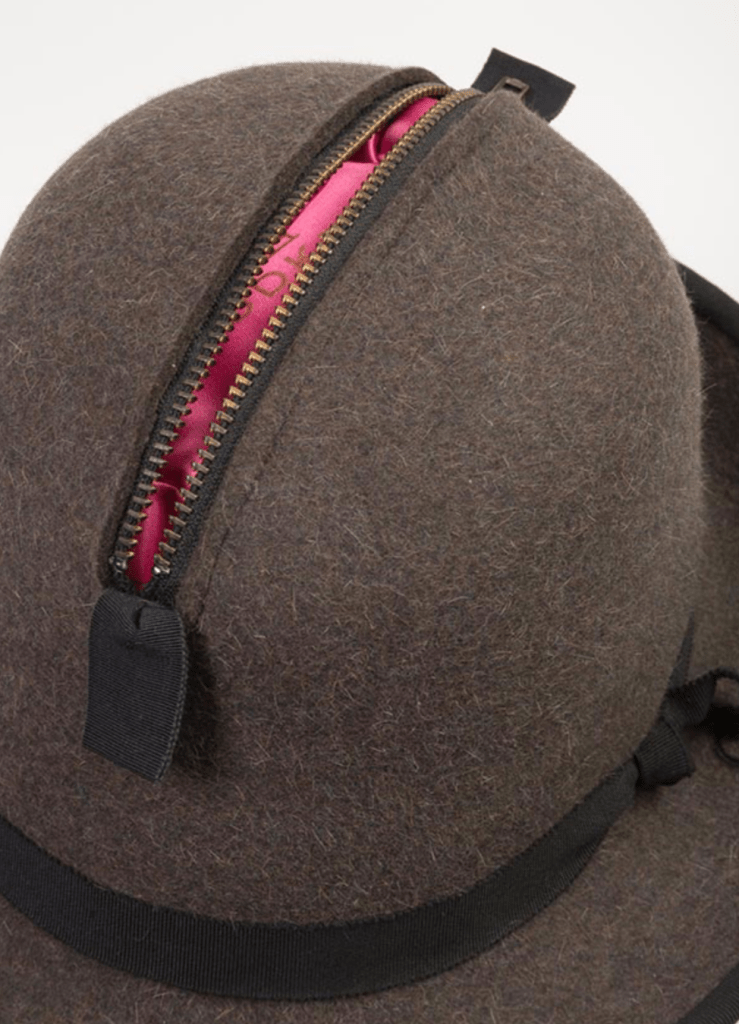
A whole new way to keep something under your hat, yes?
The next morning we embarked on a Backward Museum Mile, starting at the Museum of the City of New York and working our way south. We took the bus up Madison to 103rd Street, which was a first for me: Growing up at 89th & Third during the ’50s and ’60s, I’d been repeatedly warned never to set foot north of 96th Street, where the Upper East Side turned, well, less upper.
Times do change, don’t they.
Coincidentally, the main exhibit at MCNY was Mod New York: Fashion Takes a Trip.

The world of fashion was turned on its head in the 1960s, as its traditions were challenged, rejected, and reimagined for the restless next generation. Beginning with the introduction of First Lady Jacqueline Kennedy as a new American style icon and evolving over the course of the decade, fashions of the 1960s were legendary for their energy, their ingenuity, and their enduring appeal. Their influence was far-reaching—many of the era’s defining styles have been invoked by new generations of designers. Yet the scope of the decade’s trends far exceeds its iconic miniskirt, color-block dress, or bohemian spirit. Mod New York: Fashion Takes a Trip explores the full arc of 1960s fashion, shedding new light on a period marked by tremendous and daring stylistic diversity.
Here’s a solid flashback to the Mod squad.
New York on Ice: Skating in the City was also a delightful trip down Memory Lane, while New York Silver, Then and Now was, well, sterling.
From MCNY we dropped down to the Jewish Museum for Veiled Meanings: Fashioning Jewish Dress, from the Collection of The Israel Museum, Jerusalem, which frankly I didn’t get because I have a goyishe kop. But I totally got Scenes from the Collection, “a new, major exhibition of the Jewish Museum’s unparalleled collection featuring nearly 600 works from antiquities to contemporary art — many of which will be on view for the first time.”
Among those works were Mel Bochner’s The Joys of Yiddish . . .
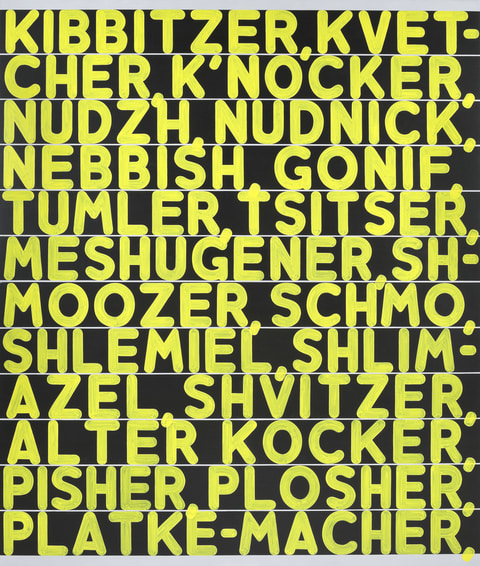
. . . and Louise Nevelson’s Self-Portrait.

L’Chaim!
From there it was on to the Neue Galerie for Before the Fall: German and Austrian Art of the 1930s.
This exhibition, comprised of nearly 150 paintings and works on paper, will trace the many routes traveled by German and Austrian artists and will demonstrate the artistic developments that foreshadowed, reflected, and accompanied the beginning of World War II. Central topics of the exhibition will be the reaction of the artists towards their historical circumstances, the development of style with regard to the appropriation of various artistic idioms, the personal fate of artists, and major political events that shaped the era.
Such as Mother and Eva by Otto Dix . . .

. . . and Striding by Rudolf Dischinger.
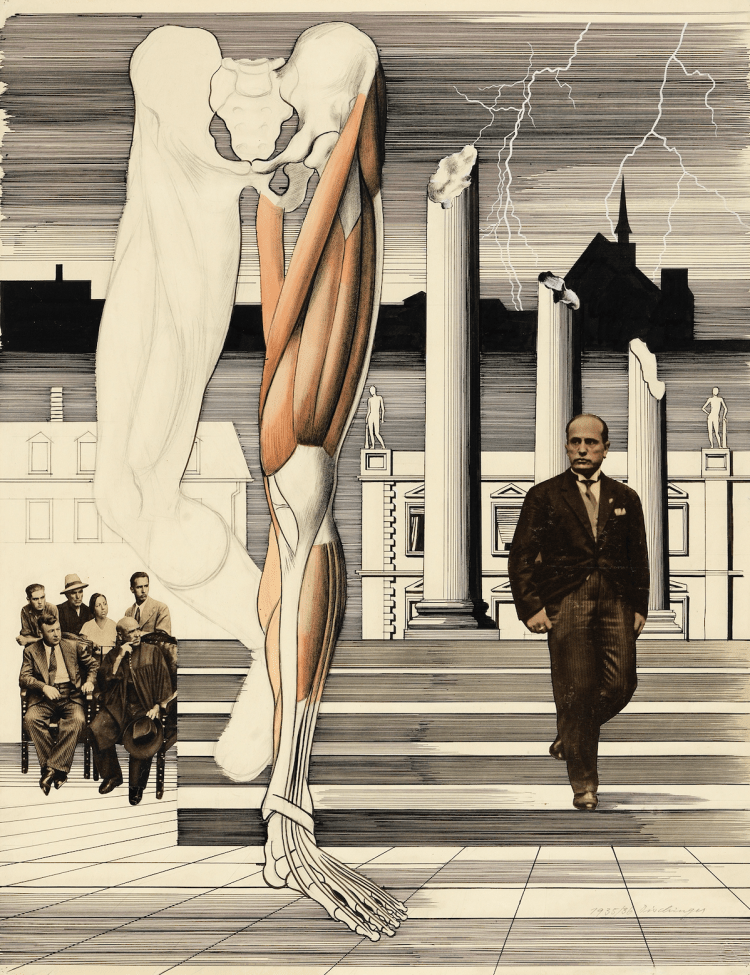
The Missus: “As someone who loves German Expressionism, I think this exhibit is creepy and not very good.”
Ditto.
So we moved on to The Met, where we made a beeline for Birds of a Feather: Joseph Cornell’s Homage to Juan Gris – “18 boxes, two collages, and one sand tray created in homage to Juan Gris, whom [Cornell] called a ‘warm fraternal spirit’.”
What jump-started that brotherly love was the Spanish cubist’s distinctive 1914 collage, The Man at the Café.

The Man at the Café is the largest collage by Gris, and the only one to feature a human figure. Inspired by the fictional criminal mastermind Fantômas, popular in serial novels and silent films, Gris humorously captured a shady character hiding his face, his fedora casting an ominous shadow. The newspaper article, cut and pasted from Le Matin, reads, “One will no longer be able to make fake works of art,” although Gris himself attempted to trick the eye with the wood-grain paneling of the café interior.
In Cornell’s Homage to Juan Gris four decades later, “the black cutout, though split midway (a classic Gris maneuver), becomes more bottle than bird. As in many of the boxes [in the series], a real piece of wood serves as the bird’s perch, which sits, Cubist style, on a round table indicated by the wood-grain printed paper.”

You can find other works from the series here.
Also at The Met were Golden Kingdoms: Luxury and Legacy in the Ancient Americas, which was quite exhaustive, and Quicksilver Brilliance: Adolf de Meyer Photographs, which was quite fantastic.

A member of the “international set” in fin-de-siècle Europe, Baron Adolf de Meyer (1868–1946) was also a pioneering photographer, known for creating works that transformed reality into a beautiful fantasy. Quicksilver Brilliance is the first museum exhibition devoted to the artist in more than twenty years and the first ever at The Met. Some forty works, drawn entirely from The Met collection, demonstrate the impressive breadth of his career.
Public Parks, Private Gardens: Paris to Provence provided a placid finish to our Met meander.
Drawn from seven curatorial departments at The Met and supplemented by a selection of private collection loans, Public Parks, Private Gardens: Paris to Provence features some 150 works by more than 70 artists, spanning the late eighteenth through early twentieth century. Anchored by Impressionist scenes of outdoor leisure, the presentation offers a fresh, multisided perspective on best-known and hidden treasures housed in a Museum that took root in a park: namely, New York’s Central Park, which was designed in the spirit of Parisian public parks of the same period.
Those works in the exhibit included Claude Monet’s capture of Parc Monceau, one of our favorite spots in Paris.

On the way back to Boston we swung by Hartford’s Wadsworth Atheneum to catch Gorey’s Worlds, which was “centered on his personal art collection, which he chose to bequeath to the Wadsworth Atheneum Museum of Art, the only public institution to receive his legacy.”
The collection was personal, all right, and entirely peculiar, as you would expect. Just as Gorey “frequently stopped in Hartford when traveling between the city and his Cape Cod house in Yarmouth Port,” the Missus and I also frequently found the Wadsworth Atheneum a welcome pit stop as we wended our way homeward.
• • • • • • •
When we returned to the city in September, the main event was Heavenly Bodies: Fashion and the Catholic Imagination at The Met.
The Costume Institute’s spring 2018 exhibition—at The Met Fifth Avenue and The Met Cloisters—features a dialogue between fashion and medieval art from The Met collection to examine fashion’s ongoing engagement with the devotional practices and traditions of Catholicism.
Serving as the cornerstone of the exhibition, papal robes and accessories from the Sistine Chapel sacristy, many of which have never been seen outside The Vatican, are on view in the Anna Wintour Costume Center. Fashions from the early twentieth century to the present are shown in the Byzantine and medieval galleries, part of the Robert Lehman Wing, and at The Met Cloisters.
In other words, all over the place.
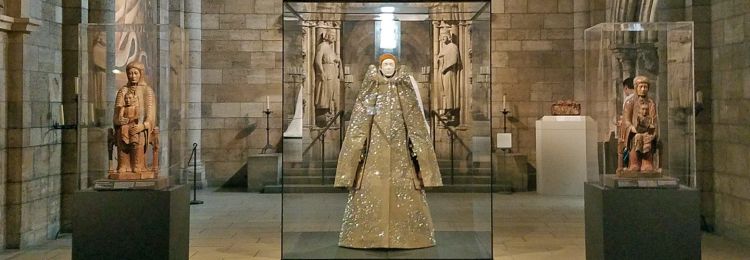
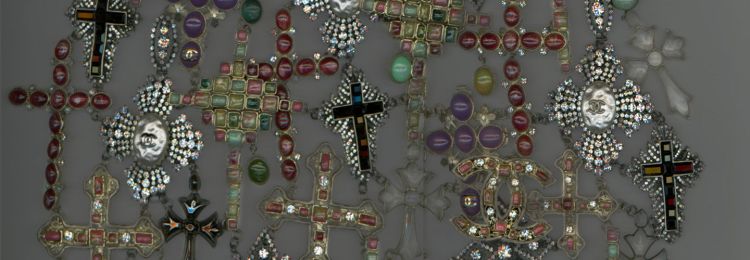
The Met’s time-lapse video of the show’s installation is lots of fun, while this video provides a good overview of the exhibit.
As the Missus said, one of the best things about the exhibition was that it made us look more closely at the amazing work in the medieval gallery, a place we normally breeze through on the way to The Met cafeteria.
Unfortunately, we couldn’t say the same for many of the other works because their display was too, well, elevated. In a review of the exhibit on her CultureGrrl blog, Lee Rosenbaum wrote, “no one can properly see the fashion designers’ intricate creations, installed high above eye level for dramatic effect and to facilitate visitor flow. The sprawling installation, in multiple galleries at both the Met Fifth Avenue and the Cloisters, is a neck-craning experience . . .”
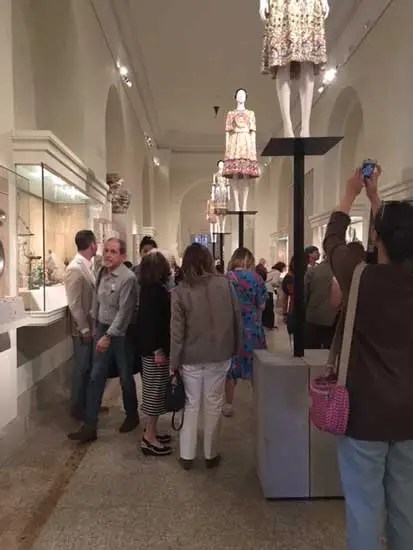
True enough. More down-to-earth, though, was the exhibit Visitors to Versailles.

Bringing together works from The Met, the Château de Versailles, and over fifty lenders, this exhibition highlights the experiences of travelers from 1682, when Louis XIV moved his court to Versailles, to 1789, when the royal family was forced to leave the palace and return to Paris. Through paintings, portraits, furniture, tapestries, carpets, costumes, porcelain, sculpture, arms and armor, and guidebooks, the exhibition illustrates what visitors encountered at court, what kind of welcome and access to the palace they received, and, most importantly, what impressions, gifts, and souvenirs they took home with them.
Most of the exhibit was, as the barkers say about every artwork at Paris bazaars, très jolie, très très charmante, avec beaucoup d’atmosphere.
From there we moseyed up to the Museum of the City of New York to view Through a Different Lens: Stanley Kubrick Photographs.
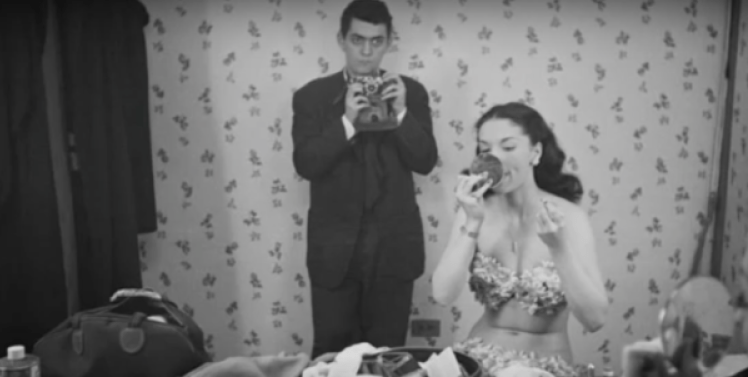
Stanley Kubrick was just 17 when he sold his first photograph to the pictorial magazine Look in 1945. In his photographs, many unpublished, Kubrick trained the camera on his native city, drawing inspiration from the nightclubs, street scenes, and sporting events that made up his first assignments, and capturing the pathos of ordinary life with a sophistication that belied his young age. Through a Different Lens: Stanley Kubrick Photographs features more than 120 photographs by Kubrick from the Museum’s Look magazine archive, along with vintage Look magazines in which many of the photographs were published. Through a Different Lens evokes the grit, glamor, and resilience of New York City, while telling the story of how a young amateur photographer from the Bronx took his first steps toward becoming one of the most important and influential film directors of the twentieth century.
The exhibit highlights a number of other stories as well.

There’s a great anecdote about Kubrick Riding the Subway.
“I wanted to retain the mood of the subway, so I used natural light,” he said. People who ride the subway late at night are less inhibited than those who ride by day. Couples make love openly, drunks sleep on the floor and other unusual activities take place late at night. To make pictures in the off-guard manner he wanted to, Kubrick rode the subway for two weeks. Half of his riding was done between midnight and six a.m. Regardless of what he saw he couldn’t shoot until the car stopped in a station because of the motion and vibration of the moving train. Often, just as he was ready to shoot, someone walked in front of the camera, or his subject left the train.
Kubrick finally did get his pictures, and no one but a subway guard seemed to mind. The guard demanded to know what was going on. Kubrick told him
“Have you got permission?” the guard asked.
“I’m from LOOK,” Kubrick answered.
“Yeah, sonny,” was the guard’s reply, “and I’m the society editor of the Daily Worker.”
From there we hoofed it down to the Met Breuer, although in the end we sort of wished we hadn’t. The main exhibit was Like Life: Sculpture, Color, and the Body, which purported to “explores narratives of sculpture in which artists have sought to replicate the literal, living presence of the human body,” but was just kind of bizarre and creepy. Obsessions: Nudes by Klimt, Schiele, and Picasso, on the other hand, was just meh.
So we shuttled crosstown to the New-York Historical Society, whose numerous attractions started with Summer of Magic: Treasures from the David Copperfield Collection , which included “iconic objects used by Harry Houdini, and . . . the Death Saw from one of Copperfield’s most famous illusions!”
Also quite magical was the newly installed Gallery of Tiffany Lamps, an exhibit that is totally eye-popping.

As the centerpiece of the 4th floor, the Gallery of Tiffany Lamps features 100 illuminated Tiffany lamps from our spectacular collection, displayed within a dramatically lit jewel-like space. Regarded as one of the world’s largest and most encyclopedic, the Museum’s Tiffany Lamp collection includes multiple examples of the Dragonfly shade, a unique Dogwood floor lamp (ca. 1900–06), a Wisteria table lamp (ca. 1901), and a rare, elaborate Cobweb shade on a Narcissus mosaic base (ca. 1902), among many others.
The hidden history behind the lamps offers a fascinating look at the contributions of women
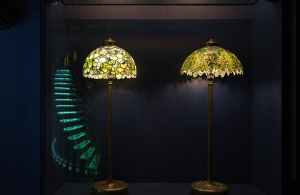 in the creation of this art. Louis C. Tiffany (1848–1933) was the artistic genius behind Tiffany Studios. However, he was not the exclusive designer of its lamps, windows, and luxury objects: Clara Driscoll (1861–1944), head of the Women’s Glass Cutting Department from 1892 to 1909, has recently been revealed as the designer of many of the firm’s leaded glass shades. Driscoll and her staff, self-styled the “Tiffany Girls,” labored in anonymity but were well compensated. Driscoll’s weekly salary of $35 was on par with that of Tiffany’s male designers, a reflection of his regard for her abilities. The lamps in this exhibition reflect the prodigious talent of designers and artisans who worked in anonymity to fulfill Tiffany’s aesthetic vision.
Also at NYHS: an exhibit Celebrating Bill Cunningham, the legendary New York Times photographer, and a kicky Walk This Way: Footwear from the Stuart Weitzman Collection of Historic Shoes.
Then we walked back to our hotel.
The next morning we started at The Morgan Library & Museum, which featured The Magic of Handwriting: The Pedro Corrêa do Lago Collection.

For nearly half a century, Brazilian author and publisher Pedro Corrêa do Lago has been assembling one of the most comprehensive autograph collections of our age, acquiring thousands of handwritten letters, manuscripts, and musical compositions as well as inscribed photographs, drawings, and documents. This exhibition—the first to be drawn from his extraordinary collection—features some 140 items, including letters by Lucrezia Borgia, Vincent van Gogh, and Emily Dickinson, annotated sketches by Michelangelo, Jean Cocteau, and Charlie Chaplin, and manuscripts by Giacomo Puccini, Jorge Luis Borges, and Marcel Proust.
Here’s a totally engrossing video about the exhibit.
It was great to be there so early – the place was empty and quiet and we got to read almost all the manuscripts in Corrêa do Lago’s staggering collection.
From there we drifted up to MoMA to catch Constantin Brâncuși Sculpture, which “celebrates MoMA’s extraordinary holdings—11 sculptures by Brâncuși will be shown together for the first time, alongside drawings, photographs, and films.” Extraordinarily swell.
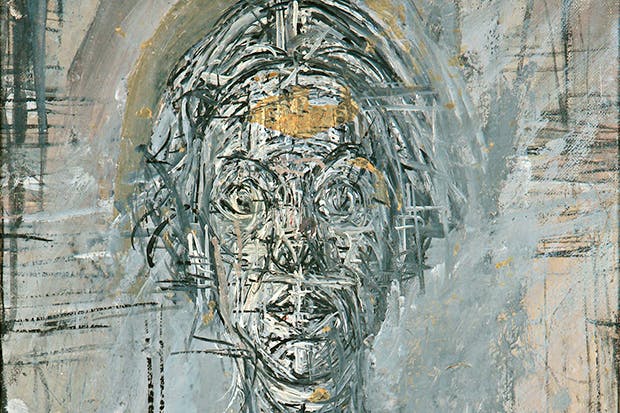
As was the Guggenheim’s exhibit of fellow sculptor Alberto Giacometti.

A preeminent artist of the twentieth century, Alberto Giacometti (1901–1966) investigated the human figure for more than forty years. This comprehensive exhibition, a collaboration with the Fondation Giacometti in Paris, examines anew the artist’s practice and his unmistakable aesthetic vocabulary. Featuring important works in bronze and in oil, as well as plaster sculptures and drawings never before seen in this country, the exhibition aims to provide a deeper understanding of this artist, whose intensive focus on the human condition continues to provoke and inspire new generations.
Giacometti’s paintings are just as engrossing as his sculpture, from his long-sitting brother Diego . . .
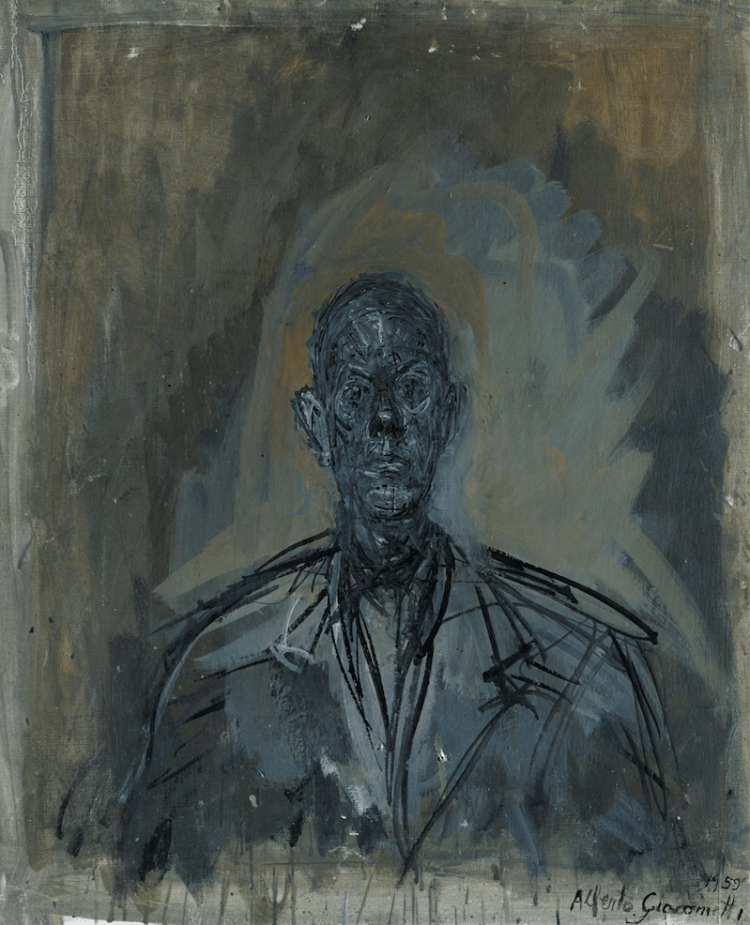
. . . to his long-suffering wife Annette.
It was art of a different color at The Jewish Museum, which showcased Chaim Soutine: Flesh.
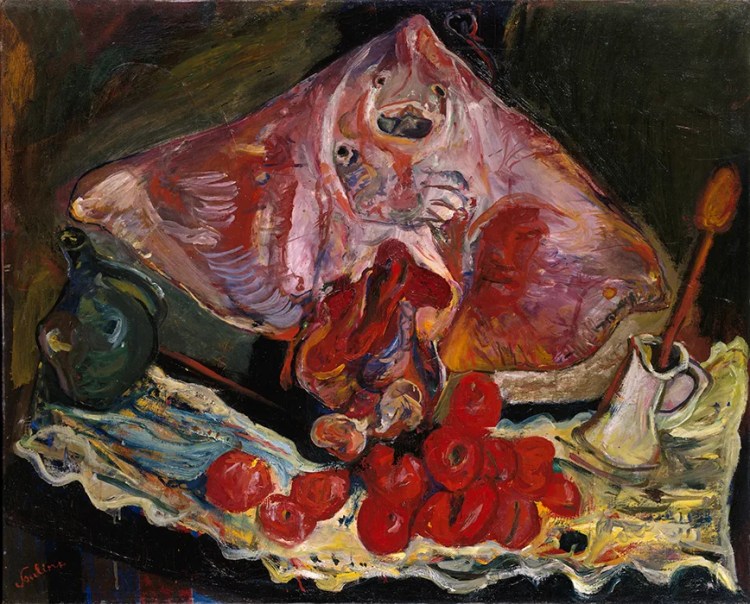
Chaim Soutine (1893–1943) is one of the twentieth century’s great painters of still life. In the Paris of the 1920s, Soutine was a double outsider—an immigrant Jew and a modernist. Guided by his expressive artistic instincts, he both embraced the traditional genre of still life and exploded it . . .
Soutine’s harsh and wrenching portrayals—of beef carcasses, plucked fowl, fish, and game—create a parallel between the animal and human, between beauty and pain. His still-life paintings, produced over a period of thirty years, express with visceral power his painterly mastery and personal passion.
The exhibit didn’t exactly make us hungry, but the Missus and I grabbed a quick dinner anyway and headed down to the Second Stage Theater production of Young Jean Lee’s Straight White Men at the Helen Hayes Theater. The play itself was smart enough, but the deafening pre-show music – “loud hip-hop with sexually explicit lyrics by female rappers” – was less so, designed by the playwright to make the audience feel as uncomfortable as the LGBTQ+ community commonly feels.
A whole bunch of the audience, however, did not want to hear it.
On our way back to Boston the next day, the Missus and I swung by The Met Cloisters to catch the other half of Heavenly Bodies and, given the setting, it was even more effective (and far less crowded) than the show at the mothership.

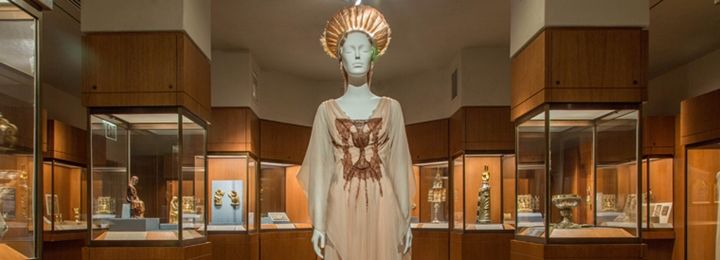
Then we took our bodies home.
• • • • • • •
Whether by dumb luck or the hand of providence, the Missus and I ventured to the Big Town four times in 2019, the last full year of the Before Times.
Our March trip kicked off with a subway ride from our hotel on 32nd Street to Lincoln Center and The New York Public Library for the Performing Arts, where Voice of My City: Jerome Robbins and New York was on display, “[tracing] Robbins’ life and dances alongside the history of New York, inspiring viewers to see the city as both a muse and a home.”
This virtual tour from Playbill is well worth taking.
After that we headed back downtown to the Fashion Institute of Technology, which had mounted Exhibitionism: 50 Years of The Museum at FIT.
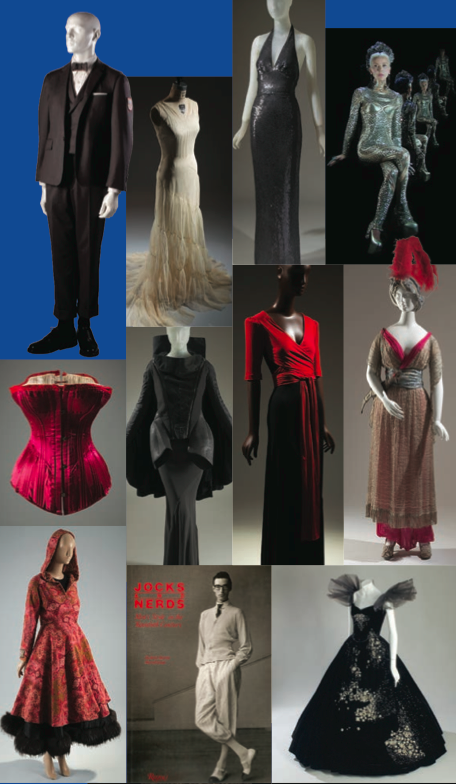
Exhibitionism: 50 Years of The Museum at FIT celebrates the 50th anniversary of what Michael Kors calls “the fashion insider’s fashion museum” by bringing back 33 of the most influential exhibitions produced since the first one was staged in 1971. Taken entirely from the museum’s permanent holdings, more than 80 looks are on display. From Fashion and Surrealism to The Corset to A Queer History of Fashion, the exhibitions are known for being “intelligent, innovative, and independent,” says MFIT Director Valerie Steele. “The museum has been in the forefront of fashion curation, with more than 200 fashion exhibitions over the past half century, many accompanied by scholarly books and symposia.”
Our favorite in the shoe department.

Kicky, no?
As we hoofed it out of FIT, we spotted this across 27th Street in FIT’s Art and Design Gallery.
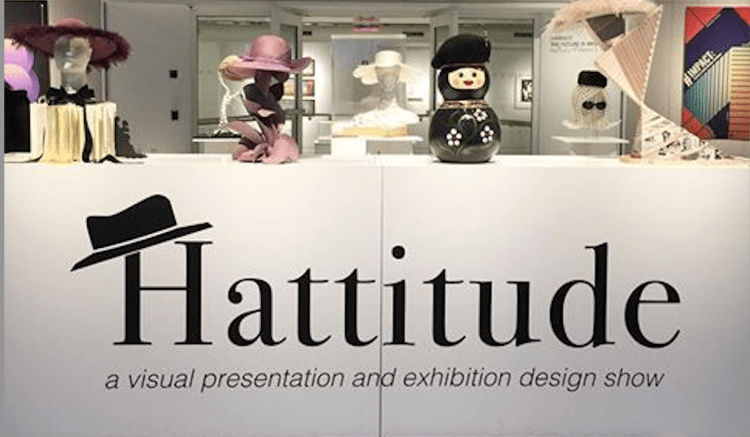
This special short exhibition, curated by Communication Design Pathways Professor Anne Kong and 42 students in the Visual Presentation and Exhibition Design program, features hats from the celebrated collection of the late former FIT dean and professor Nina Kurtis.
The students designed and created individual 360-degree displays featuring a hat from a distinctive time period or fashion trend using visual storytelling to entertain and educate the viewer. The displays incorporate various materials, handmade props, and mannequin parts.
The hats were a hoot, as “Jackie” stylishly illustrates.

That topped off our evening rather nicely.
The next morning it was off to the Museum of Modern Art to view Joan Miró: Birth of the World.

“You and all my writer friends have given me much help and improved my understanding of many things,” Joan Miró told the French poet Michel Leiris in the summer of 1924, writing from his family’s farm in Montroig, a small village nestled between the mountains and the sea in his native Catalonia. The next year, Miró’s intense engagement with poetry, the creative process, and material experimentation inspired him to paint The Birth of the World.
In this signature work, Miró covered the ground of the oversize canvas by applying paint in an astonishing variety of ways that recall poetic chance procedures. He then added a series of pictographic signs that seem less painted than drawn, transforming the broken syntax, constellated space, and dreamlike imagery of avant-garde poetry into a radiantly imaginative and highly inventive form of painting. He would later describe this work as “a sort of genesis,” and his Surrealist poet friends titled it The Birth of the World.
The exhibit also featured this monumental mural.

A story goes with it: The mural was commissioned in 1950 for Harvard University’s new Graduate Student Center by Walter Gropius, the Department of Architecture chair and founder of Germany’s Bauhaus School in 1919. After Miró delivered it, the mural was hung in the Grad Center . . . over a radiator, which during the next few years started to sort of melt the artwork.
So Miró said, hey – send it back and I’ll fix it. And the fix was certainly in: Miró returned a ceramic tile version of the mural to Harvard (which is still there), then touched up the original mural and sold it to MoMA for a pretty penny.
But – consolation prize! – Harvard also has Miró’s original sketch for the mural, which the Harvard Art Museums displayed in its 2019 exhibit, The Bauhaus and Harvard.

That mural traveled more than just Cambridge to New York, yeah?

From MoMA we headed down to SoHo and the Center for Italian Modern Art to see Metaphysical Masterpieces 1916-1920: Morandi, Sironi, and Carrà.
The term “metaphysical painting” (pittura metafisica) refers to an artistic style that emerged in Italy during the First World War. Closely associated with [Giorgio] de Chirico, it often featured disquieting images of eerie spaces and enigmatic objects, eliciting a sense of the mysterious. Metaphysical Masterpieces concentrates on rarely seen early works by Giorgio Morandi and important paintings by the lesser- known artists Carlo Carrà and Mario Sironi, offering a richer and more nuanced view of pittura metafisica than previous exhibitions in the United States, creating a vivid portrait of the genre.
Representative samples from Morandi and Sironi.

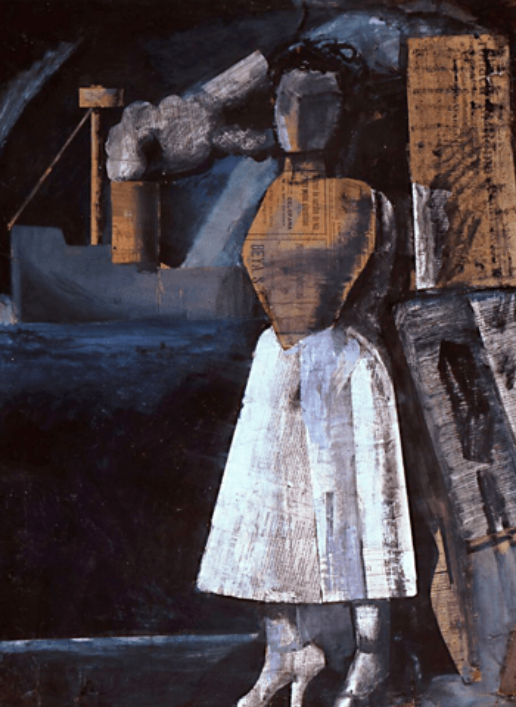
The exhibit was excellent and the people there were lovely – they gave me and the Missus a wonderfully informative tour and even made espresso for us. Molte grazie!
Sadly, the Center for Italian Modern Art is no more, victim of a challenging economic climate, as Zachary Small reported in the New York Times.
Laura Mattioli, founder of the Center for Italian Modern Art, said that recent financial challenges had led to the decision to close.
“We were open for about 11 years, but the situation has changed since the pandemic,” said Mattioli, who has an apartment in the same Broome Street building as the museum. “We sometimes spent more on the travel of artworks to and from Italy than the actual value of the artworks themselves.”
Beyond that, Mattioli told the Times, “after the pandemic and the Black Lives Matter movement . . . many grant-making organizations appeared to require that exhibition proposals include elements of diversity and inclusion” – something not exactly prevalent in modern Italian art.
Our loss, sì?
Back in the Big Town, we subwayed to the Brooklyn Museum for the much-hyped Frida Kahlo: Appearances Can Be Deceiving.
Mexican artist Frida Kahlo’s unique and immediately recognizable style was an integral part of
 her identity. Kahlo came to define herself through her ethnicity, disability, and politics, all of which were at the heart of her work. Frida Kahlo: Appearances Can Be Deceiving is the largest U.S. exhibition in ten years devoted to the iconic painter and the first in the United States to display a collection of her clothing and other personal possessions, which were rediscovered and inventoried in 2004 after being locked away since Kahlo’s death, in 1954.
There was lots of clothing, photos, jewelry, and assorted other Fridabilia – but not all that much artwork. The whole exhibit seemed more about Kahlo as celebrity/cult figure than anything else. That’s certainly what the Selfie Set was most interested in, to all appearances.
(Luckily, a better sense of Kahlo as an artist was on display at Boston’s Museum of Fine Arts at the time. Frida Kahlo and Arte Populaire explored “how her passion for objects such as decorated ceramics, embroidered textiles, children’s toys, and devotional retablo paintings shaped her own artistic practice.” It was more interesting than the Brooklyn show, even if a bit less selfie-satisfied.)
The next morning we cruised up Madison Avenue with nary a red light for fifty blocks (as opposed to Boston’s traffic lights, which seem to have been timed by Joe Cocker), turned onto 84th Street, and found a spot right in front of my old grammar school, St. Ignatius Loyola, which is operated by the Sisters of (Parking) Charity.
From there we sashayed up to The Met for Epic Abstraction: Pollock to Herrera, which began with a quote from AbEx pioneer Barnett Newman.
We felt the moral crisis of a world in shambles, a world devastated by a great depression and a fierce world war, and it was impossible at that time to paint the kind of painting that we were doing—flowers, reclining nudes, and people playing the cello. . . . So we actually began, so to speak, from scratch, as if painting were not only dead but had never existed.
You can see most of the exhibition objects here, but these highlights will give you a sense of the collection overall.
Willem de Kooning, Easter Monday (1955-56).

Louise Nevelson, Mrs. N’s Palace (1964-77).

Barnett Newman, Shimmer Bright (1968).

Although the exhibit is long gone, many of the works remain on view in Galleries 917–925 at The Met.
After a costly lunch in the Met cafeteria (where we watched two young women pour two glasses of wine – one red, one white – arrange them just so, and Instagram them to the world at large), we moseyed up to the Neue Galerie for The Self-Portrait, from Schiele to Beckmann.
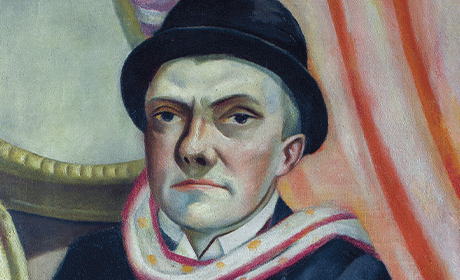
“The Self-Portrait, from Schiele to Beckmann” is an unprecedented exhibition that examines works primarily from Austria and Germany made between 1900 and 1945. This groundbreaking show is unique in its examination and focus on works of this period. Approximately 70 self-portraits by more than 30 artists—both well-known figures and others who deserve greater recognition—will be united in the presentation, which is comprised of loans from public and private collections worldwide . . .
Some of the most outstanding self-portraits in this exhibition are by women, including Paula Modersohn-Becker, who painted a number of bold, groundbreaking self-portraits, some of which highlighted her pregnancy; and Käthe Kollwitz, who cast an unsparing eye on her own world-weary visage. The best of these works always engage the viewer in a complex and meaningful way.
Some other autoportraits from those madcap German Expressionists.

With that, we headed back to face the stop-and-go-and-stop traffic of Boston.
• • • • • • •
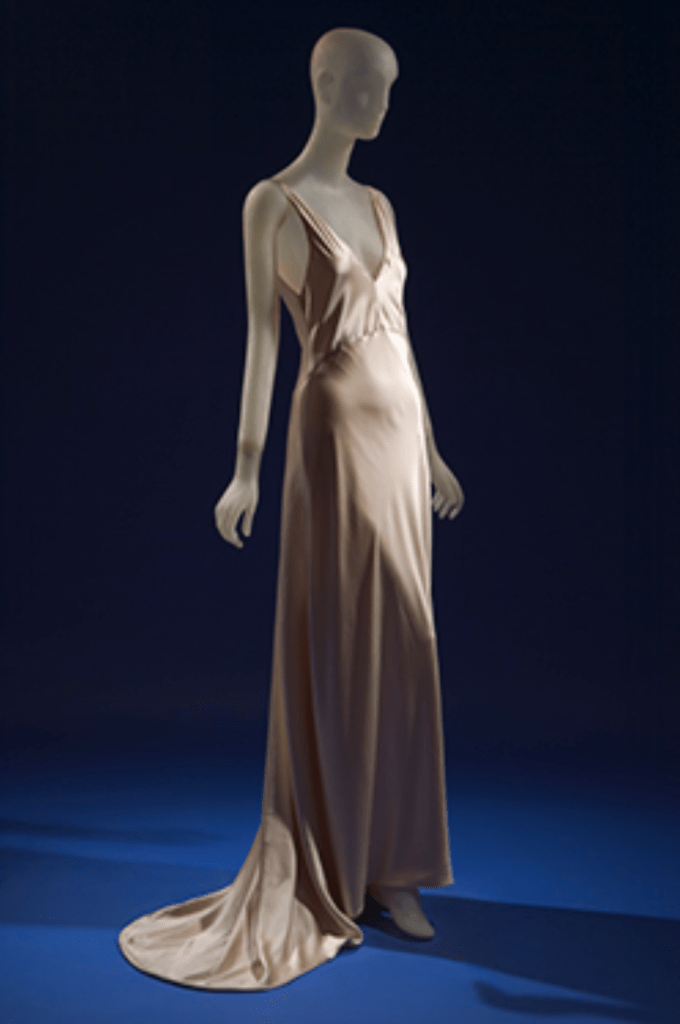
Upon our return to the city in June, the Missus and I first visited, as we often did, The Museum at FIT, where Minimalism/Maximalism (“the first exhibition devoted to the historical interplay of minimalist and maximalist aesthetics as expressed through high fashion”) was on display, although in fairness it should really have been called Artful/Awful.
The former, from Narcisco Rodriguez in 2011.
The latter, from Comme des Garçons in 2018.
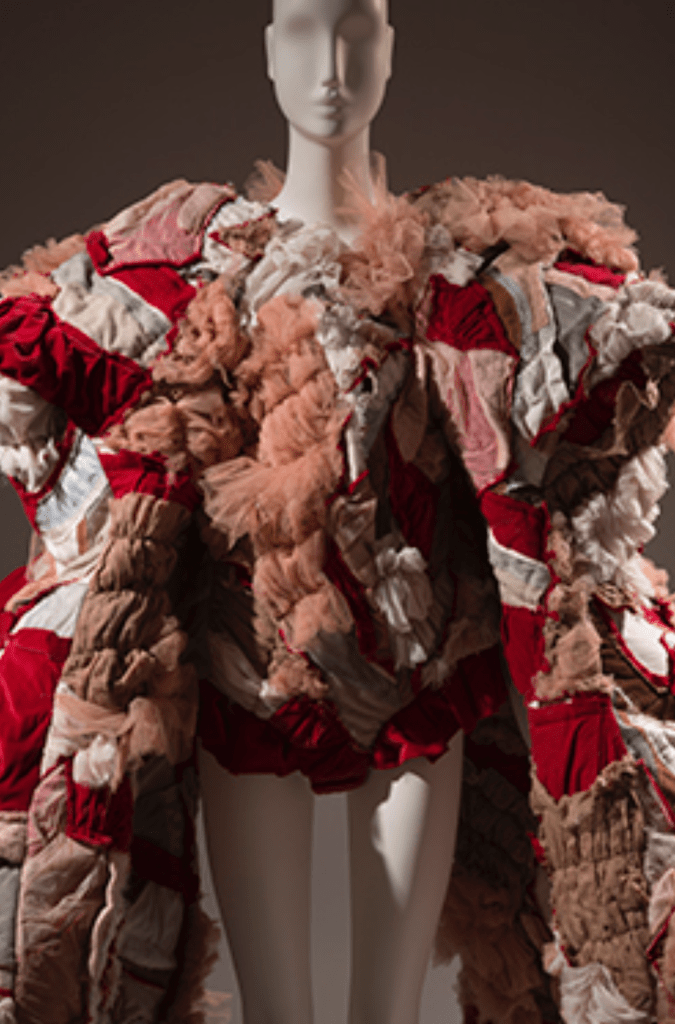
That’s just so . . . ongepotchket.
From there we drifted past Bryant Park and – lucky us – stumbled upon Yoga Night!, which urged us to “perfect your downward dog at our outdoor yoga classes.” We did not, for those of you keeping score at home.
Instead, we wandered over to the Manhattan Theatre Club’s Samuel J. Friedman Theatre for the Almeida Theatre production of James Graham’s Ink.
 It’s 1969 London. The brash young Rupert Murdoch (Tony winner Bertie Carvel) purchases a struggling paper, The Sun, and sets out to make it a must-read smash which will destroy – and ultimately horrify – the competition. He brings on rogue editor Larry Lamb (Olivier winner Jonny Lee Miller) who in turn recruits an unlikely team of underdog reporters. Together, they will go to any lengths for success and the race for the most ink is on!
 Larry Lamb is tasked by Rupert Murdoch with overtaking – in one year – The Mirror, which has the largest circulation in the U.K. (four million daily), while The Sun’s circulation is among the smallest.
The production was loud, manic, and fabulously staged, with terrific performances by the lead actors.
Here’s a clip about the Theme Weeks that The Sun relentlessly promoted to boost readership. It’s a hoot.
The play wasn’t just smart – it was prescient. The Sun was determined to be a disruptor, giving voice to the people and relying on them for content, which the paper now describes this way.
From the beginning, it was clear Sun readers were not content to sit on the sidelines and be lectured to. They wanted to get involved.
Whether fighting injustice, dashing off an opinion to our Letters page, sharing a shopping tip or entering competitions, our army of readers has always been as much a part of the fabric of the paper as the journalists who put it together.
And that was well before social media took over.
An Australian woman was sitting behind us, decrying how Rupert Murdoch has been so destructive to democracy the world over. But she failed to recognize the creative Murdoch – the one who has seen the gaps in the media world that he could fill with The Sun, the Fox Broadcast Network, the Fox News Channel.
The mistake people make is in thinking Rupert Murdoch has some set of bedrock conservative principles. Not even close. He’s only interested in principal – how much money he can make exploiting the public’s basest instincts, which are fear, hatred, and rage.
And that’s what Ink so deftly illustrated.
The next morning it was off to the Museum of Modern Art – which was closing after that weekend to undertake a four-month $450 million expansion – for Lincoln Kirstein’s Modern.
“I have a live eye,” proclaimed Lincoln Kirstein, signaling his wide-ranging vision. Lincoln Kirstein’s Modern explores this polymath’s sweeping contributions to American cultural life
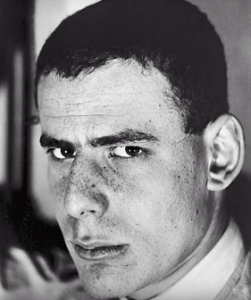 in the 1930s and ’40s. Best known for cofounding New York City Ballet and the School of American Ballet with George Balanchine, Kirstein (1907–1996), a writer, critic, curator, impresario, and tastemaker, was also a key figure in MoMA’s early history. With his prescient belief in the role of dance within the museum, his championing of figuration in the face of prevailing abstraction, and his position at the center of a New York network of queer artists, intimates, and collaborators, Kirstein’s impact remains profoundly resonant today.
Not to mention Kirstein’s being a major enabler of Nazi-sympathizing starchitect Philip Johnson, which MoMA actually did not mention, to its discredit.
Here’s MoMA’s video, if you’re still interested. And here are the images in the exhibit. For me and the Missus, the best parts of the show were the artworks Kirstein himself collected, such as Elie Nadelman’s Man in the Open Air.

Over all, a decent presentation of a not-so-decent guy.
Next up: The Frick Collection, which was planning a four year renovation of its own, with an interim residence at the Breuer Building (which The Met would very helpfully be vacating). In addition to the sheer pleasure of wandering through Frick’s old pad, there was Whistler as Printmaker: Highlights from the Gertrude Kosovsky Collection.
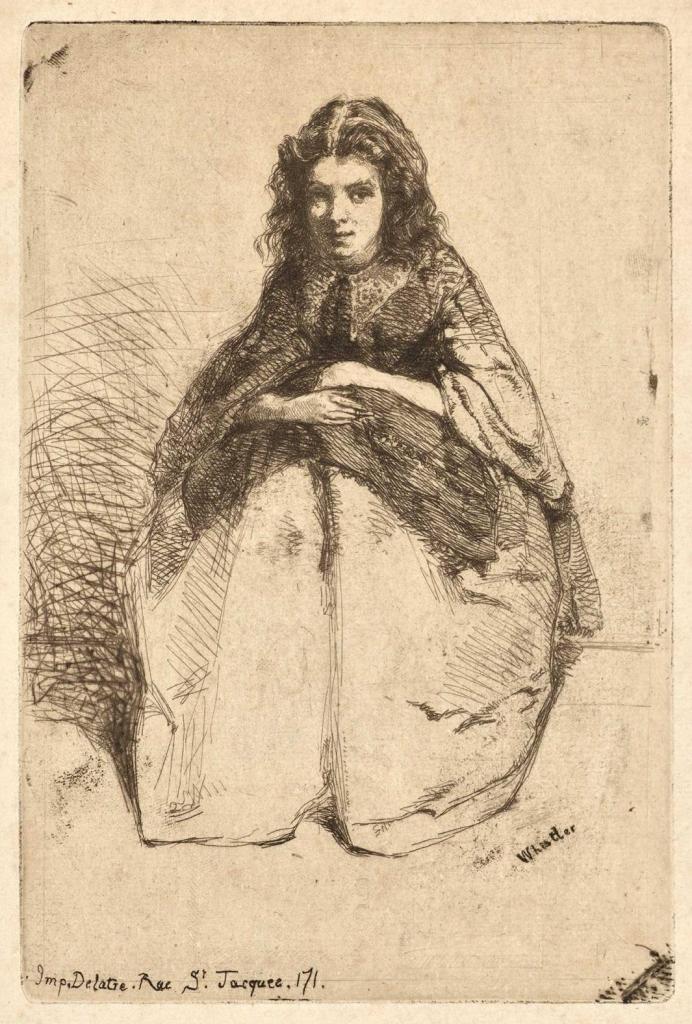
The Frick Collection was pleased to announce a promised gift of forty-two works on paper by James McNeill Whistler (1834–1903), from the collection of Gertrude Kosovsky. An exhibition highlighting fifteen prints and one pastel from the gift is now on view in the Cabinet Gallery. The collection was formed over five decades by Mrs. Kosovsky, with the support of her husband, Dr. Harry Kosovsky, and includes twenty-seven etchings, fourteen lithographs, and one pastel, which range from Whistler’s early etchings dating from the late 1850s to lithographs of the late 1890s. Most are impressions made during his lifetime, a number of them from his major published sets, while others were produced for periodicals, thus encompassing different aspects of the American expatriate’s prolific activity as a printmaker.
The sixteen works from the exhibit are here, but it was a joy to see Whistler’s etchings up close, especially with the aid of the magnifying glasses the Frick thoughtfully provided.
From the Frick we moseyed up Fifth Avenue to The Met, where the main attraction was Camp: Notes on Fashion.
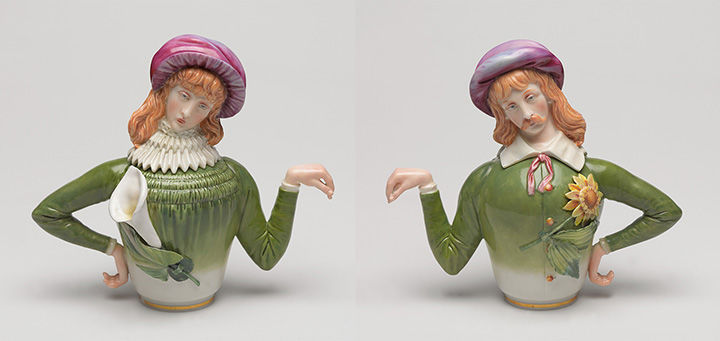
Through more than 250 objects dating from the seventeenth century to the present, The Costume Institute’s spring 2019 exhibition explores the origins of camp’s exuberant aesthetic. Susan Sontag’s 1964 essay “Notes on ‘Camp’” provides the framework for the exhibition, which examines how the elements of irony, humor, parody, pastiche, artifice, theatricality, and exaggeration are expressed in fashion.
Here’s Sontag’s essay (tip o’ the hat to UCLA’s Design Media Arts department). And here’s a guided tour of the exhibit.
Sontag said that “the essence of Camp is its love of the unnatural: of artifice and exaggeration.” The Met exhibit seemed to say that Camp was whatever the curator wanted it to be. So the whole thing – audio, video, clothing, accessories, etc. – was a hot mess. Add to that the swarms of people taking selfies and barely looking at any one object for more than five seconds, and we quickly went from Camp to decamp.
While the Camp exhibit was a hot mess, Play It Loud: Instruments of Rock & Roll was just hot.

For the first time, a major museum exhibition examines the instruments of rock and roll. One of the most important artistic movements of the twentieth century, rock and roll’s seismic influence was felt across culture and society. Early rock musicians were attracted to the wail of the electric guitar and the distortion of early amplifiers, a sound that became forever associated with rock music and its defining voice. Rock fans have long been fascinated with the instruments used by musicians. Many have sought out and acquired the exact models of instruments and equipment used by their idols, and spent countless hours trying to emulate their music and their look. The instruments used in rock and roll had a profound impact on this art form that forever changed music.
You can see all the exhibit’s instruments here, from Keith Emerson’s customized Moog Synthesizer to Jimmy Page’s Black Beauty guitar that was stolen from a Minneapolis airport in 1970 and – amazingly – returned to him (the exhibit doesn’t say how) in 2015. A Whitman’s Sampler of videos can be found here. You are definitely encouraged to sample.
We did some other stuff on that trip, but nothing worth spending any more time on.
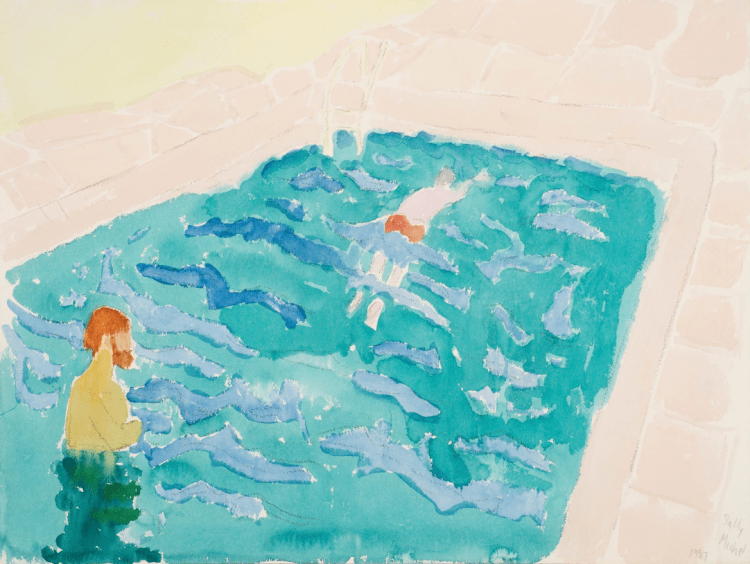
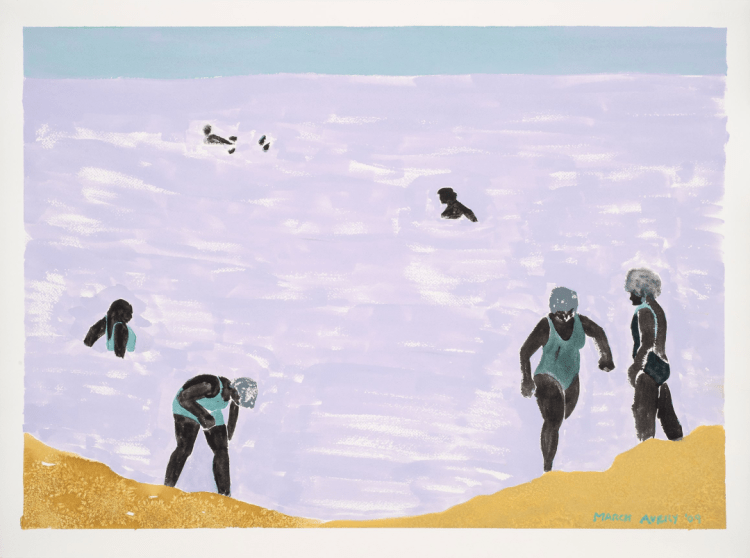
On the way home, however, we stopped by the Bruce Museum in Greenwich to see Summer with the Averys [Milton | Sally | March].

On May 11, 2019, the Bruce Museum [opened] Summer with the Averys [Milton | Sally | March]. Featuring landscapes, seascapes, beach scenes, and figural compositions—as well as rarely seen travel sketchbooks—the exhibition takes an innovative approach to the superb work produced by the Avery family. Along with canonical paintings by Milton Avery, the show offers a unique opportunity to become acquainted with the remarkable art created by Avery’s wife Sally and their daughter March.
Milton Avery, his wife Sally Michel, and their daughter March were inveterate summer travelers, with destinations including Mexico; Laguna Beach, California; Canada’s Gaspé Peninsula; Provincetown, Massachusetts; Woodstock, New York; the MacDowell Colony in New Hampshire; Yaddo in upstate New York; and Europe.
What the exhibit vividly displayed was not just the closeness of the family, but the familial resemblance of the art they produced.
Milton Avery (American, 1885-1965). Thoughtful Swimmer, 1943.
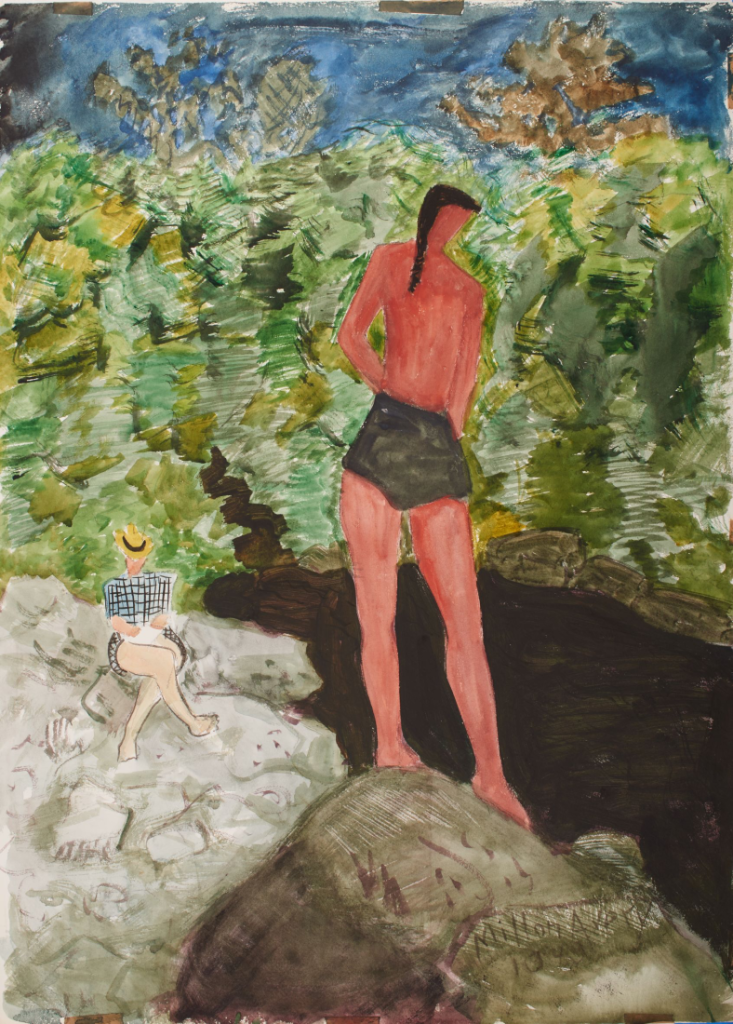
Sally Michel (American, 1902-2003). Swimming Lesson, 1987.
March Avery (American, b. 1932). The Dead Sea, 2009.
Just a lovely exhibit.
Before we left the museum, we checked out Sharks! Myths and Realities and learned this fun fact: More Americans are killed every year by ballpoint pens and vending machines than by sharks.
You could look it up.
• • • • • • •
Three months later we were back in the Big Town and headed to the Brooklyn Museum to sample its several new offerings. First up was Rembrandt to Picasso: Five Centuries of European Works on Paper, which featured “more than a hundred European drawings and prints from our exceptional collection, many of which are on view for the first time in decades.”
From the remarkably spontaneous etchings of Rembrandt, through the bold graphite lines of
 Pablo Picasso, the exhibition explores the roles of drawing and printmaking within artists’ practices, encompassing a variety of modes, from studies to finished compositions, and a range of genres, including portraiture, landscape, satire, and abstraction. Working on paper, artists have captured visible and imagined worlds, developed poses and compositions, experimented with materials and techniques, and expressed their personal and political beliefs. Other featured artists include Albrecht Dürer, Giovanni Battista Piranesi, Francisco Goya, Berthe Morisot, Edgar Degas, Édouard Manet, Vincent van Gogh, Käthe Kollwitz, and Vasily Kandinsky.
Except . . .
There was not a single etching or drypoint by James McNeill Whistler, one of the greatest artists ever to put needle to copper.
What . . . the . . . hell.
Other than that, a terrific exhibit.
Next we took in Pierre Cardin: Future Fashion, an absolutely fabulous retrospective of a designer who revolutionized fashion, fabrics, furniture, and functional items like lighting fixtures.
 Pierre Cardin: Future Fashion is the first New York retrospective in forty years to focus on the legendary couturier. Drawn primarily from Pierre Cardin’s archive, the exhibition traverses the designer’s decades-long career at the forefront of fashion invention. Known today for his bold, futuristic looks of the 1960s, 1970s, and 1980s, Cardin extended his design concepts from fashion to furniture, industrial design, and beyond.
The exhibition presents over 170 objects drawn from his atelier and archive, including historical and contemporary haute couture, prêt-à-porter, trademark accessories, “couture” furniture, lighting, fashion sketches, personal photographs, and excerpts from television, documentaries, and feature films. The objects are displayed in an immersive environment inspired by Cardin’s unique atelier designs, showrooms, and homes.
The guy was, quite simply, a genius.
We also checked out Garry Winogrand: Color. Winogrand is mostly known for his black-and-white photography of New York icons and street scenes, but the Brooklyn Museum’s exhibit displayed an entirely different aspect of his work. The thing is, given that it was eight slide shows lining two sides of the exhibition room, you sort of had to be there to fully appreciate it.
Bright and early the next morning we subwayed out to Corona, Queens to visit the original Louis Armstrong House Museum, which contained “Louis and Lucille’s vast personal collection of 1,600 recordings, 650 home recorded reel-to-reel tapes in hand-decorated boxes, 86 scrapbooks, 5,000 photographs, 270 sets of band parts, 12 linear feet of papers, letters and manuscripts, five trumpets, 14 mouthpieces, 120 awards and plaques, and much more.”
The digital collection is fun, but the experience of being inside the house was really special. This New York Times piece by Giovanni Russonello captured some of it – including clips from those home-recorded tapes – as does this house tour video.
When we were there, construction was underway across the street on an Armstrong Museum extension. It opened in the summer of 2023, as New York Times culture reporter Melena Ryzik detailed in depth.
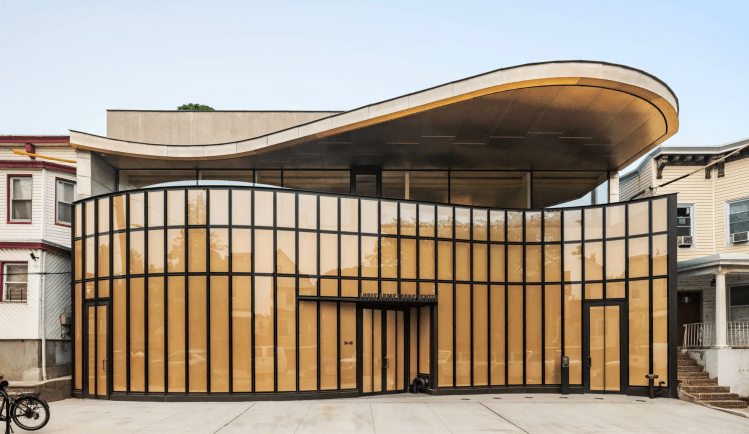
You can find anything in Queens. And yet for decades, the Louis Armstrong House Museum has been a well-kept secret on a quiet street in Corona. The longtime residence of the famed jazz trumpeter, singer and bandleader, it is a midcentury interior design treasure hidden behind a modest brick exterior.
The museum’s new extension, the 14,000 square foot Louis Armstrong Center, blends in a little less. It looks, in fact, a bit like a 1960s spaceship landed in the middle of a residential block. By design, it doesn’t tower over its neighboring vinyl-sided houses but, with its curvilinear roof, it does seem to want to envelop them. And behind its rippling brass facade lie some ambitious goals: to connect Armstrong as a cultural figure to fans, artists, historians and his beloved Queens community; to extend his civic and creative values to generations that don’t know how much his vision, and his very being, changed things. It wants, above all, to invite more people in.
With any luck, the Missus and I might get back there to see it one of these days.
Returning to Manhattan, we swung by the Guggenheim Museum to check out Artistic License: Six Takes on the Guggenheim Collection. We thought it was okay, but the Big Town Bigfeet split in their reviews: The Wall Street Journal’s Peter Plagens thought it was a mess, while Roberta Smith was much more kind in the New York Times
Also at the Guggenheim was Basquiat’s “Defacement”: The Untold Story, but the waiting line was a half hour long so we about-faced and strolled up Fifth to the Cooper-Hewitt. Why, I don’t know.
As previously mentioned, the Missus and I remember fondly the days of mustard pot and pop-up book exhibits at the Cooper-Hewitt, but those days are decidedly gone. Exhibit Umpteen: Nature—Cooper Hewitt Design Triennial, in which “sixty-two international design teams . . . are engaging with nature in innovative and ground-breaking ways, driven by a profound awareness of climate change and ecological crises as much as advances in science and technology.”
Yeah – not engaging. We still like Andrew Carnegie’s old 64-room crib, though.
Happily, Jewelry for America at The Met served as a sort of visual sorbet. That left the best for last: Relative Values: The Cost of Art in the Northern Renaissance.
Bringing together sixty-two masterpieces of sixteenth-century northern European art from The Met collection and one important loan, this exhibition revolves around questions of historical worth, exploring relative value systems in the Renaissance era. Organized in six sections—raw
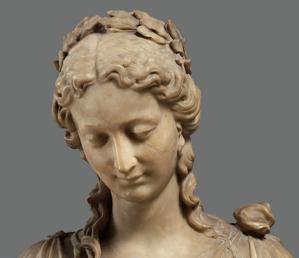 materials, virtuosity, technological advances, fame, market, and paragone—tapestry, stained and vessel glass, sculpture, paintings, precious metal-work, and enamels are juxtaposed with pricing data from sixteenth-century documents. What did a tapestry cost in the sixteenth century? Goldsmiths’ work? Stained glass? How did variables like raw materials, work hours, levels of expertise and artistry, geography, and rarity, affect this? Did production cost necessarily align with perceived market valuation in inventoried collections? Who assigned these values? By exploring different sixteenth-century yardsticks of gauging worth, by probing extrinsic versus intrinsic value, and by presenting works of different media and function side-by-side, the exhibition captures a sense of the splendor and excitement of this era.
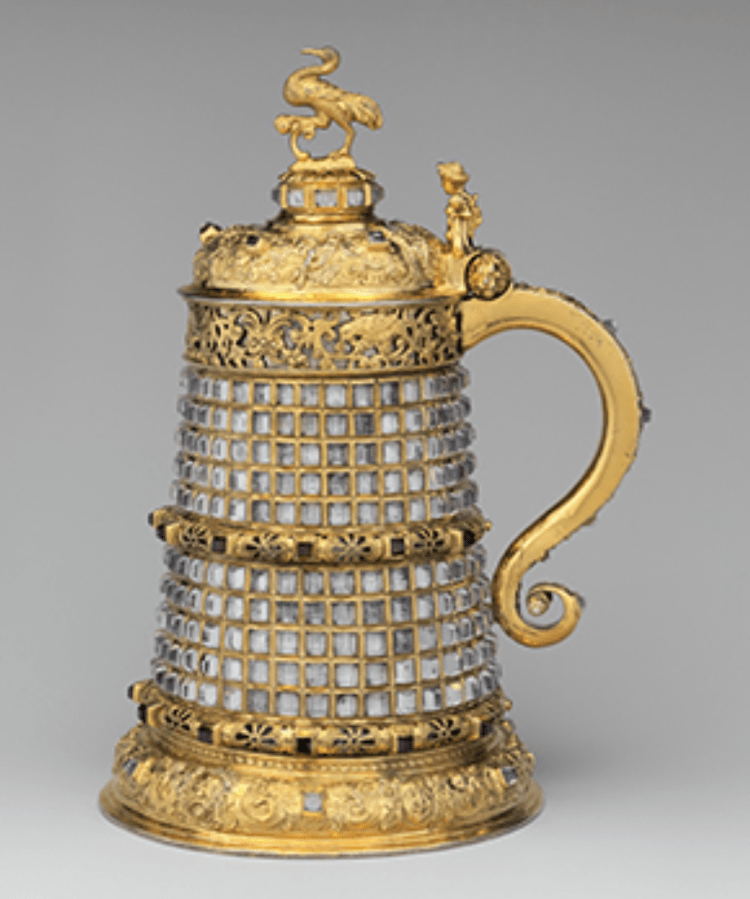
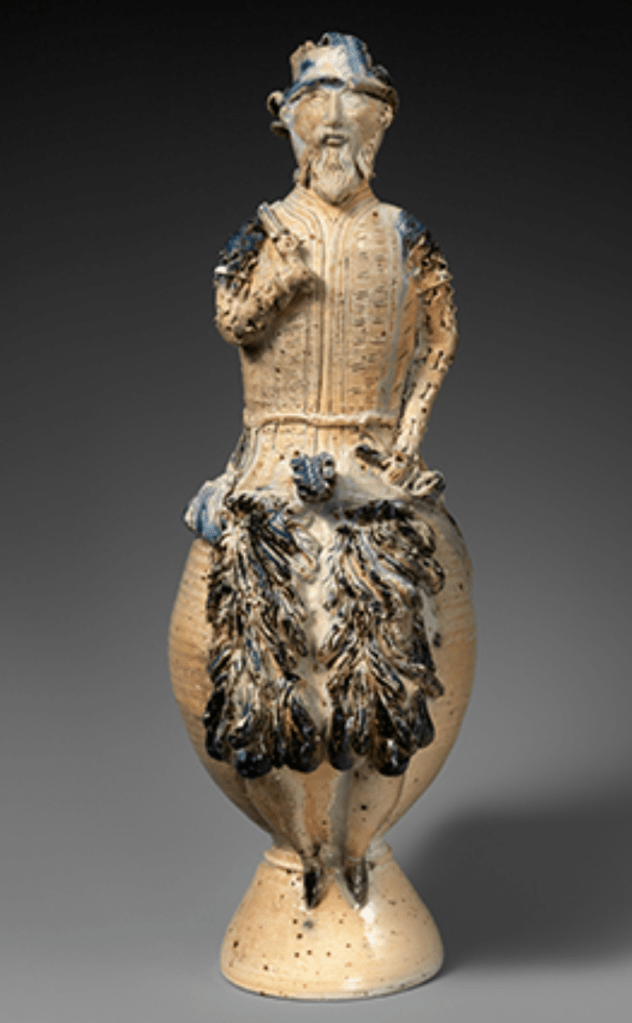
The exhibit was a total gas: It basically tells you how many cows it would take to buy each item (one cow = 175 grams of silver or 5,350 loaves of rye bread in Brussels).
So, for example, this 1585 Bohemian Tankard would have set you back 158 cows.
This 16th Century German stirrup cup on the other hand? A bargain at 1/8 cow. (Not sure how that gets handed over.)
That exhibit alone was totally worth the two cows admission price to The Met.
On the way back to Boston, the Missus and I made another pit stop at the Wadsworth Atheneum, this time to catch From Expressionism to Surrealism: Highlights of Modern Art from the Collection.
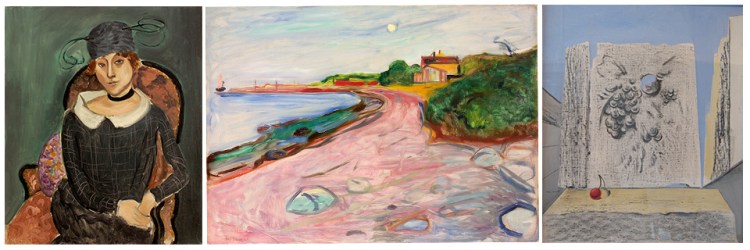
A special installation of treasures from the Wadsworth’s collection including works by Ernst, Munch, Matisse, Picasso, and Rousseau. This intimate presentation of works of art made between 1900 and 1950 illustrates expressionist and surrealist approaches to painting.
(Above: Henry Matisse, The Ostrich-Feather Hat, 1918. Edvard Munch, Aasgaardstrand, c.1904. Max Ernst, Still Death.)
After that we checked out The Bauhaus Spirit at the Wadsworth Atheneum, which “is expressed throughout the Wadsworth’s collection in art, furniture, and architectural design.”
Such as . . .

Then we went from the Bauhaus to our house.
• • • • • • •
The Missus and I trundled back to the Big Town in December and just our luck, we arrived on an official Gridlock Alert Day, which meant it took us fully 60 minutes to crawl from 71st and First to 32nd and Fifth.
Undaunted and safely ensconced in our moderately priced hotel, we first headed to the FIT Museum, which featured Paris, Capital of Fashion.
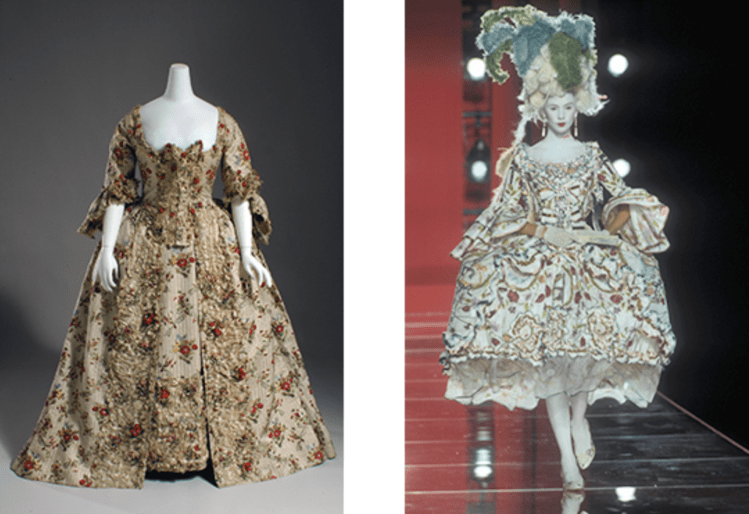
Paris, Capital of Fashion opened with an introductory gallery that places Paris within a global context, presenting it in dialogue with other fashion capitals, especially New York. By presenting an original couture suit by Chanel together with a virtually identical licensed copy sold by Orbach’s department store, for example, the exhibition demonstrated how the idea of Paris fashion “works” across fashion cultures, appealing to elite American women and making money for American manufacturers and retailers..
Entering the main gallery, visitors were immersed in the mythic glamour of Paris fashion as the exhibition traced a trajectory from royal splendor at Versailles to the spectacle of haute couture today. An 18th-century robe à la française was juxtaposed with a haute couture creation for Christian Dior, which was inspired by Marie Antoinette.
From there we subwayed uptown to the Bard Graduate Center to catch French Fashion, Women, and the First World War.
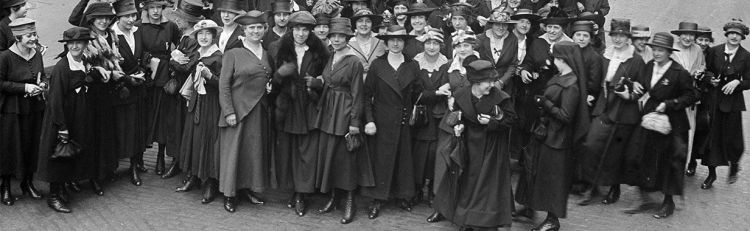
In moments of great upheaval—such as in France during the First World War—fashion becomes more than a means of personal expression. As women throughout the country mobilized in support of the war effort, discussions about women’s fashion bore the symbolic weight of an entire society’s hopes and fears. This exhibition represents an unprecedented examination of the dynamic relationship between fashion, war, and gender politics in France during World War I.
Garments by Coco Chanel and Jeanne Lanvin, two of many French women leading fashion houses during World War I, will be displayed in the United States for the first time. The clothing and ephemera on view reveal wartime as a transitional period for fashion and women’s emancipation. Skirt suits, nurses’ and ambulance attendants’ uniforms, mourning dresses and muffs, chic “military style” hats, and clothing worn by remplaçantes, women who took on a variety of jobs previously occupied by men, demonstrate how French women of all social classes dressed themselves and why.
This video provides lots of examples.
The next morning it was cold as hell (a phrase that makes absolutely no sense), so instead of walking the 21 blocks to the Museum of Modern Art as we normally did, the Missus and I ducked into the subway.
The $450 million expansion of MoMA – which enlarged the museum by 165,000 square feet – either a) “adds one-third more gallery space to the institution’s 80-year-old complex on West 53rd Street and integrates it more seamlessly with the public realm,” as Sydney Franklin wrote in The Architect’s Newspaper, or b) “[is] a supersized MoMA tote bag—very capacious, very useful, but in the end worthwhile only for what’s inside,” as Martin Filler put it in The New York Review of Books.
We started on the 5th floor, which contains artworks from the 1880s to the 1940s – MoMA’s sweet spot. What wasn’t so sweet to many critics was the absence of the traditional “isms” in organizing the works, as Filler noted.
The only “isms” on full display here are revisionism and Surrealism, which was spared in this
 thoroughgoing purge perhaps because it is a favorite of theory-oriented academics who might denounce any toying with their hobbyhorse. Thus in place of Dadaism we now have “Readymade in Paris and New York,” as if laypersons know that specialist term for the innovation of appropriating a found object and declaring it a work of art—exemplified by Marcel Duchamp’s Bicycle Wheel (1913/1951) and the snow shovel he named In Advance of the Broken Arm (1915/1964), both seen here in facsimiles recreated by the artist after the originals were lost. We also have “Masters of Popular Painting,” a designation more befitting Norman Rockwell and N.C. Wyeth than the Outsider artists unknown during their lifetimes and happily displayed here (including the magical Bill Traylor).
We spent a good – a very good – two hours traversing those galleries and thought most of the changes were for the better, even the rumpus rooms like “Around Les Demoiselles d’Avignon,” which had been roundly criticized for pairing Picasso’s breakthrough 1907 painting with Faith Ringgold’s 1967 depiction of a race riot.

(For the record, that gallery is now designated Picasso, Rousseau, and the Paris Avant-Garde, with not a Faith Ringgold in sight.)
What had not changed at MoMA, though, were all the idiots who would rather take a selfie with the artworks than actually look at them.
As we departed, there was also a moment of MoMA drama at the coat check. The garment on my hangar was someone else’s, a not inconsequential matter since it was 13˚ outside. After the coat checkers fruitlessly spun the carousel around several times, one of them ventured into the back of the room and discovered that my coat had taken up residence on the conveyor belt for God knows how long.
Once we – and by “we,” of course, I mean the Missus – thoroughly defuzzed the coat, I put it on and we wandered out.
Our next stop was the Museum of Arts and Design to enter The World of Anna Sui.

Born and raised in Detroit, educated and discovered in New York, Anna Sui reinvented pop culture fashion with her signature rock-and-roll romantic label in the 1990s and has remained a design icon ever since. Beginning with her premiere catwalk show in 1991, Sui has shaped not only the garments, textiles, accessories, cosmetics, and interiors that comprise her design universe, but also the course of fashion history by popularizing the boutique fashion look . . .
Unlike other popular American designers, Sui is driven by telling stories head-to-toe about the worlds of cowgirls, grunge girls, hippie chicks, hula girls, Mods, pirate rock stars, Pre-Raphaelite maidens, and surfer nomads.
Sui is so unlike other popular American designers, you might even say she’s sui generis. But, of course, you wouldn’t.
From there we moseyed up to the American Folk Art Museum, which had returned – a victim of its own ambition – to its original home at 2 Lincoln Square after selling its fabulous 53rd Street building in 2011 to MoMA, which wasted little time in demolishing it for the museum’s aforementioned expansion.
New York Times reporter Robin Pogrebin chronicled the sad tale two years later in this valedictory piece.
 When a new home for the American Folk Art Museum opened on West 53d Street in Manhattan in 2001 it was hailed as a harbinger of hope for the city after the Sept. 11 attacks and praised for its bold architecture.
“Its heart is in the right time as well as the right place,” Herbert Muschamp wrote in his architecture review in The New York Times, calling the museum’s sculptural bronze facade “already a Midtown icon.”
Now, a mere 12 years later, the building is going to be demolished.
In its place the adjacent Museum of Modern Art, which bought the building in 2011, will put up an expansion, which will connect to a new tower with floors for the Modern on the other side of the former museum. And the folk museum building, designed by Tod Williams and Billie Tsien, will take a dubious place in history as having had one of the shortest lives of an architecturally ambitious project in Manhattan.
The major exhibit at the reclaimed Folk Art location was Memory Palaces: Inside the Collection of Audrey B. Heckler, a remarkable and wide-ranging assemblage of outsider artwork.
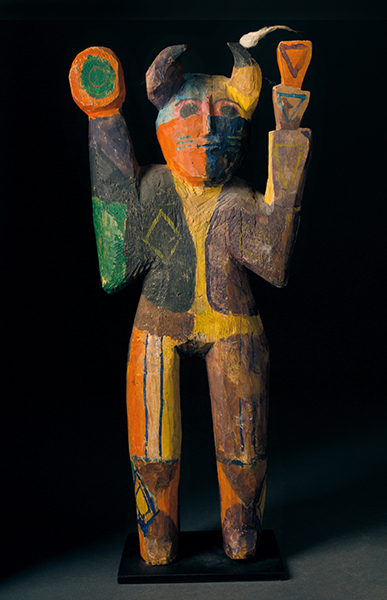
The collection of Audrey B. Heckler is emblematic of the growth of the field of self-taught art in the United States, which manifests a strong interest for African American artists, a consistent attention on American classics, a curiosity for European art brut, and a search for international discoveries. For the last twenty-seven years, Heckler—a long time and committed patron of the American Folk Art Museum—has surrounded herself with excellent examples by the most significant artists associated to this art niche, among them Emery Blagdon, Aloïse Corbaz, William Edmondson, August Klett, Augustin Lesage, Martín Ramírez, Thornton Dial, and Anna Zemánková.
Our favorites were the carved wooden figures by Charlie Willeto (see above), a Navajo medicine man who, according to the Smithsonian American Art Museum, “broke with traditional taboos against carving sacred images into wood, and created dreamlike men, women, owls, and spiritual creatures from old pieces of pine.”
Here’s what New York Magazine art critic Jerry Saltz wrote in 2019: “The American Folk Art Museum is the most underrated cultural resource in Manhattan. Show after show, mounted with grit, intelligence, and love in the museum’s difficult lobby space, luxuriates in the glories of self-taught visionary artists.”
Amen to that.
Next morning it was off to The Frick Collection (still in its old digs before decamping to the Breuer building on Madison Avenue) to take in Manet: Three Paintings from the Norton Simon Museum.
The Frick presented three Manet canvases from the collection of the Norton Simon Museum in Pasadena, California. As three distinct views of the artist’s life and work, the canvases demonstrate the range of Manet’s pioneering vision: Fish and Shrimp (1864) focuses attention on the paint itself; The Ragpicker (ca. 1865–71; possibly reworked in 1876–77) highlights the artist’s engagement with art history and contemporary visual culture; and Madame Manet (ca. 1876) prompts consideration of his biography.
Here are the other two Manet paintings from the Norton Simon.


It has always seemed to me that Édouard Manet is to French Impressionist painting what Robert Johnson is to American blues music: hugely influential, too often overlooked.
But that’s just me.
From the Frick we sashayed up Fifth Avenue to The Met, which featured its usual cornucopia of engaging exhibits.
First we visited Félix Vallotton: Painter of Disquiet, which could just as easily have been titled Printer of Disquiet given Vallotton’s distinctive and slightly disturbing woodcuts, which both revitalized and revolutionized the art of wood engraving.
Here’s a representative sample from his 1897-1898 Intimacies series of woodcuts, all of which are infused with ambiguity and tension.
Upon his arrival in Paris in 1881 at the age of 16, Vallotton flirted with Les Nabis (Pierre Bonnard, Édouard Vuillard, et. al.) but he married money, specifically the wealthy young widow Gabrielle Rodrigues-Henriques, leading to a life rich in resources but poor in, ironically, intimacy.
Disquiet, indeed.
Next up was In Pursuit of Fashion: The Sandy Schreier Collection, an exhibit that “features . . . a pioneering collector, who over the course of more than half a century assembled one of the finest private fashion collections in the United States.”
While the clothes are absolutely fabulous (video here), the backstory is even more so, as Schreier told it to New York Times fashion critic Vanessa Friedman.
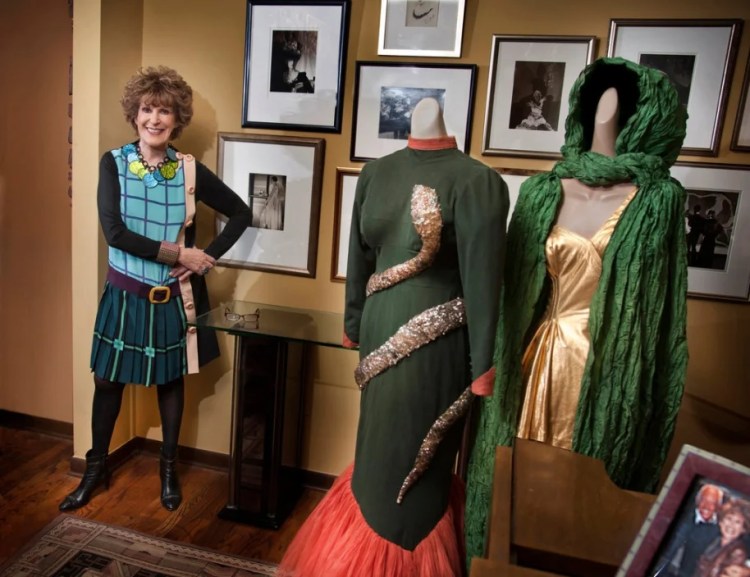
[W]hen I was little there were no nurseries and my mother was busy with my little sister, so my dad would take me to work with him [at Detroit’s high-end department store Russeks]. I’d just sit on the shop floor, and I fell in love with fashion: The staff would dress me up, and I would look at all the pictures in the magazines. At that time, it was no longer fashionable to pass clothes down, and my dad’s clientele saw how much I loved the clothes and started sending me their couture after they had worn it once, or sometimes not at all. Their drivers would bring the boxes over.
Wait — how old were you?
Three or four. I never really thought of what I was doing as collecting, though. I was just acquiring these wonderful things.
Those wonderful things now number 15,000, most of which Schreier is donating to The Met. Not sure whose drivers will bring the boxes over.
Our next exhibit was pretty much the polar opposite of velvet and silk.
The Last Knight: The Art, Armor, and Ambition of Maximilian I examines the profound
 significance of European armor at the dawn of the Renaissance, through the lens of Emperor Maximilian I’s (1459–1519) remarkable life. On view only at The Met, The Last Knight coincides with the five-hundredth anniversary of Maximilian’s death, and is the most ambitious North American loan exhibition of European arms and armor in decades. Including 180 objects selected from some thirty public and private collections in Europe, the Middle East, and the United States, The Last Knight will explore how Maximilian’s unparalleled passion for the trappings and ideals of knighthood served his boundless worldly ambitions, imaginative stratagems, and resolute efforts to forge a lasting personal and family legacy.
It was an amazing exhibit, but not nearly as eye-popping as Making Marvels: Science & Splendor at the Courts of Europe.
Between 1550 and 1750, nearly every royal family in Europe assembled vast collections of valuable and entertaining objects. Such lavish public spending and display of precious metals
 was considered an expression of power. Many princes also believed that the possession of artistic and technological innovations conveyed status, and these objects were often prominently showcased in elaborate court entertainments, which were characteristic of the period.
Making Marvels explores the complex ways in which the wondrous items collected by early modern European princes, and the contexts in which they were displayed, expressed these rulers’ ability to govern. Approximately 170 objects—including clocks, automata, furniture, musical instruments, jewelry, paintings, sculptures, print media, and more—from both The Met collection and over fifty lenders worldwide are featured. Visitors will discover marvelous innovations that engaged and delighted the senses of the past, much like twenty-first-century technology holds our attention today—through suspense, surprise, and dramatic transformations.
Marvelous innovations is exactly right, like the Swiss Draughtsman-Writer pictured above, or the wondrous objects depicted in this video.
That ended our four-hour visit to The Met. As we rode the bus down Fifth Avenue, the Missus and I debated: Should we go for a nice dinner, or for John Singer Sargent: Portraits in Charcoal at the Morgan Library & Museum?
We went for charcoal over charbroiled.
John Singer Sargent (1856–1925) was one of the greatest portrait artists of his time. While he
 is best known for his powerful paintings, he largely ceased painting portraits in 1907 and turned instead to charcoal drawings to satisfy portrait commissions. These drawn portraits represent a substantial, yet often overlooked, part of his practice, and they demonstrate the same sense of immediacy, psychological sensitivity, and mastery of chiaroscuro that animate Sargent’s sitters on canvas. The first major exhibition to explore the artist’s expressive portraits in charcoal, John Singer Sargent: Portraits in Charcoal will recognize the sheer scale of Sargent’s achievement as a portrait draftsman.
An oil portrait might take Sargent weeks or months to complete; a charcoal portrait he could produce in less than three hours. Over all, he created more than 750 charcoals of friends and famous figures, ranging from William Butler Yeats to Winston Churchill to Ethel Barrymore.
While the exhibit was great (video here), the crowd was just grating. First there was Mr. Pilot Fish, a creepy old guy who attached himself to us by standing two inches away and constantly leaning in front of us in order to be as annoying as possible.
Then there were the inevitable Sargent wannabes sprawled on the floor, charcoaling away and clogging the gallery at every turn.
Worst of all, the exhibit attracted far more than the usual number of Big Town blowhards banging on about this and that and . . . this and that all over again.
So we went to the Red Flame to cleanse our palates, so to speak.
The next day was Saturday, so the Missus took her shabbes goy to the Jewish Museum to see Edith Halpert and the Rise of American Art, “[t]he first exhibition to explore the remarkable career of Edith Halpert, the trailblazing art dealer whose influence, eye, and passion for American art championed the work of Stuart Davis, Yasuo Kuniyoshi, Jacob Lawrence, Georgia O’Keeffe, Ben Shahn, and Charles Sheeler.”

Born to a Jewish family in Odessa, Russia (now Ukraine), Edith Halpert (1900–1970) was the first significant female gallerist in the United States, propelling American art to the fore at a time when the European avant-garde still enthralled the world. In 1926, Halpert opened the Downtown Gallery in New York City, the first commercial art space in bohemian Greenwich Village. She deliberately promoted a diverse group of living American artists, fundamentally shifting the public’s opinion of whose voices mattered in the art world. Though an outsider in many respects—as a woman, an immigrant, and a Jew—Halpert was, for over 40 years, the country’s defining authority of the American art landscape.
The exhibit featured 100 works that were either owned or sold by Halpert. As the Wall Street Journal’s Terry Teachout wrote of the exhibit, “[it] also gives its viewers an opportunity to acquaint themselves with the history of American modernism prior to the rise of Abstract Expressionism in the ’40s . . . To see such paintings as [Stuart] Davis’s ‘Egg Beater No. 1’ (1927), [Charles] Sheeler’s ‘Americana’ (1931) and [John] Marin’s ‘From the Bridge, N.Y.C.’ (1933) is to witness the electrifying spectacle of ambitious American artists translating Old World styles—Cubism in particular—into the up-to-the-minute vernacular of the New World.”
Halpert was not only an ecumenical dealer but also a masterful marketer, pairing American Folk Art with modernist works to give the former more authority. She also was dedicated to providing access to artworks not only for the wealthy but for middle-class art lovers as well.
(There’s a great audio guide on the Jewish Museum website – transcript here – that’s well worth checking out, as is the Halpert biography The Girl With the Gallery by Lindsay Pollock.)
That December visit was the last of the Big Town for me and the Missus.
Ever since then, it’s been home again home again jiggedy-jig.
-
The Arts Seen in New York City (Act Two)
The Missus and I were back in the Big Town in July of 2015, and there was lots of art on display for us to take in. We started at the Fashion Institute of Technology’s Global Fashion Capitals exhibit, which “explores the history of the established fashion capitals—Paris, New York, Milan, and London—and the emergence of 16 new fashion cities.”
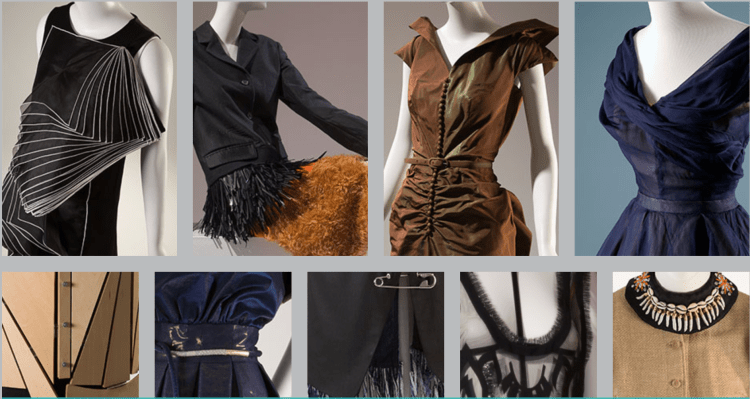
The past ten years have seen a phenomenal rise in the number of cities worldwide that host fashion weeks. Paris, New York, Milan, and London are currently the four leading fashion capitals, but other cities with emerging fashion scenes are beginning to challenge that exclusivity. Governments seeking to “re-brand” their cities as centers of creativity and innovation acknowledge the power of fashion to elevate an international profile.
Also new at the time: The Whitney Museum of American Art’s fancy-schmancy digs in the trendy Meatpacking District.

A far cry from the museum’s former Breuer building home at 75th and Madison, eh?
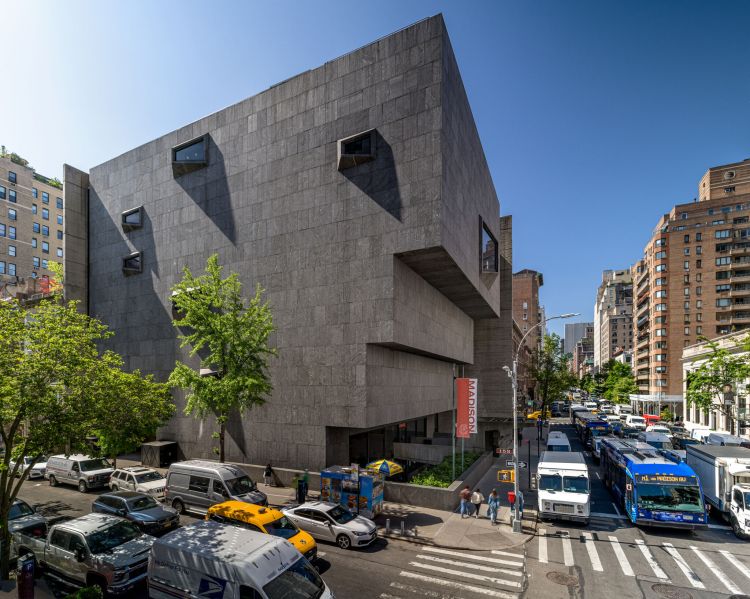
The main event at the new! maybe improved! Whitney was America Is Hard to See (which was funny because we found the costly new building sort of hard to find).

Drawn entirely from the Whitney Museum of American Art’s collection, America Is Hard to See takes the inauguration of the Museum’s new building as an opportunity to reexamine the history of art in the United States from the beginning of the twentieth century to the present. Comprising more than six hundred works, the exhibition elaborates the themes, ideas, beliefs, and passions that have galvanized American artists in their struggle to work within and against established conventions, often directly engaging their political and social contexts. Numerous pieces that have rarely, if ever, been shown appear alongside beloved icons in a conscious effort to unsettle assumptions about the American art canon.
At 600 works it was hard to see it all, but we did our best.
Wending our way uptown, we caught Sinatra: An American Icon at Lincoln Center’s New York Public Library for the Performing Arts (great quote from Bing Crosby: “Frank Sinatra is a singer who comes along once in a lifetime, but why did he have to come in mine?”); The Hirschfeld Century: The Art of Al Hirschfeld at the New-York Historical Society; Revolution of the Eye: Modern Art and the Birth of American Television at the Jewish Museum; and Everything Is Design: The Work of Paul Rand at the Museum of the City of New York. (Fun fact to know and tell: Rand always presented just one concept to his clients. You want other solutions, he would say, talk to other designers.)
The blockbuster exhibits in the Big Town that year were at The Met. First was Sargent: Portraits of Artists & Friends, which “brings together ninety-two of the artist’s paintings and drawings of members of his impressive artistic circle. The individuals seen through Sargent’s eyes represent a range of leading figures in the creative arts of the time such as artists Claude Monet and Auguste Rodin, writers Robert Louis Stevenson and Henry James, and the actor Ellen Terry, among others.”
Our favorites included British illustrator W. Graham Robertson in an elegant coat (When Robertson objected to wearing an overcoat during the summer, Sargent replied, “But the coat is the picture”) . . .

. . . and Robert Louis Stevenson in decline.

The main attraction, though, was China: Through the Looking Glass, a knee-buckling exhibit that occupied parts of three floors of the museum and presented an almost hallucinogenic survey of Chinese-inspired fashion. (Lots of images here, if you’re so inclined.)
We saw almost a dozen other exhibits around town on that trip, as I painstakingly chronicled afterward.
Back at Lincoln Center, we went to see Patti LuPone in Douglas Carter Beane’s Shows for Days, a largely forgettable production outside of one unforgettable act.
Last night, Tony winner and theater grande dame Patti LuPone took it upon herself, during Act II of Shows for Days at Lincoln Center Theater, to remove a cellphone from a texting-addicted theatergoer. LuPone subsequently issued this statement about her heroic actions: “We work hard on stage to create a world that is being totally destroyed by a few, rude, self-absorbed and inconsiderate audience members who are controlled by their phones… I am so defeated by this issue that I seriously question whether I want to work on stage anymore.”
Before the following night’s performance, Ms. LuPhone delivered this curtain speech, which certainly rang true with the audience.
On the way back to Boston we swung by the Yale University Art Gallery for the last day of Whistler in Paris, London, and Venice, “three of his earliest and most innovative sets of etchings, the so-called French, Thames, and Venice Sets.”
From the French Set . . .

From the Thames Set . . .
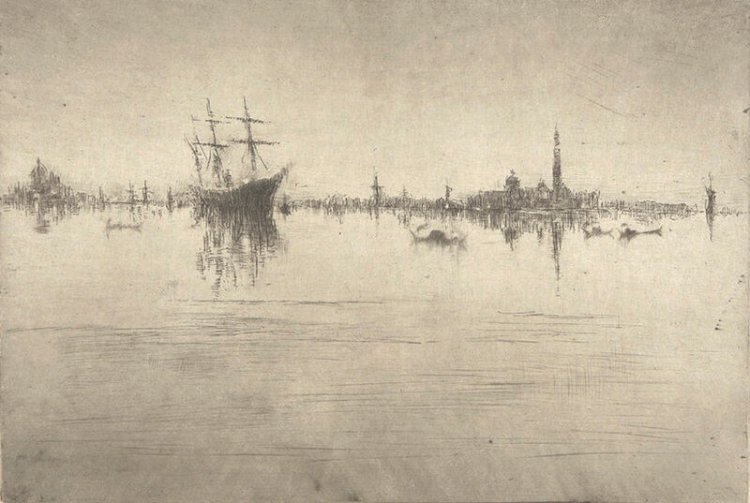
From the Venice Set . . .
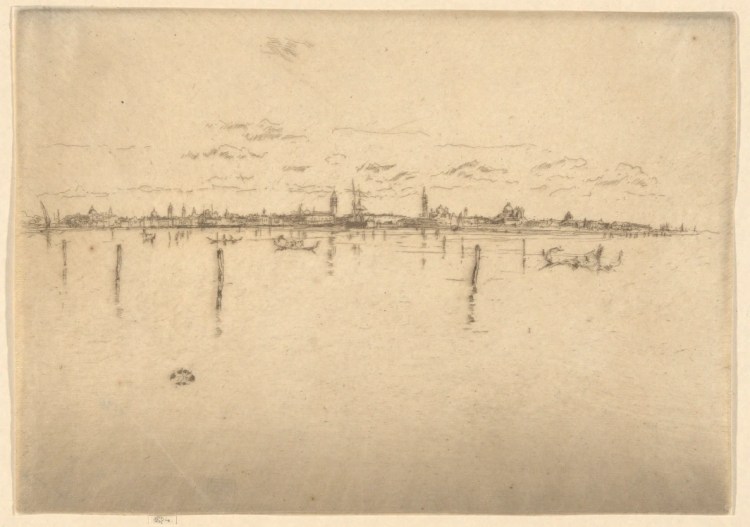
As I wrote when we got home, “Whistler qualifies as one of the greatest etchers in history, and this exhibit showed why. It also featured etchings by some of Whistler’s contemporaries – his brother-in-law Francis Seymour Hayden, Mortimer Menpes, Joseph Pennell – but with all of them the Missus and I had the same reaction: ‘Too many details.’”
A few days later, the Yale exhibit’s curator, Heather Nolin, gave a terrific lecture – Tomatoes, Buckwheat Pancakes, and Art for Art’s Sake: James Abbott McNeill Whistler in London – at Boston’s Museum of Fine Arts.
A fitting coda to our whirlwind weekend of art.
• • • • • • •
Five months later we were back for our annual holiday schlepping spree. The first place the Missus and I went was the Museum of Arts and Design to see Wendell Castle Remastered, “the first museum exhibition to examine the digitally crafted works of Wendell Castle, acclaimed figure of the American art furniture movement.”
Please, have a seat.
Next we wandered from Columbus Circle up to Lincoln Square to catch Art Brut in America: The Incursion of Jean Dubuffet at the American Folk Art Museum.

Art Brut in America: The Incursion of Jean Dubuffet is the first major U.S. exhibition to explore the introduction of art brut to America. The nearly two hundred works of art on view, by both canonical and lesser-known art brut figures, were amassed and identified as art brut by French artist Jean Dubuffet, beginning in 1945. The selection is drawn exclusively from the renowned Collection de l’Art Brut in Lausanne, Switzerland, where Dubuffet donated his collection in 1971.
The website also noted this: “The presentation highlights Dubuffet’s passionate belief in a new art paradigm that was non-Western and non-hierarchical, and that championed creators who are ‘uncontaminated by artistic culture.’”
I’m still not sure what that means, but the exhibit was very Dubuffetish. Except it didn’t include any of his work, just his collection. Brut-al disappointment.
That evening we hied ourselves to Studio 54 to see the Roundabout Theatre Company’s production of Thérèse Raquin, with Keira Knightley in the title role based on Émile Zola’s buzzkill novel.
New York Times critic Ben Brantley was also a buzzkill in his review: “Happiness is never in the cards in this tale of murder and adultery. And that’s as true for audiences at this Roundabout Theater Company production, directed by Evan Cabnet, as it is for our gal Thérèse.”
As I noted back then, the Missus and I aren’t as smart as Ben Brantley, so we liked it.
Bright and (way too) early the next morning, we headed out to the Museum of Modern Art to see the blockbuster Picasso Sculpture.
Over the course of his long career, Picasso devoted himself to sculpture wholeheartedly, if
 episodically, using both traditional and unconventional materials and techniques. Unlike painting, in which he was formally trained and through which he made his living, sculpture occupied a uniquely personal and experimental status for Picasso. He approached the medium with the freedom of a self-taught artist, ready to break all the rules. This attitude led him to develop a deep fondness for his sculptures, to which the many photographs of his studios and homes bear witness. Treating them almost as members of his household, he cherished the sculptures’ company and enjoyed re-creating them in a variety of materials and situations.
Sounds like sculptures got way better treatment than the women in his life.
While we were there, we checked out the excellent exhibit Joaquín Torres-García: The Arcadian Modern, “one of the most complex and important artists of the first half of the 20th century . . . [whose] work opened up transformational paths for modern art on both sides of the Atlantic.”
For example, Construction in Black and White from 1938.

Not to mention Torres-Garcia’s key role in movements from Catalan Noucentismo to Cubism, Ultraism-Vibrationism, and Neo-Plasticism.
Yeah – our heads exploded too. If yours hasn’t yet, here’s a gallery tour.
Also at MoMA at the time: Soldier, Spectre, Shaman: The Figure and the Second World War, which was kind of interesting, and Jackson Pollock: A Collection Survey, 1934–1954, which was kind of meh.
After that we drifted up to the Jewish Museum (free for the goyim on Saturday, although there is a Shabbos elevator for the observant) to take in The Power of Pictures: Early Soviet Photography, Early Soviet Film.
From early vanguard constructivist works by Alexander Rodchenko and El Lissitzky, to the
 modernist images of Arkady Shaikhet and Max Penson, Soviet photographers played a pivotal role in the history of photography. Covering the period from the 1917 Bolshevik Revolution through the 1930s, this exhibition explores how early modernist photography influenced a new Soviet style while energizing and expanding the nature of the medium — and how photography, film, and poster art were later harnessed to disseminate Communist ideology. The Power of Pictures revisits this moment in history when artists acted as engines of social change and radical political engagement, so that art and politics went hand in hand.
 The photography was riveting, as was the screening of Aelita: Queen of Mars, which we watched for 45 headscratching minutes. Here’s the full two hours if you want to take a crack at it. (The Tower of Radiant Energy alone is worth the price of admission.)
Back on planet earth, we moved on to Becoming Jewish: Warhol’s Liz and Marilyn.
The public personas of Elizabeth Taylor and Marilyn Monroe were constructed, but when
 they converted to Judaism, the change for both women was personal and profound. Becoming Jewish: Warhol’s Liz and Marilyn draws parallels between the actresses’ identities as Jewish women and Warhol’s exploration of their celebrity through his image-making.
“Marilyn was a myth,” wrote the journalist Max Lerner in 1962. “And Liz is a legend.” Andy Warhol’s iconic portraits of Marilyn Monroe and Elizabeth Taylor reflect this sentiment. Elizabeth and Marilyn enthralled him: they were beauty, success, and fame personified.
All due respect, double meh.
We also saw Valeska Soares’ Time Has No Shadows (weird and wonderful) and Unorthodox (weird and creepy).
Then we shuffled down to the Roundabout Theatre Company’s revival of Harold Pinter’s Old Times. Here’s what I wrote back then about the production, which featured Clive Owen, Eve Best, and Kelly Reilly.
The set was fairly hallucinogenic: A bee-hived dome with horizontal striations, constantly pulsating, strobing, circling – just like the characters constantly circling each other, and the play constantly circling itself, and the entire set constantly circling sometimes quickly sometimes slowly . . .
It was altogether dizzying. And quite exhilarating.
But not for Sunshine Ben Brantley . . .
The dyspeptic New York Times critic had issues.
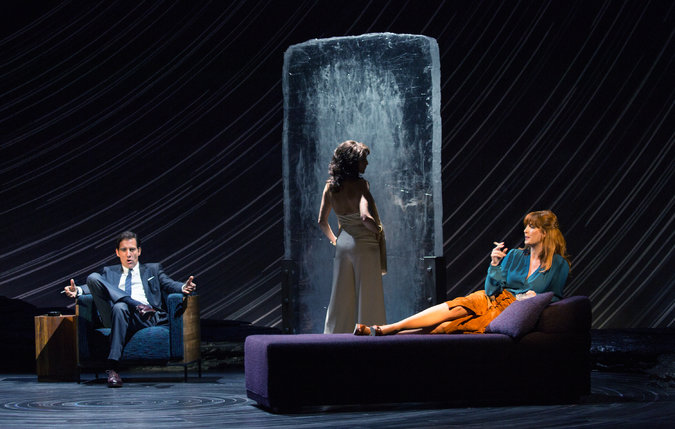
This “Old Times” . . . might be described as an example of Pinter for the Hard of Understanding (i.e., Americans), or for audiences who might otherwise be bored by dialogue in which characters seldom say — or know — what they mean, and spend a lot of time saying nothing at all. Those celebrated Pinter pauses, which classically loom like a purpose-devouring black hole, are in this version plugged with electronic music by Radiohead’s Thom Yorke . . .
This is Pinter with apocalyptic special effects, “Old Times: Armageddon.” And at 70 minutes, it’s far shorter than your average end-of-the-world movie.
Not to get technical about it, but the play ran more like 60 minutes, making it our first Dollar-Fifty-a-Minute Drama. Then again, the folks sitting next to us paid two dollars a minute for the same experience, so we didn’t feel quite so bad in the end.
Our final stop on that trip was the Metropolitan Museum of Art, where we first took in Jacqueline de Ribes: The Art of Style, which featured a countess who said she just wanted to be comfortable when she was backstage organizing ballets and charity events and TV shows and . . . whatever.
Whatever.
After that we checked out Kongo: Power and Majesty, which really nailed the artistic traditions of Central Africa’s Kongo civilization, and the mega-exhibit Ancient Egypt Transformed: The Middle Kingdom, which we sort of mailed in.
The exhibit we absolutely loved, though, was The Luxury of Time.
 This exhibition explores the relationship between the artistry of the exterior form of European timekeepers and the brilliantly conceived technology that they contain. Drawn from the Museum’s distinguished collection of German, French, English, and Swiss horology from the sixteenth through the nineteenth century, the extraordinary objects on view show how clocks and watches were made into lavish furniture or exquisite jewelry.
The creation of timekeepers required that clockmakers work with cabinetmakers, goldsmiths and silversmiths, enamelers, chasers and gilders, engravers, and even those working in sculpture and porcelain. These craftsmen were tasked with accommodating internal mechanisms by producing cases that, in both shape and function, adapted to timekeeping technologies. Their exteriors are often as complicated as the movements they house. Examining the dialogue between inside and out, adornment and ingenuity, The Luxury of Time reveals the complex evolution of European clockmaking and the central place of timekeepers in the history of decorative arts.
Punch in here and here for very cool videos of clocks in motion.
Our personal favorite? The African Princess clock, created by Jean-Baptiste-André Furet (French, ca. 1720–1807).

This bust of an African princess is one of the most remarkable clocks in the Museum’s collection. The marble plinth contains a musical movement: a tiny pipe organ. On the hour, music would play and the figure’s eyes would open, showing the hour in roman numerals in her right eye and the minutes in arabic numerals in her left. By pulling her left earring, her eyes could be opened at any time—a feature that remains functional today.
An eye-opening way to end a swell 72 hours in the Big Town.
• • • • • • •
Now’s as good a time as any to talk about New York coffee shops. Not the trendoid types like the East Village’s Mudspot (“where the downtown set—and NYU freshman—can hang out and dish”) or The Oma, Shop II Coffee+ Lifestyle (“Harlem’s one-stop shop for curated home goods, coffee and a place to get your hair right”).
No – I’m talking about traditional coffee shops, the kind Bernard Brussel-Smith depicted in this 1940 etching.

The Missus and I are longtime habitués of the coffee shops that have peppered – sorry – Madison Avenue on the Upper East Side for decades. One of our favorites was Gardenia Café and Restaurant, which closed in 2007 after 30 years as “a budget diner on a luxury block,” as this New York Times piece by Anthony Ramirez put it.
Along a stretch of Madison Avenue in Manhattan, Chanel and Jimmy Choo share pride of address with a Greek diner called Gardenia, where an attention-seeking fan once lifted a French fry off Joe DiMaggio’s plate and where, at the counter, the “Lonely Guys Club” regularly convened between wives.
Lately, though, its clientele has been woebegone: Gardenia is closing in a few weeks. Although the brownstone that houses Gardenia is owned by the same extended family that owns the restaurant, the relatives in Greece who own the building plan to renovate and lease it to a single top-dollar tenant.
And so Gardenia, established in 1977 and one of the oldest restaurants on the Upper East Side, will yield to that supreme leveler, the New York real estate market.
Dorothy Fernandez, a sales executive at Marina Rinaldi, an Italian apparel designer, eats at Gardenia four times a week. “I don’t want to spend a fortune to eat,” she said. “Just because it’s Madison Avenue and because it’s posh-posh, so? People still need to eat!”
Yeah – they just needed to eat elsewhere.
Gardenia was only one of the 21st Century coffee-shop casualties in the Big Town, as Steve Cuozzo noted in a 2015 New York Post article: “Since 2007, three Madison Avenue diners have closed: the Gardenia, where Joe DiMaggio took many a meal in his waning years, Soup Burg and Viand Cafe at 78th — a favorite of former Mayor Mike Bloomberg’s, and of Robert B. Parker’s fictional PI, Spenser.”
Cuozzo listed six Madison Avenue survivors back then, half of which are now gone. The 3 Guys Restaurant at 89th closed a few years after his piece ran. (The 3 Guys at 96th, which he inexplicably did not list, closed in 2023.) The sole remaining 3 Guys is the one between 75th and 76th, which, sad to say, has long been our least favorite coffee shop of all.
Cuozzo’s other four Madison Avenue survivors included Viand Coffee Shop at 61st (no relation to the one that closed); Nectar Cafe at 79th (which according to Yelp is now closed); Nectar of 82nd, which is wildly overpriced, the better to fleece the daily Met set; and New Amity at 84th, which is just around the corner from St. Ignatius Loyola grammar school where I toiled in relative obscurity for nine long years, and which has also closed.
So now there are three.
We ate in all of them over the years, almost always for lunch. For dinner we tended to eat in actual restaurants, La Bonne Soupe on West 56th and Pergola Des Artistes in the theater district being our regular spots. Eventually, though, the former grew too pricey and the latter too hectic (albeit less so now that it has closed after six decades), so on theater nights we would eat dinner at the Red Flame on West 44th.
It was friendly, reliable, tasty, and affordable (albeit less so now that our go-to Chicken Souvlaki Dinner costs about 40% more than last time we ate there – slightly outpacing the rate of inflation). Regardless . . .
The headline on Steve Cuozzo’s Post piece had it right: You’re going to miss these diners when they get priced out of NYC. And they all will, probably sooner rather than later.
• • • • • • •
The Missus and I were back in the Big Town in April of 2016 and, as was our wont, we headed first to the Fashion Institute of Technology, where Fairy Tale Fashion was on display. The exhibit “attempts to bridge the gap between the significance of dress within fairy tales and the use of the term ‘fairy tale’ in fashion journalism and photography.”
Case in point: These two cloaks interpreting Little Red Riding Hood – one from the late 18th century, the other from Comme des Garçons in 2015.
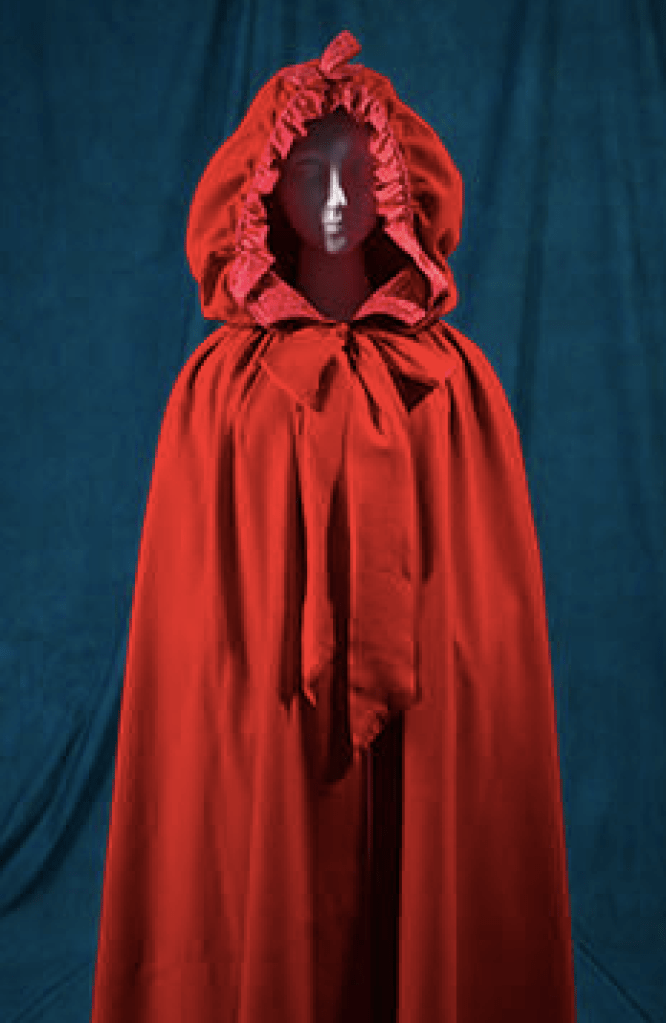

The whole exhibit – from Manish Arora’s Alice in Wonderland . . .

. . . to Thierry Mugler’s The Little Mermaid . . .

. . . was a hoot.
From there we walked 30-plus blocks uptown to catch Studio Job MAD HOUSE at the Museum of Arts and Design.
Studio Job MAD HOUSE is the first American solo museum exhibition of the work of collaborators Job Smeets (Belgian, b. 1970) and Nynke Tynagel (Dutch, b. 1977), who established their atelier, Studio Job, in Antwerp in 2000. Since then, they have developed a distinctive body of highly expressive and opulent work, characterized by pattern, ornament, humor, and historical, sociocultural, and personal narrative.
How personal? Check out “Train Crash,” a table the pair designed in 2015 to reflect the derailment of their romantic relationship.
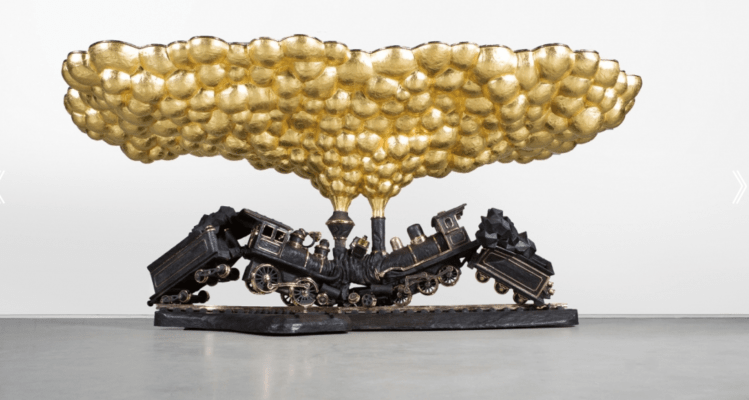
Luckily for us, the pair’s professional relationship stayed on track. Here’s their version of Chartres Cathedral flipped on its back and turned into a cabinet.

Divine!
Then it was on to the Walter Kerr Theatre for the revival of Arthur Miller’s The Crucible with Saoirse Ronan, Ben Whishaw, Ciarán Hinds, and Sophie Okonedo.
As I noted back then, it was a unique theater experience for the Missus and me – not the play, but the audience.
We were sitting in the first row of the mezzanine, where the woman of a certain age next to the Missus decided to take her shoes off and plop her feet on the railing in front of us. She proceeded to wiggle her tootsies, give herself a foot massage, and generally insert her feet into every scene of the play. I half expected her to get a mani-pedi sometime during Act Two.
Anyway, we thought Saoirse Ronan was very good, Ben Whishaw was kind of squishy, and the production overall was interesting but not compelling.
New York Times theater critic Ben Brantley, on the other hand, thought it was fabulous, while Wall Street Journal theater critic Terry Teachout declared it dreadful.
So go figure.
Next day we started off at the Museum of Modern Art’s exhibit Edgar Degas: A Strange New Beauty.
Edgar Degas is best known as a painter and chronicler of the ballet, yet his work as a printmaker reveals the true extent of his restless experimentation. In the mid-1870s, Degas was introduced to the monotype process—drawing in ink on a metal plate that was then run through a press, typically resulting in a single print. Captivated by the monotype’s potential, he immersed in the technique with enormous enthusiasm, taking the medium to radical ends.
A master of a different medium had the spotlight at The Frick Collection: Van Dyck: The Anatomy of Portraiture.
Anthony van Dyck (1599–1641), one of the most celebrated and influential portraitists of all
 time, enjoyed an international career that took him from his native Flanders to Italy, France, and, ultimately, the court of Charles I in London. Van Dyck’s supremely elegant manner and convincing evocation of a sitter’s inner life — whether real or imagined — made him the favorite portraitist of many of the most powerful and interesting figures of the seventeenth century . . . Through approximately one hundred works, the exhibition explored the astounding versatility and inventiveness of a portrait specialist, the stylistic development of a draftsman and painter, and the efficiency and genius of an artist in action.
Some of those one hundred works are here, and this video provides a splendid overview.
The Missus and I never expected to like the show as much as we did, but we did.
Isaac Mizrahi: An Unruly History, on the other hand, we knew would be a gas. His clothing designs are invariably a delight, as the Jewish Museum’s exhibit vividly demonstrated.
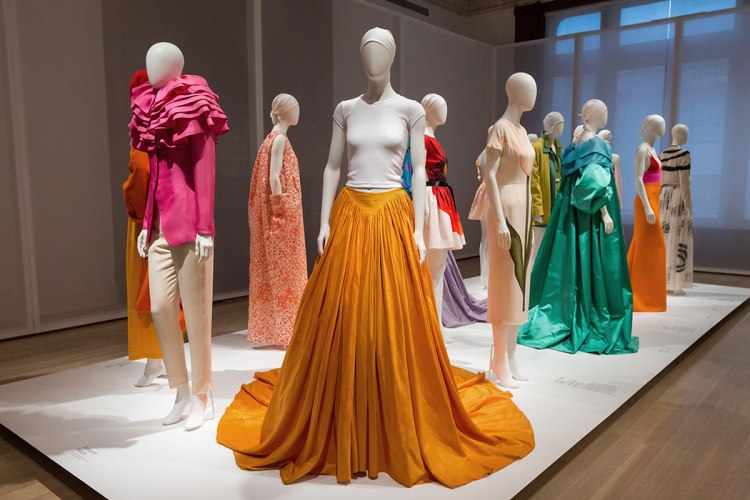

The irrepressible Mizrahi is an equally colorful interview subject. His dialogue/discourse with choreographer Mark Morris at the Jewish Museum was a thoroughly amusing ping-pong match of a conversation.Best Mizrahi one-liner: “Style makes you feel great because it takes your mind off the fact that you’re going to die.”
That night we took in the Roundabout Theatre Company’s revival of Eugene O’Neill’s Long Day’s Journey Into Night featuring Gabriel Byrne and Jessica Lange, who won the 2016 Tony Award for Best Actress in a Play. Here and here tell you why.
Lange was absolutely riveting throughout the production, and thankfully, there were no bare feet nearby to distract us.
Next morning the Missus and I moseyed up to the Metropolitan Museum of Art for Vigée Le Brun: Woman Artist in Revolutionary France, which was a total knockout.
 Elisabeth Louise Vigée Le Brun (French, 1755–1842) is one of the finest 18th-century French painters and among the most important of all women artists. An autodidact with exceptional skills as a portraitist, she achieved success in France and Europe during one of the most eventful, turbulent periods in European history . . .
She was remarkable not only for her technical gifts but for her understanding of and sympathy with her sitters. This is the first retrospective and only the second exhibition devoted to Vigée Le Brun in modern times. The 80 works on view include paintings and a few pastels from European and American public and private collections.
Vigée Le Brun painted more than 600 portraits and became the most famous female artist in Europe. Here’s a short preview of the exhibit and an extensive audio guide.
Then we went from the sublime to Crime Stories: Photography and Foul Play, which “explores the multifaceted intersections between photography and crime, from 19th-century ‘rogues’ galleries’ to work by contemporary artists inspired by criminal transgression.” Unfortunately, photos of the exhibition objects seem to have been pilfered from the Met’s website, a digital crime story of its own.
From the Met mothership we wandered down to The Met Breuer, née the Old Whitney at 75th and Madison, to finish our spring tour with its featured exhibit, Unfinished: Thoughts Left Visible.
This exhibition addresses a subject critical to artistic practice: the question of when a work of
 art is finished. Beginning with the Renaissance masters, this scholarly and innovative exhibition examines the term “unfinished” in its broadest possible sense, including works left incomplete by their makers, which often give insight into the process of their creation, but also those that partake of a non finito—intentionally unfinished—aesthetic that embraces the unresolved and open-ended. Some of history’s greatest artists explored such an aesthetic, among them Titian, Rembrandt, Turner, and Cézanne.
Lots of other examples here, along with this short preview for your consideration.
And that – wait for it – finished that trip to the Big Town.
• • • • • • •
After another extended absence, the Missus and I returned to the city in September of 2017. One of our first stops was the Society of Illustrators at 63rd & Lex to catch FASHION AND SATIRE: The Drawings Of Orson Byron Lowell And Charles Dana Gibson.
The exhibit pairs a collection of satirical illustrations with Gilded Age fashion pieces and accessories. Focusing on the life of “high society” in New York City, the illustrations invite the viewer to understand fashion as a vehicle for representing and interpreting societal ideals in the Gilded Age.
Orson Byron Lowell and Charles Dana Gibson were two of the most influential illustrators of the late 19th and early 20th century, working from about 1890 to 1930. They created fashion-filled compositions that linked dress and witty social commentary. Their observations about people in society and their foibles were artfully represented in popular publications like The Saturday Evening Post, Ladies Home Journal, Vogue and the original Life magazine.
Representative samples:

Then we shuffled up to the Met Breuer to catch Ettore Sottsass: Design Radical.
A seminal figure in 20th-century design, the Italian architect and designer Ettore Sottsass (1917–2007) created a vast body of work, the result of an exceptionally productive career that spanned more than six decades. This exhibition reevaluates Sottsass’s career in a presentation of key works in a range of media—including architectural drawings, interiors, furniture, machines, ceramics, glass, jewelry, textiles and pattern, painting, and photography.
The 177 objects in the exhibition are here, but Sottsass’s truly key work was the Olivetti Valentine portable typewriter, of which he said “I worked sixty years of my life, and it seems the only thing I did is this fucking red machine.”
This video helps to fill in the blanks.
Then it was off to the Jewish Museum for an exhibit featuring one of our favorite artists: Florine Stettheimer: Painting Poetry.
The artist Florine Stettheimer (1871–1944) is an icon of Jazz Age New York. Born to a wealthy Jewish family in Rochester, she studied at the Art Students League in New York City and then in Europe, where she encountered two profound influences: the Symbolist painters
 and poets and, on the eve of the Great War, the Ballets Russes. Returning to Manhattan, she hosted an elite salon together with her sisters Carrie and Ettie and their mother, Rosetta, attracting many of the leading lights of the artistic vanguard. Her circle included Alfred Stieglitz, Carl Van Vechten, Georgia O’Keeffe, Elie Nadelman, Gaston Lachaise, and many others. Among her intimate friends was Marcel Duchamp.
Through over 50 paintings and drawings, a selection of costume and theater designs, photographs and ephemera, as well as critically acclaimed poems, the Jewish Museum will offer a timely reconsideration of this important American artist, revealing Stettheimer’s singular and often satiric vision and significant role in American modern art.
Spring Sale at Bendel’s . . .
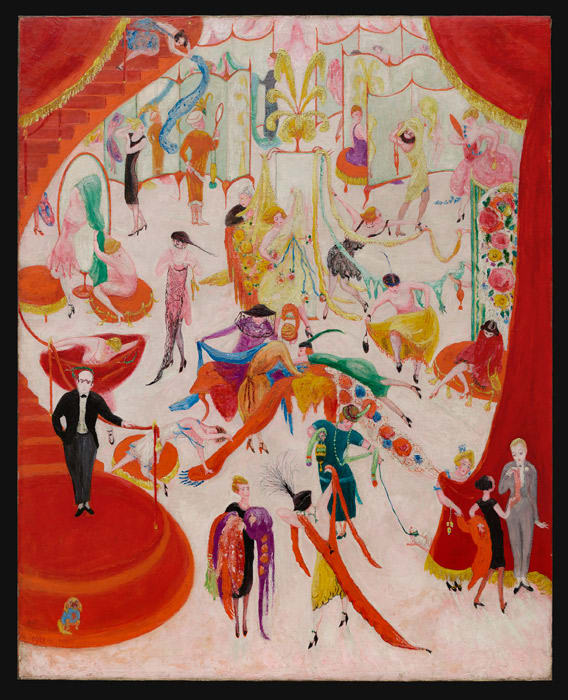
. . . and a couple of self-portraits . . .


. . . and some poetry.
NEW YORK
At last grown young
with noise
and color
and light
and jazz
dance marathons and poultry shows
soulsavings and rodeos
gabfeasts and beauty contests
sky towers and bridal bowers
speakeasy bars and motor cars
columnists and movie starsOne last stanza: “Art is spelled with a Capital A/And Capital also backs it—/Ignorance also makes it sway/The chief thing is to make it pay.”
Irony alert: Stettheimer rarely sold her art, saying at one point “letting people have your paintings is like letting them wear your clothes.” Beyond that, according to Helen Holmes in The Observer, “at the end of her life, she directed her sister to burn all of the artwork she ever produced, an order that her sister fortunately did not follow.”
Very fortunately. You don’t have to take my word for it, though. Check out Christopher Benfey’s New York Review of Books piece, The Bruegel of Bendel’s, for further details.
Also at the Jewish Museum, the work of another favorite artist of ours – Modigliani Unmasked.
 Modigliani Unmasked considers the celebrated artist Amedeo Modigliani (Italian, 1884-1920) shortly after he arrived in Paris in 1906, when the city was still roiling with anti-Semitism after the long-running tumult of the Dreyfus Affair and the influx of foreign emigres. Modigliani’s Italian-Sephardic background helped forge a complex cultural identity that rested in part on the ability of Italian Jews historically to assimilate and embrace diversity. The exhibition puts a spotlight on Modigliani’s drawings, and shows that his art cannot be fully understood without acknowledging the ways the artist responded to the social realities that he confronted in the unprecedented artistic melting pot of Paris.
 Modigliani responded like this . . .

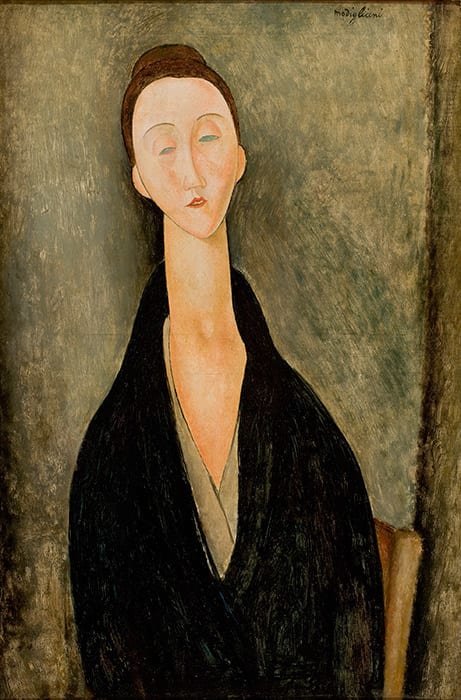

Much more in this video, so don’t give us that long face.
That night the Missus and I headed over to the American Airlines Theatre for the Roundabout Theatre Company production of J.B. Priestley’s Time and the Conways starring Elizabeth McGovern. I remember exactly nothing about the play, although I did write at the time that McGovern gave a splendid performance, adding this: “It’s that rare play that grows more and more interesting as it unfolds, with a satisfying, if unsettling, ending.”
I’ll take my word for it.
The next morning we drifted by The Metropolitan Museum of Art, where we poked around Sara Berman’s Closet.
 The meticulously organized, modest closet in which Sara Berman (1920–2004)—an immigrant who traveled from Belarus to Palestine to New York—kept her all-white apparel and accessories both contained her life and revealed it. Inspired by the beauty and meaning of Berman’s closet, the artists Maira and Alex Kalman (who are also Berman’s daughter and grandson) have recreated the closet and its contents as an art installation.
The exhibition also recreated Berman’s closet from the small Greenwich Village flat she occupied between 1982 and 2004.
With its neatly arranged stacks of starched and precisely folded clothing, the closet is presented
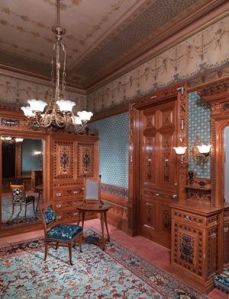 as a small period room in dialogue with The Met’s recently installed Worsham-Rockefeller Dressing Room from 1882, which features clothing from the 1880s of the type that Arabella Worsham, a wealthy art patroness, might have worn. Despite vast differences of scale and ornament, and the separation of 100 years, the two rooms show there were similarities between the life stories of Berman and Worsham (c. 1850–1924). Both began as women of limited means who, by their own ingenuity, created new lives for themselves in New York.
It was all quite engaging, as was Adrián Villar Rojas’s The Theater of Disappearance on the Met’s Roof Garden.

Argentinian artist Adrián Villar Rojas has transformed the Cantor Roof with an intricate site-specific installation that uses the Museum itself as its raw material. Featuring detailed replicas of nearly 100 objects from The Met collection, The Theater of Disappearance encompasses thousands of years of artistic production over several continents and cultures, and fuses them with facsimiles of contemporary human figures as well as furniture, animals, cutlery, and food. Each object—whether a 1,000-year-old decorative plate or a human hand—is rendered in the same black or white material and coated in a thin layer of dust.
Sound crazy? It was a knockout, as this short video suggests.
Then the Missus and I disappeared from the Big Town for the next six months.
– to be continued –
-
The Arts Seen in New York City (Act One)
Over the past four decades there have been – scattered across our many journeys like sprinkles atop an ice cream cone – the numerous trips the Missus and I have made to The Big Town.
From the mid-’80s through the mid-’90s, we traveled there several times a year for the Missus to deliver her trend forecasting and product development insights to her myriad – and extremely lucky – footwear manufacturing clients.
Other times during those years we went just for the fun of it, drinking in the museums, the art galleries, the theatrical productions, and the coffee shops.
For the most part we traveled to New York on the Eastern Airlines Shuttle, which launched in 1961 and offered hourly departures from Boston to New York for around $12. By 1986 the flight cost more like 60 bucks – which is $166 in today’s dollars (plus the four cab fares to and from Logan and LaGuardia) – but that was okay, because here’s what Eastern’s ad campaign promised back then.
That’s right – “a guaranteed seat without a reservation,” even if you were the only one on the flight. (That never happened with me and the Missus, for those of you keeping score at home.)
What did happen to us quite often was the weather. In the winter there were snowstorms; in the summer, thunderstorms. One stormy evening our flight to Logan got diverted to Albany, where airline personnel put us on a school bus that had no rest room and a governor on its engine so it couldn’t go above 55 mph. At the Carlton rest stop on the Mass. Pike, the guy sitting in front of us re-boarded with a Big Gulp. You bet that kept us awake the rest of the way home.
More often, though, flights would just be cancelled, leaving us to make a mad dash for the New York Port Authority Bus Terminal in Times Square to catch the next Greyhound to Boston.
The worst was the bus ride when a) I had no reading light, and b) the young gal sitting in front of us reclined her seat all the way back and talked non-stop on her cell phone for the first hour of the trip. I finally leaned forward and said, “Excuse me, miss, but I’m learning far more about your personal life than I’m really comfortable with.”
She gave me her factory-installed OK Boomer look, grumpily signed off with her bestie, and returned her seatback to its full upright position.
I happily slept the rest of the way home.
In 1989 the Eastern shuttle got sold to Donald Trump, who – as Andrew Curran noted at Simple Flying – screwed it up in record time.

The Trump Shuttle operated a fleet of Boeing 727-100s and 727-200s between Boston, New York, and Washington DC. The airline first took to the air in mid-1989. Fourteen months after that first flight, Trump Shuttle defaulted on a $1.1 million debt payment.
Within two years of the first flight, there were active negotiations to sell the airline. By mid-1992, the Trump Shuttle had ceased to exist. It was rebranded, bought by US Airways, and subsequently absorbed into American Airlines.
The Missus and I are lifelong Never Trumpers, so when he took over we switched to the Pan Am shuttle, which Delta bought in 1991. According to Wikipedia, Delta was “the last of the shuttle operations to guarantee a seat to walk-up passengers. If a plane was oversold, a second plane would be rolled out within fifteen minutes to form an ‘extra section’ to fly the overflow passengers. This practice ended in 2005.”
Well before then, however, the Missus and I had stopped flying to New York and started driving there. It was a vastly improved travel experience, not to mention a helluva lot cheaper.
• • • • • • •
Once we arrived in the Big Town, of course, we needed somewhere to stay. Our choice of hotels tended to go in spurts. During the Footwear Era (even I had some shoe clients for a few years), we stayed at the New York Hilton on Sixth – sorry, Avenue of the Americas – at 54th Street. That’s where the Shoe People congregated, so we did too.
Eventually we migrated across Sixth to The Warwick, which was nice but gradually grew less so. During the next five years we mostly stayed at the Club Quarters on West 45th, which was largely affordable because we piggybacked on my brother Bob’s corporate discount.
We also did a nice stretch at The Salisbury on West 57th, which was owned by the next-door Calvary Baptist Church. The rooms were fine, the staff actually remembered us (largely because the Missus is both gracious and generous), and you could get a discount if you attended church services during your stay. The Missus and I never did, for those of you keeping score at home.
(We still have a Salisbury Hotel ballpoint pen, a remnant of that bygone era when amenities like pens and hotel stationery routinely came with your room. Nowadays, you’re lucky if a room comes with your room.)
For a while we ditched hotels for a rental apartment on West 70th off Broadway. It was a clean, airy place up four flights of stairs, which was a bit of a strain. Eventually the place got renovated, which made its new nightly rate even more of a strain, so we moved on. Unfortunately, the next apartment we rented was a Kips Bay flat where someone actually lived between rentals, which turned out to be kind of creepy.
Our final shot at apartment hopping found us in Brooklyn’s Park Slope, that hallowed haven of curated cuisine and bespoke baby strollers. (Don’t ask – we had somehow thought we might one day move back to the city, but we soon came to our senses.) A bigger problem than the terminal tweeness of the neighborhood: It was a 55-minute subway ride to The Met. Game over for any borough but Manhattan.
And so we went back to booking hotel rooms.
The final hotel we landed in was the New York Manhattan on 32nd Street between Fifth and Broadway, in the heart of Koreatown. At first it was a swell place to stay – reasonable rates, comfortable accommodations, elevators a little slow but no big deal. Over time, unfortunately, the bean counters jacked up the rates, removed most of the comforts from the rooms (hey – could we get a chair in here, please?), and generally made it a depressingly bare-bones place to stay.
Then the pandemic came along, and we didn’t stay anywhere in the Big Town.
• • • • • • •
In the Before Times, whenever the Missus and I went to New York – however we got there, wherever we stayed, whatever the reason – all we really cared about was the cultural life of the city. We could easily do and see more in three days than most people we knew would do or see in a week.
Take, for instance, this recap I wrote of a March, 2010 trip the Missus and I took to the city.
WEDNESDAY
Any day that Page One of both the New York Times and the Wall Street Journal features a piece about 17th century Italian painter Caravaggio is bound to be a good art day.
Even in Chelsea.
The Missus and I normally avoid the galleries in that trendoid neighborhood of New York because they’re, well, trendoid. But the current crop of exhibits turned out to be okay.
 One Gagosian Gallery in Chelsea had sculptures by Alexander Calder, another had sculptures by David Smith. Pace Wildenstein showcased Joseph Beuys’ anarchic assemblages/sculptures, while Betty Cuningham exhibited William Bailey’s Giorgio Morandiesque still lifes.
(Sorry, I’m not on this earth long enough to link everything.)
Best of the bunch: the Julie Saul Gallery exhibit of watercolors by Maira Kalman (“a cross between Florine Stettheimer and Milton Avery,” as the Missus rightly noted).
 Later on, we caught Remembering Mr. Maugham, a thoroughly engaging two-man play adapted by playwright/director Garson Kanin from his memoir about his lifelong friendship with playwright/novelist/essayist W. Somerset Maugham. It was smart, literate (of course), and at times moving. Our only criticism: It ran for just one week.
THURSDAY
 Speaking of Milton Avery, the Knoedler Gallery [shuttered the following year for massive art fraud] currently features Milton Avery: Industrial Revelations through May 1st. It’s a side of Avery the Missus and I had never seen, and apparently we’re not the only ones.
Also worth seeing: Allen Tucker’s portraits and Betty Parsons’ wood constructions at Spanierman, George Segal’s humanoid sculptures at L&M Arts (The Missus: “In black they’re even more lifelike. It’s creepy.”), and the inestimable Man Ray at Zabriske.
On to the Metropolitan Museum of Art, where we tagged along on two guided tours: Fashion in Art, which I was allowed to attend with some suspicion, since apparently that daily tour doesn’t get much traffic from the Y-chromosome set; and the daily Modern Art tour, during which we lasted a grand total of three paintings, thanks to our tour guide’s well, let’s just say, eccentricities.
FRIDAY
Start with a quick bang-around of Midtown galleries:
 An impressive show of Yvonne Jacquette’s New York urbanscapes at D C Moore, an odd African Americans: Seeing and Seen 1766-1916 exhibit at the Babcock Gallery, Denis Darzaco’s gravity-defying photographs at Laurence Miller, and Seventy Years Grandma Moses at Galerie St. Etienne. Two observations:
1) a little Grandma Moses goes a long way;
2) a lot of Grandma Moses went out Galerie St. Etienne’s door: 37 of the 70 painting in the exhibit sold in a little over a month.
Next up: The Approaching Abstraction exhibit at the American Folk Art Museum, which was sort of interesting but not engaging.
And then on to the Museum of Modern Art for Marina Abramovic: The Artist Is Present.
MoMA’s description:
“This performance retrospective traces the prolific career of Marina Abramović (Yugoslav, b.
 1946) with approximately fifty works spanning over four decades of her early interventions and sound pieces, video works, installations, photographs, solo performances, and collaborative performances made with Ulay (Uwe Laysiepen). In an endeavor to transmit the presence of the artist and make her historical performances accessible to a larger audience, the exhibition includes the first live re-performances of Abramović’s works by other people ever to be undertaken in a museum setting.”
Loosely translated, this blockbuster performance art retrospective features (not necessarily in this order): nude women standing around, a naked guy lying under a skeleton, a guy with clothes on (!) just lying there with concrete blocks under his head and feet, and endless videos of Abramovic’s history of, yes, nudity, self-mutilation, sexual acts, screaming for no apparent reason, more nudity while hitting herself in the chest with a skull, more random screaming, more random nudity, and etc.
(You can see for yourself here.)
[For those of you keeping score at home, in early 2024 John Bonafede – one of the naked performance artists – sued MoMA, “saying that officials neglected to take corrective action after several visitors groped him during a nude performance for the 2010 retrospective Marina Abramovic: The Artist Is Present,” as Zachary Small reported in the New York Times.]
As a special bonus, the artist herself was appearing in MoMA’s Atrium (as she will throughout the exhibition) in a performance piece that largely consisted of her sitting stone-faced at a table while a succession of people sit across from her, some – wait for it – in various states of nudity. (For a more – I dunno – fleshed-out picture, see this Times review.)
At a certain point the Missus said, “Could we just go look at some real art?” so we went to the permanent galleries to do a little homework on Mark Rothko, since we were going to see [John Logan’s play] Red later on.
 But first we swung by the International Center of Photography for Twilight Visions: Surrealism, Photography, and Paris.
From the ICP:
“[P]hotographers such as Jacques-André Boiffard, Brassaï, Ilse Bing, André Kertész, Germaine Krull, Dora Maar, and Man Ray used fragmentation, montage, unusual viewpoints, and various technical manipulations to expose the disjunctive and uncanny aspects of modern urban life.”
On the topic of exposing, the ICP also has an exhibit featuring the “reclusive and mysterious” Czech photographer Miroslav Tichý. “Now over eighty years old, Tichý is a stubbornly eccentric artist, known as much for his makeshift cardboard cameras as for his haunting and distorted images of women and landscapes, many of them taken surreptitiously.”
In other word, a peeper/stalker. Creepy.
 A play about Mark Rothko at the height of his artistic powers and fame, Red is a knockout. It takes place in Rothko’s studio mostly in 1949, and there’s lots of talk about abstract expressionism, pop art, and . . . Caravaggio! At one point Rothko (played by the commanding Alfred Molina) waxes eloquent about Caravaggio’s Conversion of Paul, which occupies a dark corner in Rome’s Santa Maria del Popolo and “makes its own light.”
Just the way Red does.
SATURDAY
 One last excursion before heading back home:
A return trip to the Jewish Museum for Alias Man Ray (sadly, just closed).
It was just as good as the first time.
Lively, exhilarating, and typical of trips to the city mapped out by the Missus.
• • • • • • •
We were extremely lucky that we got to see so many major Broadway productions back then, long before it started costing half a month’s rent to catch a show in the Big Town.
Our four decades of theatergoing got off to an auspicious start in 1980 with two amazing musical productions. The first featured Patti LuPone’s transcendent performance in Andrew Lloyd Webber & Tim Rice’s Evita (thank you, Marvelous Marvin Sutton). Here’s how she sounded on her final night in that role.
As one commenter recalled, “I will never forget when she sang this, half the audience was on its feet with tears running down our faces and she too was crying. It was simply extraordinary, beautiful.”
The other production showcased the magical pairing of Angela Lansbury and Len Cariou in Stephen Sondheim’s Sweeney Todd, part of which they reprised during Sondheim’s 75th birthday celebration at the Hollywood Bowl in 2005.
Still tasty after all those years.
P.S. Here’s how the two looked in the original production.

(Full disclosure: I’m pretty sure we saw that production, but the Missus has her doubts, believing we saw the 1982 production with Angela Lansbury and George Hearn, for those of you keeping score at home.)
The ’80s also brought us George C. Scott, Kate Burton, and Nathan Lane in Noël Coward’s Present Laughter; Matthew Broderick in Neil Simon’s Brighton Beach Memoirs; Jeremy Irons, Glenn Close, and Christine Baranski in Tom Stoppard’s The Real Thing; Judd Hirsch and Mercedes Ruehl in Herb Gardner’s I’m Not Rappaport; and Lindsay Duncan and Alan Rickman in a gorgeous production of Christopher Hanson’s Les Liasons Dangereuses. Here they are in a clip from the 1987 Tony Awards (what was presenter Mary Tyler Moore thinking?).
We rounded out the ’80s by catching Madonna’s forgettable performance in David Mamet’s Speed-the-Plow, James Naughton’s memorable one in City of Angels, and Tom Hulce in the 1989 Broadway premiere of Aaron Sorkin’s A Few Good Men. He was superb and should’ve gotten the movie role, but Tom Cruise was bigger box office, so there you go.
We were lucky enough to see Maggie Smith as the hilariously ahistorical docent in Peter Shaffer’s Lettice and Lovage, for which she won the 1990 Tony Award for Best Actress in a Play. Her co-star Margaret Tyzack won Best Featured Actress in a Play. (Here they are at the 1990 Tony Awards.)
The early ’90s brought some other familiar faces to the Broadway stage: Stockard Channing in John Guare’s Six Degrees of Separation and Richard Chamberlain in Alan Jay Lerner’s My Fair Lady (don’t laugh – he was really good).
Also really good: the theatrical offerings in 1994, starting with the great Philip Bosco and Rosemary Harris in J.B. Priestley’s An Inspector Calls. The Missus met Bosco at a charity event some years later, after we had seen him in Michael Frayn’s Copenhagen, an incredibly complex drama about a 1941 meeting between the physicists Niels Bohr and Werner Heisenberg. She told him how terrific we found his performance and asked if he would be doing anything similar soon. He replied that he couldn’t do plays that complicated any more – his memory wasn’t good enough. That was sad, but he was wonderfully kind to the Missus.
Then we bought tickets for Glenn Close’s final performance in Andrew Lloyd Webber/Don Black/Christopher Hampton’s Sunset Boulevard. As the theater lights dimmed, an announcement came over the loudspeaker: “The role of Norma Desmond tonight will be played by . . . [gasps, groans, curses] . . . Glenn Close.” The audience was not amused – and, given the production that ensued, only mildly entertained.
Bebe Neuwirth, on the other hand, was something else in the Broadway revival of George Abbott and Douglas Wallop’s Damn Yankees. The Missus and I had only known her as Frasier Crane’s buttoned-down wife Lilith in the sitcom Cheers. As Lola, she was the polar opposite. (Full disclosure: New York Times critic David Richards liked it a lot less than we did.)
In subsequent years we were fortunate enough to witness many other notable Broadway performances, among them the following . . .
• Marian Seldes in the Vineyard Theatre’s 1994 production of Edward Albee’s Three Tall Women. New York Times critic Ben Brantley called her performance, along with that of Myra Carter, “two of the most riveting performances in town.”
• Philip Bosco and Cherry Jones in Ruth and Augustus Goetz’s The Heiress, the 1995 Tony Award winner for Best Revival of a Play and Best Actress in a Play.
• Zoe Caldwell and Audra McDonald in a masterly production of Terrence McNally’s Master Class, for which they won the 1996 Tony Awards for Best Actress in a Play and Best Featured Actress in a Play. This contemporaneous Reviewer’s Reel will tell you why – especially at the beginning for Caldwell’s acid-tongued Maria Callas, and at 17:54 for McDonald’s spectacular Sharon.
• George Grizzard, Rosemary Harris, and Elaine Stritch in Edward Albee’s A Delicate Balance (1996 Tony Awards: Best Revival of a Play, Best Actor in a Play).
• Al Pacino in Hughie, Eugene O’Neill’s one-act play that was our first Dollar-a-Minute Drama (50 bucks, 50 minutes), though certainly not our last.
• Janet McTeer as a riveting Nora Helmer in Henrik Ibsen’s A Doll’s House, 1997 Tony Award winner for Best Revival of a Play and Best Actress in a Play. (The quality of this video is pretty poor, but the acting is really good.)
• Ann Reinking, Bebe Neuwirth, Joel Grey, and James Naughton in the original Broadway production of Chicago. Here’s Reinking and Naughton (who won the 1997 Tony Award for Best Actor in a Musical; Neuwirth won Best Actress in a Musical) in a rollicking performance of “We Both Reached for the Gun” on the Rosie O’Donnell Show.
• Alan Alda, Victor Garber, and Alfred Molina in a “minimalist, clean and attractively geometric” production of Yazmina Reza’s Art, which won the 1998 Tony Award for Best Play.
• Brian Dennehy and Elizabeth Franz in Arthur Miller’s Death of a Salesman, 1999 Tony Award winner for best Revival of a Play, Best Actor in a Play, and Best Featured Actress in a Play. (Receipts here.)
• Mary-Louise Parker as a brilliant, haunted math nerd in David Auburn’s Proof, 2000 Tony Award winner for Best Play and Best Actress in a Play.
• Elaine Stritch as very much herself in Elaine Stritch at Liberty, 2002 Tony Award winner for Special Theatrical Event. (Her performance at London’s Old Vic Theatre is here.)
• Lindsay Duncan and Alan Rickman together again – this time in Noël Coward’s Private Lives, 2002 Tony Award winner for Best Revival of a Play and Best Actress in a Play. (Please do your best to ignore the video’s – I dunno, Russian? – subtitles.)
• John Lithgow as J.J. Hunsecker in the Broadway musical version of Sweet Smell of Success, with music by Marvin Hamlisch and book by John Guare. No one can touch Burt Lancaster’s cut-glass turn as the “powerful and sleazy newspaper columnist” in the 1957 movie, but Lithgow did well enough to earn the 2002 Tony Award for Best Actor in a Musical.
• Ashley Judd and Ned Beatty in the 2003 revival of Tennessee Williams’ Cat on a Hot Tin Roof. The play also featured Margo Martindale as Big Mama and Jason Patric as a thoroughly inebriated Brick.
Eight years later Patric delivered an equally soggy performance as the perpetually drunk Tom Daley in the revival of That Championship Season (written by his father Jason Miller), which featured a starry cast of Brian Cox (excellent), Kiefer Sutherland (very good), Jim Gaffigan in his Broadway debut (very impressive), and Chris Noth (very unimpressive).
Fun facts to know and tell: 1) Those were Patric’s only two Broadway performances, and 2) his maternal grandfather was Jackie Gleason. Your punchline goes here.
• Frank Langella, Ray Liotta, and Jane Adams in Stephen Belber’s Match, about which I remember just three things: 1) Ray Liotta didn’t know a bunch of his lines; 2) Jane Adams didn’t know any of hers – she carried a script on stage for the entire performance (to be fair, she’d been parachuted in as a last-minute replacement for the part); and 3) Frank Langella seemed kind of pissed at both of them.
• Cherry Jones and Brian F. O’Byrne in John Patrick Shanley’s Doubt, which won the 2005 Tony Award for Best Play. Jones’s stark portrayal of Sister Aloysius produced both a) shuddering flashbacks to my eight years at St. Ignatius Loyola in the care of the laughingly named Sisters of Charity, and b) the 2005 Tony Award for Best Actress in a Play.
• Kathleen Turner and Bill Irwin in a smashmouth production of Edward Albee’s Who’s Afraid of Virginia Woolf?, which won Irwin a 2005 Tony Award for Best Actor in a Play.
• Christine Ebersole (as “Little” Edie Beale) and Mary Louise Wilson (as Edith Bouvier Beale) in Scott Frankel/Michael Korie/Doug Wright’s Grey Gardens. Here’s Ebersole singing The Revolutionary Costume of Today at the 2007 Tony Awards, where she won Best Actress in a Musical (Wilson won Best Featured Actress in a Musical).
Extremely Edie-fying, wouldn’t you say?
• Julie White as a hilariously scorched-earth Hollywood agent in Douglas Carter Beane’s The Little Dog Laughed, for which she won the 2007 Tony Award for Best Actress in a Play.
• Frank Langella and Michael Sheen in Peter Morgan’s Frost/Nixon, which earned Langella the 2007 Tony Award for Best Actor in a Play.
• Angela Lansbury and Marian Seldes as former tennis partners in Terrence McNally’s Deuce. It was great seeing those two wonderful actresses on stage together.
• Liev Schreiber in Eric Bogosian’s Talk Radio. Here’s the lede to Ben Brantley’s review in the New York Times.
Liev Schreiber doesn’t merely fill a stage, as great actors are said to do. In the gut-grabbing revival of Eric Bogosian’s “Talk Radio,” which opened last night at the Longacre Theater, Mr. Schreiber’s presence seems to fill the air as inescapably as weather. You get the feeling that even if you shut your eyes and plugged your ears, he would still be gnawing at your senses and manipulating your mood.

Well, that’s how God is supposed to be, right? Omnipresent, invasive, all-seeing. And Mr. Schreiber is playing Barry Champlain, an abrasive radio talk show host who, as another character puts it, has seen the face of God — “in the mirror.”
In the course of “Talk Radio,” set during one eventful night broadcast in a Cleveland studio, Barry will be forced to confront another, less august image of himself, offered up by the sort of lonely, angry people who regularly phone in. What Barry glimpses allows Mr. Schreiber to provide the most lacerating portrait of a human meltdown this side of a Francis Bacon painting.
No argument here.
• James Gandolfini, Marcia Gay Harden, Jeff Daniels, and Hope Davis in Yasmina Reza’s God of Carnage, which won the 2009 Tony Award for Best Play. As I noted elsewhere at the time, “James Gandolfini very convincingly played not-Tony-Soprano, but Marcia Gay Harden stole the show as his wife,” which won her the 2009 Tony Award for Best Actress in a Play.
• A riveting Jane Fonda as an American musicologist wrestling with both Lou Gehrig’s disease and Beethoven’s genius in Moisés Kaufman’s 33 Variations.
• Janet McTeer (Mary) and Harriet Walter (Elizabeth) in Friedrich Schiller’s Mary Stuart. The Missus and I agreed that both delivered terrific performances, but Walter won the Queen-off.
• Angela Lansbury in Noël Coward’s Blithe Spirit, in which her madcap portrayal of Madame Arcati won her the 2009 Tony Award for Best Featured Actress in a Play.
Remarkably, just a few months later she was back on Broadway in Stephen Sondheim’s A Little Night Music, submitting a touching turn as Madame Armfeldt.
Here’s what I wrote back then: “As we left the theater, the Missus commented that the musical emphasized the raunchy elements at the expense of the lyrical and tender ones, and I entirely agree. Meanwhile, Catherine Zeta-Jones did a bit of scenery-chewing in her role as Desirée Armfeldt, but at least she didn’t have to floss between scenes.”
Full disclosure: Zeta-Jones won the 2010 Tony Award for Best Actress in a Musical Play, so what do I know.
• Liev Schreiber and Scarlett Johansson in Arthur Miller’s A View From the Bridge. He was compelling as Eddie Carbone and she was even better as the niece he burned for, winning the 2010 Tony Award for Best Featured Actress in a Play.
• Laura Linney and Eric Bogosian in Donald Margulies’ Time Stands Still, a meditation on journalism and war and loss and compromise.
And that brought us to 2011.
• • • • • • •
(What follows is a Whitman’s sampler of what the Missus and I caught during our many trips to the city between 2011 and 2014, along with links to my recaps when we got back home.)
In the summer of 2011, the Big Exhibit in the Big Town was Alexander McQueen: Savage Beauty at the Metropolitan Museum of Art.

The exhibition, organized by The Costume Institute, celebrates the late Alexander McQueen’s extraordinary contributions to fashion. From his Central Saint Martins postgraduate collection of 1992 to his final runway presentation, which took place after his death in February 2010, Mr. McQueen challenged and expanded the understanding of fashion beyond utility to a conceptual expression of culture, politics, and identity. His iconic designs constitute the work of an artist whose medium of expression was fashion. The exhibition features approximately one hundred ensembles and seventy accessories from Mr. McQueen’s prolific nineteen-year career.
It was an eye-popping tribute to the unique vision of a fashion designer who cut his dresses long but his life short at the age of 40. Very sad, indeed.
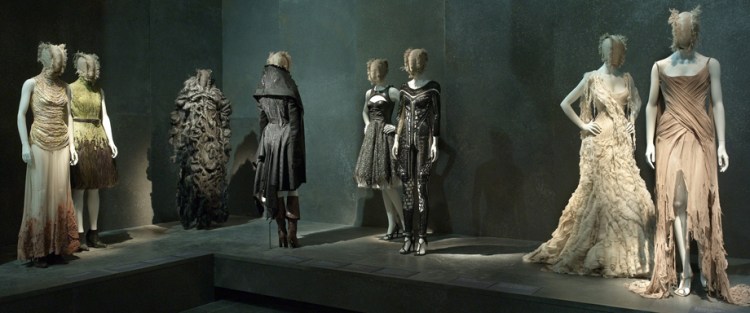

Ten blocks north at the Cooper-Hewitt National Design Museum, Set in Style: The Jewelry of Van Cleef & Arpels was on glittering display. Here’s a gallery tour with installation designer Patrick Jouin.
At the time I called it “one giant product placement (literally) for the upscale jeweler.” New York Times critic Karen Rosenberg was far less gentle.
“The recipe for making an exquisite piece of jewelry is akin to haute cuisine: masters employ special techniques to mix and adorn top-quality ingredients, creating something that is far greater than the sum of its parts.” So says the unctuous wall text introducing “Set in Style: The Jewelry of Van Cleef & Arpels,” a banquet of the most distasteful variety at the Cooper-Hewitt
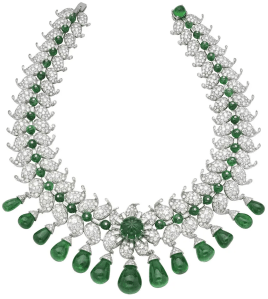 National Design Museum.
Van Cleef & Arpels, the century-old French jewelry firm, is the show’s primary sponsor and has supplied much of its megacarat menu: some 350 lavish pieces worn by royals, screen sirens and social swans.
The extravagance isn’t the nauseous part; staggering displays of wealth don’t look out of place in this former Carnegie mansion. But allowing a luxury brand that’s still very much in existence to bankroll its own exhibition — one that often looks as if it were put together by the company’s creative directors — does not seem like a smart move, even if it draws A-listers to the opening-night gala.
Ouch.
Far better was Color Moves: Art and Fashion by Sonia Delaunay, a collection of the under-appreciated artist’s textile and fashion designs. New York Times critic Roberta Smith called it “a sumptuous and enlightening show . . . that may change forever the way you look at dry goods.”
Fabric samples:
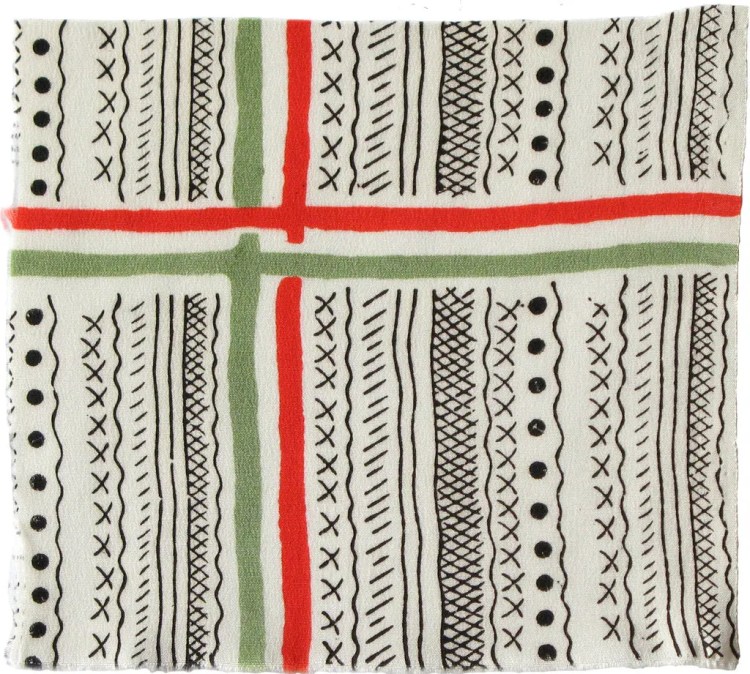

That might have been the last Cooper-Hewitt exhibit the Missus and I truly enjoyed. Soon after, the museum went full-tilt high tech in both the subjects and the presentation of its exhibits. Here’s how contributing writer Jimmy Stamp described the latter in a 2014 Smithsonian Magazine piece.
Throughout the museum, a series of new interactive features enhance the experience of every exhibition. Foremost among them is The Pen . . . a digital stylus given to every visitor to help them interact with the objects on display. Here’s how it works: every wall label includes a small cross symbol and an identical symbol is on the top of The Pen—when the two are pressed together, The Pen vibrates to signal the interaction, and the object is saved to your personal online collection, which is keyed to either your ticket or a unique user profile.
End result: That “alternative to passive audio guides” had people of all ages dashing hither and thither to randomly joy-stick wall labels at exhibits like Access+Ability (“Fueled by advances in research, technology, and fabrication, this proliferation of functional, life-enhancing products is creating unprecedented access in homes, schools, workplaces, and the world at large”) or The Senses: Design Beyond Vision (“Explore experimental works and practical solutions designed to inspire wonder and new ways of accessing our world”).
The Missus and I guessed that most people were unlikely to look even once at the objects in their feverishly assembled “personal online collection,” which meant they’d never see the objects at all.
We’d already realized that the days of pop-up book and mustard pot exhibits were long gone, but the new Cooper-Hewitt increasingly just seemed to me a cross between pretentious and sad.
A couple more blocks north, the Jewish Museum featured Collecting Matisse and Modern Masters: The Cone Sisters of Baltimore. That would be Claribel and Etta Cone, who collected about 3000 decorative objects and works of art from the likes of Pierre Bonnard, André Derain, and especially Pablo Picasso and Henri Matisse.
For those of you keeping score at home: Etta Cone (at right, below) was in love with Gertrude Stein (at center, below), but got aced out by Alice B. Toklas. So Etta didn’t collect everything she’d hoped to.

Henri Matisse fondly called Dr. Claribel and Miss Etta Cone “my two Baltimore ladies.” The two Cone sisters began buying art directly out of the Parisian studios of avant-garde artists in 1905. Although the sisters’ taste for modern art was little understood—critics disparaged Matisse at the time and Pablo Picasso was virtually unknown—the Cones followed their passions and amassed one of the world’s greatest art collections including artworks by Matisse, Picasso, Paul Gauguin, Vincent van Gogh, Paul Cézanne, and other modern masters . . .
Collecting Matisse and Modern Masters: The Cone Sisters of Baltimore features over 50 of these works of art—including paintings, sculptures and works on paper by Matisse, Picasso, Gauguin, Renoir, van Gogh, Pissarro, Courbet and more—on loan from The Baltimore Museum of Art.
Paging Henri Matisse, Pablo Picasso, and Paul Gauguin . . .


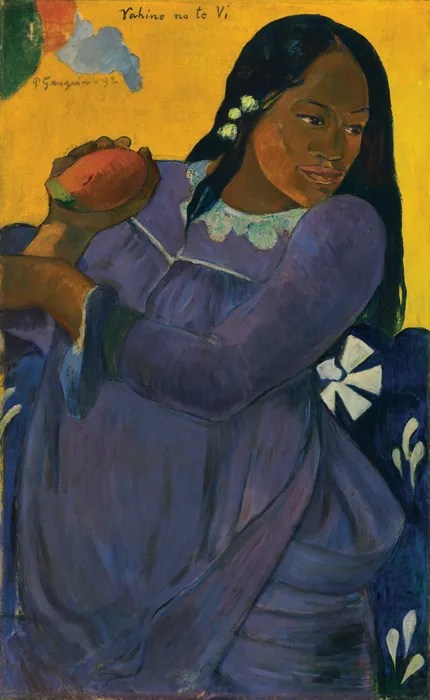
Here’s a virtual tour of the Cone sisters’ Baltimore apartments, via the Imaging Research Center. It’s a corker.
Bonus Flâneur Double Feature: 1) A gallery tour of the Baltimore Museum of Art’s Cone Collection, and 2) Michael Palin’s 2003 BBC documentary, The Ladies Who Loved Matisse.
• • • • • • •
In January of 2012 we were back in the Big Town for a quick art-go-round, starting with Vivian Maier: Photographs From the Maloof Collection at Howard Greenberg Gallery.
A nanny by trade, Vivian Maier’s street and travel photography was discovered by John Maloof in 2007 at a local auction house in Chicago. Always with a Rolleiflex around her neck, she managed to amass more than 2,000 rolls of films, 3,000 prints and more than 100,000 negative which were shared with virtually no one in her lifetime. Her black and white photographs–mostly from the 50s and 60s–are indelible images of the architecture and street life of Chicago and New York. She rarely took more than one frame of each image and concentrated on children, women, the elderly, and indigent.
Maier also produced “a series of striking self-portraits” like this one.
September 10th, 1955, New York City Much more of Maier’s work here – all well worth a look.
Next stop was the Bard Graduate Center to catch Hats: An Anthology by Stephen Jones, which originated at London’s Victoria and Albert Museum.
The exhibition, which had over 100,000 visitors at the V&A, displays more than 250 hats chosen with the expert eye of a milliner.
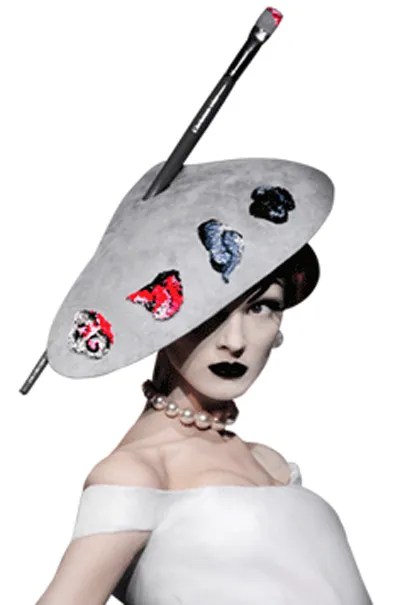
On display are hats ranging from a twelfth-century Egyptian fez to a 1950s Balenciaga hat and couture creations by Jones and his contemporaries. To show the universal appeal of wearing hats, Jones has chosen wide variety of styles such as motorcycle helmets, turbans, berets, and a child’s plastic tiara. There also are hats worn by Madonna and Keira Knightley. For the special exhibition at the BGC, the curators have arranged for loans found only in the United States, including Babe Ruth’s baseball cap, original 1950s Mouseketeer ears, and the top hat worn by President Franklin Roosevelt to his fourth inauguration.
Hat damn!
Damn – or language even stronger than that – was the byword between Diego Rivera and the Rockefeller family when John D. Jr. hired the Mexican artist in 1932 to create a mural for the new Rockefeller Center across Fifth Avenue from St. Patrick’s Cathedral.
Diego Rivera: Murals for The Museum of Modern Art provided the backdrop.
Diego Rivera was the subject of MoMA’s second monographic exhibition (the first was Henri Matisse), which set new attendance records in its five-week run from December 22, 1931, to January 27, 1932. MoMA brought Rivera to New York six weeks before the exhibition’s
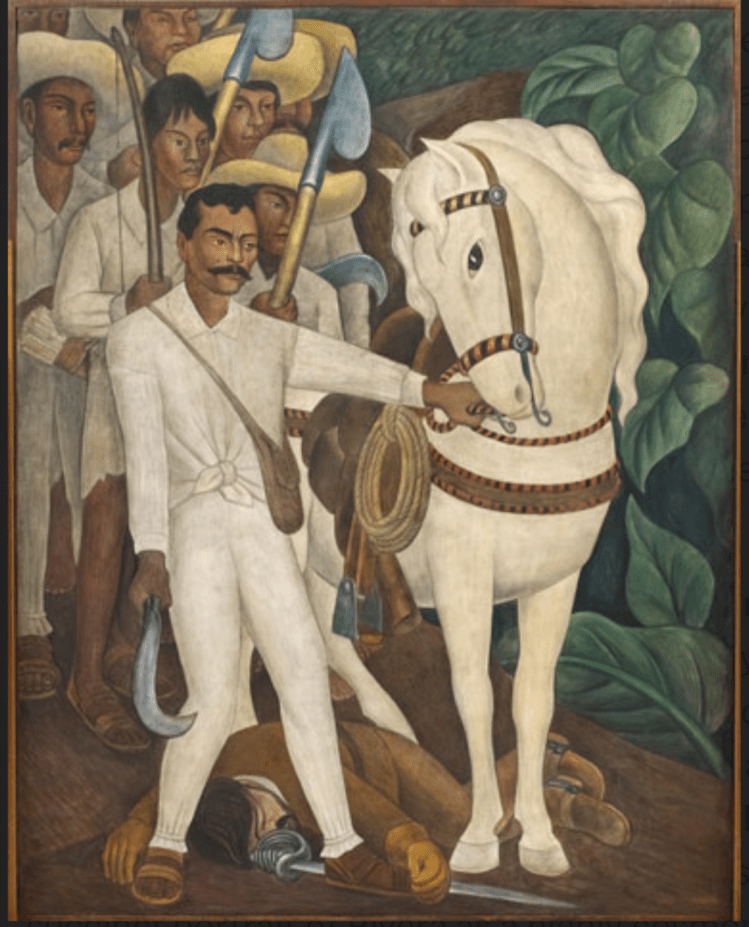 opening and gave him studio space within the Museum, a strategy intended to solve the problem of how to present the work of this famous muralist when murals were by definition made and fixed on site. Working around the clock with two assistants, Rivera produced five “portable murals”—large blocks of frescoed plaster, slaked lime, and wood that feature bold images drawn from Mexican subject matter and address themes of revolution and class inequity. After the opening, to great publicity, Rivera added three more murals, now taking on New York subjects through monumental images of the urban working class and the social stratification of the city during the Great Depression. All eight were on display for the rest of the show’s run. The first of these panels, Agrarian Leader Zapata, is an icon in the Museum’s collection.
As for that Rocky commission, here’s how MoMA’s press release described it.
While Rivera was in New York in 1931, he began discussions for a commission at Rockefeller Center. Materials related to the commission are on view, including preparatory drawings for the Rockefeller mural, Man at the Crossroads, and photographs of the mural in progress . . . Rivera began work on the mural in March 1933, but by mid-May he had been discharged from the project and his fresco covered with a tarp, concealed until it was chipped from the wall the following year. The most frequently cited reason for the sudden dismissal of the artist is Rivera’s inclusion of a portrait of Vladimir Lenin – a detail that provoked inflammatory headlines. Rivera’s patrons requested that he remove the offending image, but he refused.
Far more offensive than the portrait of Lenin, however, was the image alongside him of Junior “drinking martinis with a harlot” (lots more juicy details in this NPR piece by Allison Keyes).
Undeterred – or perhaps spurred – by the destruction of the original mural, Rivera recreated this version, named Man, Controller of the Universe.
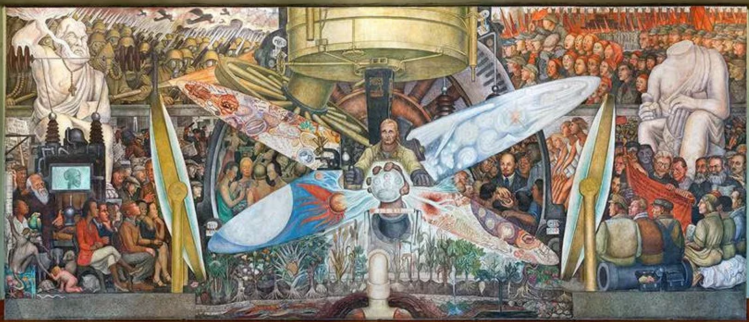
At least Diego Rivera could control that.
The next day we were back on the photography beat with Cecil Beaton: The New York Years at the Museum of the City of New York. Here’s how Leslie Camhi began her review it in the New York Times.
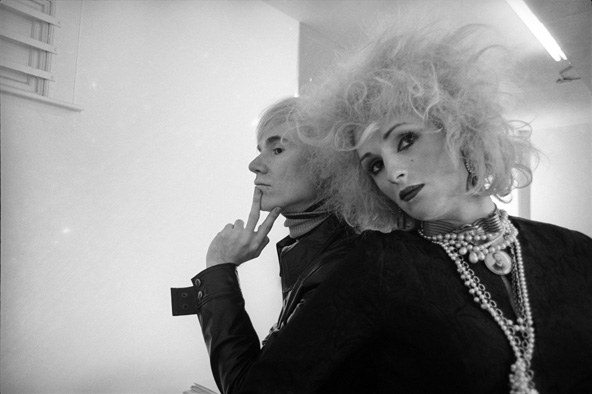
What was Manhattan for the wildly ambitious, talented and tirelessly self-promoting 24-year-old Cecil Beaton, but a candy box of opportunities, just waiting to be picked? And pick them he did, over the course of some five decades, in a peripatetic career that saw him cross-pollinating the social and cultural elites of the Old and New Worlds, and applying his protean gifts to everything from fashion photography and portraiture to illustration to stage and costume design. “Cecil Beaton: The New York Years,”curated by Donald Albrecht and opening today at the Museum of the City of New York, includes vintage fashion prints and a wide range of portraits, from Marilyn Monroe (cajoled into relaxation in Beaton’s Ambassador Hotel suite) to the very young Mick Jagger to Wallis Simpson and the aging Greta Garbo (one of the photographer’s rare heterosexual liaisons). Together with drawings, theatrical designs and other ephemera, they illuminate this English dandy’s astonishingly productive and long-lasting engagement with the booming cultural metropolis that was Manhattan at midcentury.
That’s Andy Warhol and Candy Darling in a 1969 photo, in case you were wondering.
Continuing to keep tabs on the shutterbug set, we dropped down to the Jewish Museum to take in The Radical Camera: New York’s Photo League, 1936-1951.
Artists in the Photo League were known for capturing sharply revealing, compelling moments from everyday life. Their focus centered on New York City and its vibrant streets — a shoeshine boy, a brass band on a bustling corner, a crowded beach at Coney Island. Many of the images are beautiful, yet harbor strong social commentary on issues of class, child labor, and opportunity. The Radical Camera explores the fascinating blend of aesthetics and social activism at the heart of the Photo League.
This review in Time magazine offers a nice array of Photo League images, from Alexander Alland’s 1938 Untitled (Brooklyn Bridge) . . .
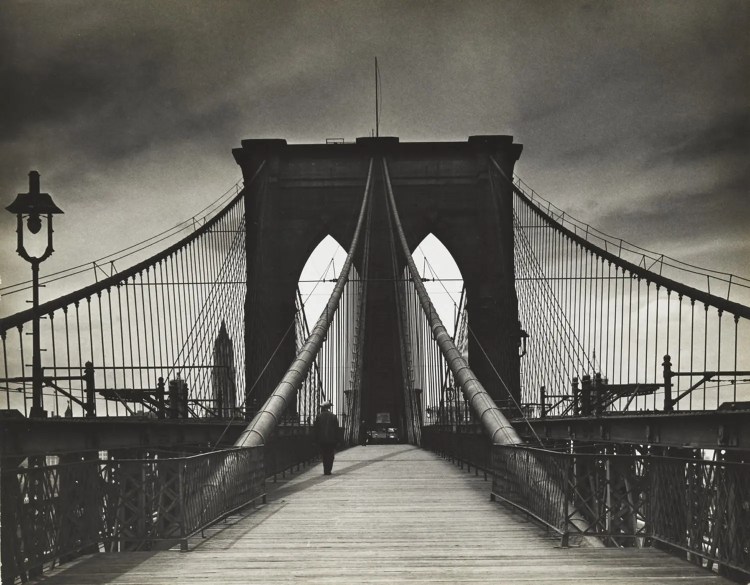
to Jerome Liebling’s classic Butterfly Boy, New York (1949) . . .
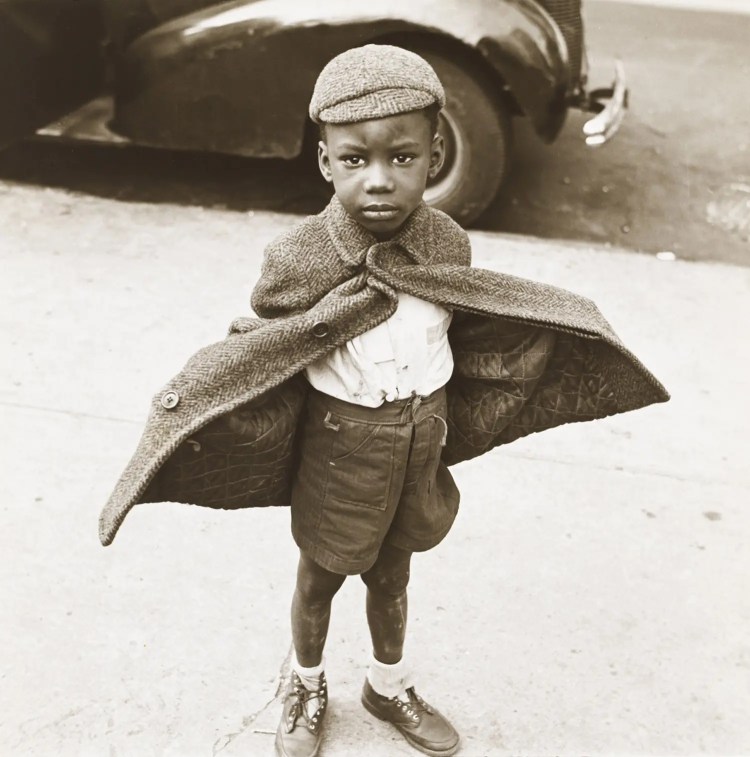
to Berenice Abbott’s Zito’s Bakery, 259 Bleecker Street (1937).
Great show.
Our last stop was Maurizio Cattelan: All at the Guggenheim Museum, and it was all that and more.
The exhibition brings together virtually everything the artist has produced since 1989 and presents the works en masse, strung seemingly haphazardly from the oculus of the Guggenheim’s rotunda. Perversely encapsulating Cattelan’s career to date in an overly literal, three-dimensional catalogue raisonné, the installation lampoons the idea of comprehensiveness. The exhibition is an exercise in disrespect: the artist has hung up his work like laundry to dry.
Alternative take: This nutshell review of the exhibit I posted on Campaign Outsider that night.
Common elements in this exhibit: Lots of taxidermy (dogs, pigeons, horses, donkeys), lots of suicide (even a squirrel suicide in a little kitchen), lots of historical figures (Picasso, Hitler, Pope John Paul II killed by a meteor).
Also: Granny in the fridge, the world’s largest foosball table, and a whole bunch of stuff the hardworking staff isn’t smart enough to understand.
But two things we do know:
1) It wasn’t enough for the museum goers (and this was on Pay What You Wish Night) to just look at the the truly amazing array of artwork. Shutterbug Nation needs to RECORD it on their Smartphones.
2) Maurizio Cattelan has got issues.
The Missus and I, by contrast, had no issues at all as we happily trundled home.
• • • • • • •
As it turned out, 2012 was also a very good theatergoing year for me and the Missus. On a trip to the city in March, we went down to the Barrow Street Theatre in Greenwich Village to see Nina Raine’s Tribes, which New York Times critic Ben Brantley called “a smart, lively and beautifully acted new play that asks us to hear how we hear, in silence as well as in speech.”
This British-born comic drama . . . considers the passive and aggressive forms of listening (or not listening) within an insular intellectual family. They’re a bunch of dueling narcissists, this lot, with words as their weapons of choice.
You’ve probably met their kind before in fiction (like J. D. Salinger’s tales of the Glass family) or film (like Wes Anderson’s “Royal Tenenbaums”). But a few significant traits set Ms. Raine’s characters apart from similar clans with high I.Q.’s and a self-regard to match. One of their members, you see, is deaf. Everyone else more or less pretends that he is not. And therein lie the seeds of a rebellion that could crack a house in two.
The performance we saw pretty much brought the house down.
Much the same happened at the Broadway revival of Gore Vidal’s The Best Man, which featured a star-studded cast of Candice Bergen, James Earl Jones, John Larroquette, Eric McCormack, and – God love her – Angela Lansbury. Here’s her first scene.
The Missus and I felt very lucky to have seen that wonderful actress in so many notable performances.
A couple of months later we were back in the Big Town cruising various gallery shows. One of the most compelling was The Figure in Modern Sculpture at the Forum Gallery, which featured works by Alexander Archipenko, Chaim Gross, Gaston Lachaise, Jacques Lipchitz, Elie Nadelman, and John Storrs.
From the Forum Gallery’s press release: “[B]eginning with the second decade of the twentieth century, artists on both sides of the Atlantic broke with academic tradition to depict modern man in original ways, infusing their work with a sense of mystery, mirth and movement, creating a new and dynamic vision of the human figure.”
Representative samples . . .

Alexander Archipenko, La Danse (Dance), 1912 
Chaim Gross, Acrobatic Performers, 1932 
Jacques Lipchitz, Harlequin with Clarinet, 1920 
Elie Nadelman, Femme Drapée, 1912 
John Storrs, Modern Madonna, c. 1918 Then it was on to Gagosian’s Madison Avenue gallery for Picasso and Françoise Gilot: Paris–Vallauris 1943–1953.
This exhibition is a departure from its precedents in that it has been conceived as a visual and conceptual dialogue between the art of Picasso and the art of Françoise Gilot, his young muse and lover during the period of 1943 to 1953. The result of an active collaboration between Gilot and Picasso’s biographer John Richardson, assisted by Gagosian director Valentina Castellani, Picasso and Françoise Gilot celebrates the full breadth and energy of Picasso’s innovations during these postwar years, presenting Gilot’s paintings alongside his marvelously innovative depictions of her and their family life. It is the first time that their work has been exhibited together—that the painterly dialogue between the fascinated mature male artist and the self-possessed young female artist can be retraced and explored.
Picasso on Gilot . . .

Gilot on Picasso . . .

You get the picture.
Another smart show was Edouard Vuillard: Paintings And Works On Paper at Jill Newhouse Gallery.
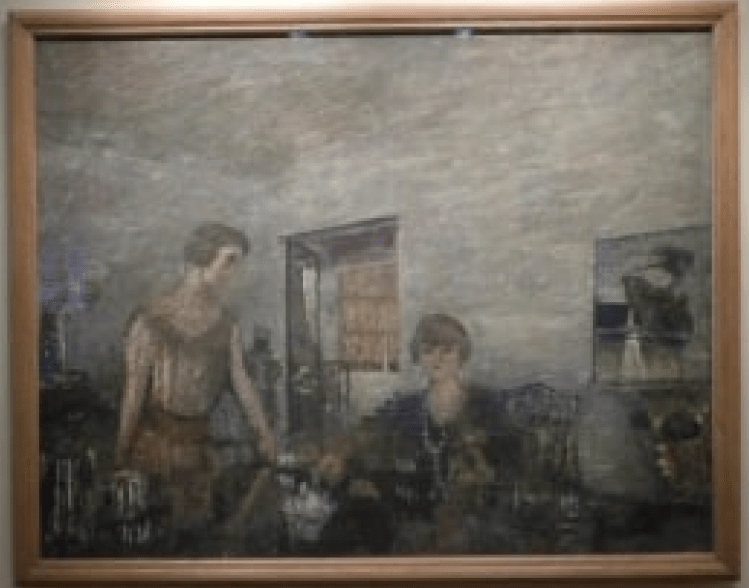
“On February 13, 1923, now more than ninety years ago, Vuillard dropped by the Hotel Meurice, where his old friend, Misia, was finishing a long lunch with Coco Chanel and Pierre Bonnard. It seems that Bonnard walked Vuillard back to the apartment Misia shared with her third husband, the Catalan painter, Josep Maria Sert. From Vuillard’s brief journal entry, we know that Sert insisted then and there that Vuillard paint a portrait of Misia, which the painter commenced—seemingly against his will—in 1923…… “
The resulting painting titled The Black Cups was called by Musée d’Orsay Director and Vuillard scholar Guy Cogeval a “perverse anti-portrait.” This painting, a large preparatory study in distemper, and 113 preparatory drawings, will be exhibited together for the first time, in a highly focused exhibition designed to complement the much larger retrospective of Vuillard’s career at the Jewish Museum in New York.
The Missus and I are a sucker for retrospectives, so we moseyed up to the Jewish Museum to catch Edouard Vuillard: A Painter and His Muses, 1890-1940.
 As a young man in the 1890s, Vuillard was a member of a Parisian group of avant-garde artists known as the Nabis (“prophets” in Hebrew and Arabic). Taking their inspiration from the Post-Impressionist Paul Gauguin, the group used simplified form and pure colors to create decorative, emotionally charged pictures. During his Nabi period, Vuillard produced some of his best-known artworks: paintings of friends and family in warm interiors filled with patterned wallpapers, draperies, carpets, and clothing
As New York Times art critic Ken Johnson noted at the time in a helpful overview of Vuillard’s career, “before the age of 30 he made some of the most beguiling paintings of fin de siècle Paris . . . Painting with special attention to wallpaper and fabric patterns, he made people almost dissolve into atomized, flattened surfaces, anticipating a century that would pulverize into air everything once taken for solid.”
Case in point: this depiction of Félix Vallotton and Misia Natanson in the Natansons’ dining room at Rue Saint-Florentin.

After 1900, Johnson wrote, “Vuillard . . . turned back his own clock. Reverting to a more conventionally naturalistic style and often using his own photographs as references, he painted portraits of well-to-do people and decorative murals for their homes. In the eyes of many critics he became a mere society painter.” The two Vuillard exhibits, however, illustrated that he was “not just another John Singer Sargent knocking out suave portraits of the rich and indolent for lunch money,” as Johnson put it, but deeper and more rewarding than that.
Ten blocks down Fifth Avenue, the Metropolitan Museum of Art hosted The Steins Collect: Matisse, Picasso, and the Parisian Avant-Garde, a sweeping survey of a remarkable family’s remarkable art collection.
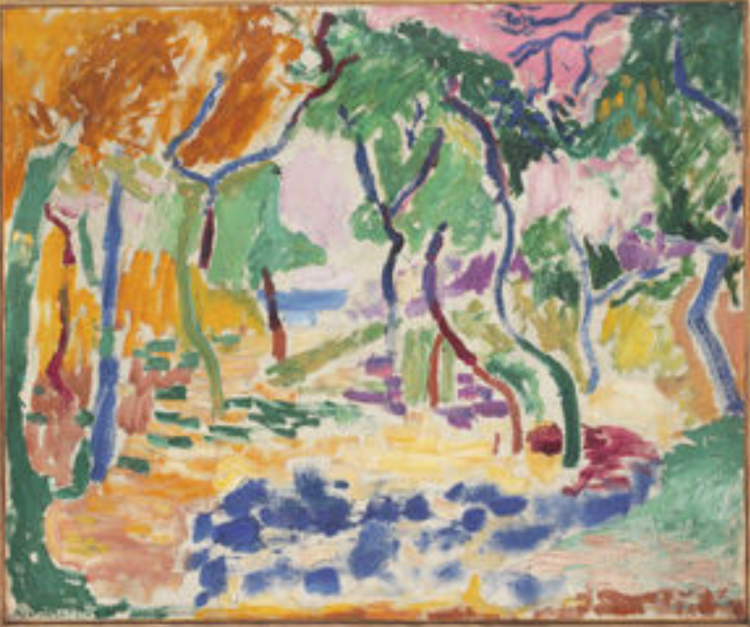
Gertrude Stein, her brothers Leo and Michael, and Michael’s wife Sarah were important patrons of modern art in Paris during the first decades of the twentieth century. This exhibition unites some two hundred works of art to demonstrate the significant impact the Steins’ patronage had on the artists of their day and the way in which the family disseminated a new standard of taste for modern art . . .
Beginning with the art that Leo Stein collected when he arrived in Paris in 1903—including paintings and prints by Paul Cézanne, Edgar Degas, Paul Gauguin, Henri de Toulouse-Lautrec, Édouard Manet, and Auguste Renoir—the exhibition traces the evolution of the Steins’ taste and examines the close relationships formed between individual members of the family and their artist friends. While focusing on works by Matisse and Picasso, the exhibition also includes paintings, sculpture, and works on paper by Pierre Bonnard, Maurice Denis, Juan Gris, Marie Laurencin, Jacques Lipchitz, Henri Manguin, André Masson, Elie Nadelman, Francis Picabia, and others.
More pictures from the exhibition here.
As I noted at the time, the Missus and I checked out one other exhibit, which was distinguished largely by the crowd it drew.
Schiaparelli and Prada: Impossible Conversations, while hosting the most pretentious gathering of humans per square foot in the universe, still delivered a smart compare-and-contrast of two fashion giants.
Our theater karma stayed strong on that trip, starting with Jon Robin Baitz’s Other Desert Cities, which featured Stockard Channing, Judith Light, Stacy Keach, Thomas Sadoski, and Elizabeth Marvel – all of them marvelous.
We also caught Paul Weitz’s Lonely, I’m Not with Topher Grace and Olivia Thirlby. Nutshell review from the Missus: “A totally charming, clever production that was just SO CUTE.”
Last but not least: Gina Gionfriddo’s Rapture, Blister, Burn with Amy Brenneman and Kellie Overby, a “comedy-drama about the fallout of choices made by two women of the generation that followed the modern women’s movement.” New York Times critic Charles Isherwood called it “intensely smart [and] immensely funny.” We totally agreed.
• • • • • • •
The Missus and I went back to the Big Town at Christmastime and caught a preview performance of the Broadway revival of Picnic, William Inge’s Pulitzer Prize-winning play. Here’s what I wrote afterward.
We liked it a lot, despite lead actor Sebastian Stan’s chewing enough scenery that he needs to floss after every performance.
(Then again, as the Missus noted, William Holden did much the same in the 1955 movie version.)
But Ellen Burstyn and Mare Winningham are terrific in the new production, as was Elizabeth Marvel, whose performance as Rosemary Sydney eerily echoes Rosalind Russell’s in the film.
Even better, the Missus met some lovely women from Long Island who invited her to join their weekly Mah Jong game.
Ah! To live in the Big Town!
We spent most of the next day at The Met and saw, among other exhibits, George Bellows.
George Bellows (1882–1925) was regarded as one of America’s greatest artists when he died, at the age of forty-two, from a ruptured appendix. Bellows’s early fame rested on his powerful depictions of boxing matches and gritty scenes of New York City’s tenement life, but he also painted cityscapes, seascapes, war scenes, and portraits, and made illustrations and lithographs that addressed many of the social, political, and cultural issues of the day.
Coincidentally, that night we went to the Lincoln Center revival of Golden Boy, the Clifford Odets classic (that, also coincidentally, featured William Holden in the 1939 film version). The entire cast was excellent, especially Tony Shaloub as Mr. Bonaparte (lots more clips here).
The next day we moseyed up to the Guggenheim for Picasso Black and White.
Picasso Black and White is the first exhibition to explore the remarkable use of black and white throughout the Spanish artist’s prolific career. Claiming that color weakens, Pablo
 Picasso purged it from his work in order to highlight the formal structure and autonomy of form inherent in his art. His repeated minimal palette correlates to his obsessive interest in line and form, drawing, and monochromatic and tonal values, while developing a complex language of pictorial and sculptural signs. The recurrent motif of black, white, and gray is evident in his Blue and Rose periods, pioneering investigations into Cubism, neoclassical figurative paintings, and retorts to Surrealism. Even in his later works that depict the atrocities of war, allegorical still lifes, vivid interpretations of art-historical masterpieces, and his sensual canvases created during his twilight years, he continued to apply a reduction of color.
Among the exhibit’s artworks were these.


As I wrote back then, it’s like Picasso dismantled the human body and then reassembled it without consulting the owner’s manual.
On the way back to Boston we stopped by the Yale University Art Gallery to see its spectacular installation, The Société Anonyme: Modernism for America.
 The Société Anonyme Collection at the Yale University Art Gallery is an exceptional anthology of European and American art in the early 20th century. Founded in New York in 1920 by Katherine S. Dreier, Marcel Duchamp, and Man Ray to promote contemporary art among American audiences, Société Anonyme, Inc., was an experimental museum dedicated to the idea that the story of modern art should be told by artists. The Société Anonyme: Modernism for America traces the transformation of this organization from an exhibition initiative to an extraordinary art collection. It features works by over 100 artists who made significant contributions to modernism, including Constantin Brancusi, Paul Klee, Piet Mondrian, and Joseph Stella, along with lesser-known artists, such as Marthe Donas, Louis Eilshemius, and Angelika Hoerle.
Representative samples from Kurt Schwitters, Man Ray, and Katherine Dreier.


New York Times critic Martha Schwendener noted one legacy of the Société Anonyme: “It suggested a version of modernism different to that highlighted, as Dreier put it, in ‘most collections.’ (By 1936 she felt there was ‘neither love nor intelligence regarding art’ over at MoMA.)”
We’ll let MoMA rebut in good time.
• • • • • • •
In November of 2013, there were two highlights in the Big Town. First, The Line King’s Library at the New York Public Library for the Performing Arts at Lincoln Center, “the largest exhibition of Al Hirschfeld’s artwork and archival material from its collection.”

Al Hirschfeld (1903 – 2003) brought a new set of visual conventions to the task of performance portraiture when he made his debut in 1926. His signature work, defined by a linear calligraphic style, made his name a verb: to be “Hirschfelded” was a sign that one has arrived. Hirschfeld said his contribution was to take the character, created by the playwright and portrayed by the actor, and reinvent it for the reader. Playwright Terrence McNally wrote: “No one ‘writes’ more accurately of the performing arts than Al Hirschfeld. He accomplishes on a blank page with his pen and ink in a few strokes what many of us need a lifetime of words to say.”
As Naomi Fry noted in a New Yorker piece two years ago, “in the course of his nearly nine-decade career, [Hirschfeld] captured the likenesses of a wide-ranging array of performers in the world of theatre, music, television, and film: from Leonard Bernstein to Liza Minnelli, Dizzy Gillespie to the “Sex and the City” foursome, the Beatles to the “Sesame Street” puppets, Katharine Hepburn to Cher.”
This fabulous New York Times documentary (via some Russian (?) outfit called Bkk) tells you all you need to know.
About a mile uptown, the New-York Historical Society had mounted The Armory Show at 100, “an exhibition of more than ninety masterworks from the 1913 exhibition, including the European avant-garde, icons of American art, and earlier works that were meant to show the progression of modern art.”
The Armory Show was a stunning exhibition of nearly 1,400 objects that included both
 American and European works, but it is best known for introducing the American public to the new in art: European avant-garde paintings and sculpture. One hundred years later it is hard to imagine what it would have been like to see works by Pablo Picasso, Henri Matisse, Marcel Duchamp, Paul Gauguin, Paul Cézanne, and Vincent Van Gogh, all together for the very first time. The exhibition created a huge sensation in New York. It traveled to Chicago and Boston, and was even more controversial in Chicago, where students burned paintings by Matisse in effigy. The exhibition’s travel turned it into a national event, and the polemical responses to the show have come to represent a turning point in the history of American art.
There’s a ton of 1913 Armory Show artworks here, but spoiler alert: The European stuff is amazing, the American stuff much less so.
• • • • • • •
When we returned to the Big Town the following June, we went hither and yon to catch a batch of museum exhibits and gallery shows.
• The American Folk Art Museum for Self-Taught Genius: Treasures from the American Folk Art Museum. It was . . . smart.
• The Museum of Art and Design (whose offerings I quite often didn’t get) for Re:Collection and Multiple Exposures: Jewelry and Photography. They were, well, smarter than I was.
• The Museum of Modern Art to see Gauguin: Metamorphoses, which was kind of meh. Then again, we’ve always thought Gauguin was a one-trick painter.
But we did like MoMA’s Lygia Clark: The Abandonment of Art, 1948–1988.
• The New-York Historical Society for Bill Cunningham: Facades and The Black Fives, which “[covered] the pioneering history of the African-American basketball teams that existed in New York City and elsewhere from the early 1900s through 1950, the year the National Basketball Association became racially integrated.”
Jordan G. Teicher’s review in Slate has lots of photos, including this one of the 1943 Washington Bears professional basketball team.
• The Jewish Museum for Masterpieces and Curiosities: Diane Arbus’s Jewish Giant. It was, well, smaller than that.
• The Met to catch Charles James: Beyond Fashion, an exhibit celebrating the “wildly idiosyncratic, emotionally fraught fashion genius.” And yes he was.
• Finally, pay-what-you-wish-night ($22 admission fee? seriously?) at the Guggenheim for Italian Futurism, 1909–1944: Reconstructing the Universe. Even more seriously, admission is now $30.
We also managed to get to the theater one night to see Act One at Lincoln Center, a play by James Lapine based on Broadway legend Moss Hart’s autobiography, which Frank Rich called “The greatest showbiz book ever written” in an article in New York Magazine.
At the time I said it “was kind of hokey but featured terrific performances in multiple roles by Tony Shaloub and Andrea Martin.” Here’s a taste.
That was the final act for that trip.
• • • • • • •
Six months later, the Big Town was a regular Pablo-palooza. Start with Picasso & the Camera at the Gagosian Gallery in Chelsea, a stunning display that “explores how Picasso used photography not only as a source of inspiration, but as an integral part of his studio practice.”
Pace Gallery Midtown and Pace Gallery Chelsea offered Picasso & Jacqueline: The Evolution of Style, “featuring nearly 140 works by Pablo Picasso created in the last two decades of his life while living with his muse, and later, wife, Jacqueline Roque.”
Special bonus: MARISOL: Sculptures and Works on Paper at El Museo del Barrio offered this Picasso sculpture.

Gagosian/Pace/Del Barrio: That’s Picasso cubed, for those of you keeping score at home.
Coincidentally, Cubism: The Leonard A. Lauder Collection was on exhibit at the Metropolitan Museum of Art, a show that kind of made your head explode for a couple of reasons: 1) it featured 81 different Cubist works; and 2) they all belonged to one guy.
Also at The Met was the thoroughly compelling Madame Cézanne exhibit.
This exhibition of paintings, drawings, and watercolors by Paul Cézanne (French, 1839–1906) traces his lifelong attachment to Hortense Fiquet (French, 1850–1922), his wife, the mother of
 his only son, and his most-painted model. Featuring twenty-five of the artist’s twenty-nine known portraits of Hortense, including Madame Cézanne in the Conservatory (1891) and Madame Cézanne in a Red Dress (1888–90), both from the Metropolitan Museum’s collection, the exhibition explores the profound impact she had on Cézanne’s portrait practice.
The works on view were painted over a period of more than twenty years, but despite this long liaison, Hortense Fiquet’s prevailing presence is often disregarded and frequently diminished in the narrative of Cézanne’s life and work. Her expression in the painted portraits has been variously described as remote, inscrutable, dismissive, and even surly. And yet the portraits are at once alluring and confounding, recording a complex working dialogue that this unprecedented exhibition and accompanying publication explore on many levels.
An amazing array of likenesses, but the Missus and I agreed that these two Met portraits were the best of the lot.

From that quintessential French Impressionist figure, we moved on to a pair of quintessential New York figures.
First up: Helena Rubenstein: Beauty Is Power at the Jewish Museum.

This is the first exhibition to explore the ideas, innovations, and influence of the legendary cosmetics entrepreneur Helena Rubinstein (1872 – 1965). Madame (as she was universally known) helped break down the status quo of taste by blurring boundaries between commerce, art, fashion, beauty, and design. Through 200 objects Beauty Is Power reveals how Rubinstein’s unique style and pioneering approaches to business challenged conservative taste and heralded a modern notion of beauty, democratized and accessible to all.
Best story: Madame wanted a particular Manhattan apartment but was told Jewish tenants were not welcome. So she bought the building.
Beautiful. And very powerful.
A few blocks up Fifth, the Museum of the City of New York hosted Mac Conner: A New York Life.
The New York saga of one of the original “Mad Men.”

McCauley (“Mac”) Conner (born 1913) grew up admiring Norman Rockwell magazine covers in his father’s general store. He arrived in New York as a young man to work on wartime Navy publications and stayed on to make a career in the city’s vibrant publishing industry. The exhibition presents Conner’s hand-painted illustrations for advertising campaigns and women’s magazines like Redbook and McCall’s, made during the years after World War II when commercial artists helped to redefine American style and culture.
Here’s a great interview with the 100-year-old artist. (He lived to 106.) We should all do half as well.
As for our theater forays on that trip, we made the mistake of attending the 2014 revival of Edward Albee’s “A Delicate Balance,” as I noted at the time.
On the one hand, before I say anything about the current Broadway production of “A Delicate Balance,” I should mention that the Missus and I saw the vaunted 1996 production of the Edward Albee play described here by legendary New York Times theater critic Vincent Canby.
As staged by Gerald Gutierrez and acted by a splendid cast headed by Rosemary Harris, Elaine Stritch and George Grizzard, “A Delicate Balance” is now revealed to be almost as ferocious and funny as — and far more humane than — “Who’s Afraid of Virginia Woolf?” It makes “Three Tall Women,” Mr. Albee’s 1994 Pulitzer winner, look as bland and unthreatening as a Saturday night dinner at your average upper-middle-class country club.
On the other hand, I should also mention that neither of us remembers all that much about the play itself, except that Rosemary Harris was a lot better than the current production’s Glenn Close (who flubbed about a dozen lines). Ditto George Grizzard vs. John Lithgow (who did a lot of scenery-chewing in the denouement). And Elaine Stritch – well, someone should have invoked the mercy rule for Lindsay Duncan’s performance.
Luckily, Rosemary Harris happened at the same time to be appearing Off-Broadway in Tom Stoppard’s Indian Ink, which was compelling from start to finish.
So that certainly cleansed the palate. And sent us home on a high note.
– to be continued –
-
We Loved Paris in the Springtime . . .
The first time we saw Paris was in April . . . and it snowed. The Missus and I were expecting chestnuts in blossom; instead, we got snowflakes and then some.
Since the Missus had packed nothing heavier than a jeans jacket, that was also the first of many visits to international shopkeepers in search of emergency accessories to keep her warm. (See also our encounters with the Mistral on the French Riviera and a Biblical rainfall in Munich for further details.)
From the mid-’80s to the mid-’90s, our trips to Paris were pretty evenly divided between spring and fall, as the Missus attended the European fabric shows so she could work her special magic predicting future trends for U.S. shoe manufacturers.
But starting in 1998 – and for the next ten years – we only went to Paris during Thanksgiving week. What changed was my job: I started working for WGBH-TV’s Greater Boston, a nightly news and public affairs program. At first I was the show’s sole reporter, then its managing editor, and finally its executive producer. Each role required me to restrict vacations to the program’s annual August hiatus, which of course was no time to visit Paris, since even Parisians don’t want to be there in August.
So the Missus and I would pop over for Thanksgiving. After our maiden visit to Paris, during which we stayed at a snooty Left Bank hotel (scene of The Great Orange Juice Shakedown of 1985), we cycled through a bunch of hotels on Île Saint-Louis: Hotel Du Jeu De Paume, Hotel Des Deux-Iles, and Hôtel Saint-Louis-en-l’Isle, where we were relegated to a top-floor room that could have made Toulouse-Lautrec wish he were shorter.
At the start of our ten-year stretch of Thanksgiving trips, we settled on the Hotel Saint-Louis Marais, which “combines the quaint, old-world charm of an ancient townhouse with all the comforts and conveniences of a modern hotel.” During that time, we watched the hotel upgrade from charming but basic rooms to more polished accommodations like this.

We also watched one night as an EMT crew lowered a dead guy on a stretcher out a third-story window of the apartment building across rue du Petit Musc. Extremely dramatic but strictly a one-off, for those of you keeping score at home.
Coincidentally, right around the corner at 20 rue Saint-Paul sat this establishment.
The Missus and I must’ve walked past that storefront a hundred times, and all the while I assumed it was a restaurant. But it was in fact a specialty grocer, as this Yelpster detailed in 2011.
Thanksgiving is heaven for the American expat missing Betty Crocker and Duncan Hines cake mixes (plus ready-to-spread icings), Pop Tarts, BBQ sauce, Lipton French onion soup mix, maple syrup and peanut butter.
Sure these imported indulgences won’t come cheap but can you really put a price on being able to make (and eat) a pan of Rice Krispies Treats® in Paris?
Others yelped less effusively: “Staff was extremely rude . . . absurdly high prices . . . I could find almost all of the products that they sell at my local Leclerc supermarket for 1/4 of the price.” So in skipping Thanksgiving The Store, we didn’t miss much, especially in the wallet.
We tried, however, not to skip Thanksgiving The Day, or to be tight-fisted about it. For example, one Turkey Day we lunched at Versailles and dined at the Musée d’Orsay’s la-di-da restaurant (neither meal, I should point out, included turkey).
The d’Orsay’s dining room was something else.

In the heart of the former train station, the Musée d’Orsay Restaurant is a magnificent reference to French tradition, with frescoes by Gabriel Ferrier and Benjamin Constant lining the ceilings of the grand dining room and its salon.
The chandeliers, the painted ceilings and the gilding of this room classified as a historical monument, will make this unique moment you spend here unforgettable.
Also memorable was the mini-drama that unfolded at the table next to us, where what appeared to be a hybrid family of eight was sulking its way through a wildly expensive dinner. The action centered around the stepmom, who was blatantly less interested in her husband than in his young adult son. Safe to say, the Missus and I were the only ones disappointed when the check finally arrived at their table.
Other Thanksgiving meals were more modest, but no less entertaining. At a Chinese restaurant on rue Saint-Paul called The Purple Dragon, we caught a different mini-drama between a young, highly distraught woman and an older man she constantly referred to as DA-dee, even though it was clear they were related only by money.
(On a subsequent visit there we saw a mouse scurry across the back of the bar, which a) marked our final meal at that particular establishment, and b) ensured that The Purple Dragon would forever after be known as La Souris Brune.)
A mini-drama of a different sort unfolded Thanksgiving week of 2004. The Missus and I had just landed at Charles de Gaulle Airport and were killing time until we could check into our hotel room. So we went to check out Matisse Picasso, a spectacular exhibit that had debuted at the Tate Modern, moved on to MoMA, and wound up in Paris.
I was totally jet-lagged and practically out on my feet as I staggered through the exhibit. But then I spotted something that snapped me to attention: the junior senator from Massachusetts, John Forbes Kerry.
It was just a few weeks after he had lost his presidential race against George W. Bush. I had covered the Kerry campaign extensively – and quite critically – for WGBH’s Greater Boston, much to the displeasure of Long Jawn.
We caught sight of one another at roughly the same time, but with decidedly different reactions: I smiled and started toward him; Kerry scowled and scurried away.
Score one for a free press.
The best mini-drama, though, was the one that featured me and the Missus. We were sitting in a small restaurant on Île Saint-Louis; a few tables away from us sat two imperious looking women impatiently searching for the waiter. He eventually emerged, handed us two menus in French and gave the women two English menus, much to their immediate outrage. I still recall that dinner as the most satisfying meal of our entire trip.
• • • • • • •
Thanksgiving week was an in-between time to be in Paris: The city was not yet decked out for Christmas, but – after a long summer of bumptious American tourists – was in no mood to give thanks for any more of them.
The Paris cityscape was equally severe in late fall, the trees all “bare ruin’d choirs, where late the sweet birds sang,” to borrow from the Bard.
Happily, after I left TV news for radio commentary in 2008, the Missus and I were able to return to Paris twice in the springtime. On those two trips the city looked entirely different. At first we couldn’t figure out why, but then it dawned on us: We couldn’t see the Paris cityscape – the buildings were mostly blocked by the trees in re-leaf, where again the sweet birds sang.
We could, however, see the Jardin des Plantes in full bloom, as this video of the former royal garden nicely illustrates.
While we were in the neighborhood, we also moseyed through Musée de la Sculpture en plein air.
The open-air sculpture museum along the Quai Saint-Bernard between the Pont de Sully and the Pont d’Austerlitz provides a pleasant art lover’s interlude in the course of a stroll along the banks of the Seine. Opened in 1980 in the Square Tino Rossi, the museum displays sculptures by famous artists including César, Constantin Brancusi, Nicolas Schöffer and Émile Gilioli.
You’ll find more outdoor artworks here, including these.

We also enjoyed exploring Luxembourg Gardens, “a 17th-century park with formally laid-out gardens, tree-lined promenades, a number of statues, model sailboats on its Grand Basin, and the Luxembourg Palace,” all of which this lovely video depicts.
Our favorite park by far was a small patch behind Notre-Dame Cathedral. We had eventually decamped from the Hotel Saint-Louis Marais to a variety of apartments in the Marais district, from which we would stroll after dinner to Île de la Cité via the Pont Saint-Louis. There we were lucky enough to encounter the Borsalino Jazz Band at the end of the bridge.
You bet we forked over ten euros for their CD, which we play regularly to this day. (Lots more music from those wonderful street musicians here.)
Just to the left of the quartet you can see the edge of Square Jean-XXIII, where we sat many an evening saluting the end of the day.

It became one of our favorite parks in Paris because it actually featured flowers, unlike so many of the city’s over-regimented gardens (lookin’ at you, Jardin des Tuilieries). For example . . .

Sadly, after the tragic fire at Notre-Dame in April 2019, the Cathedral and Square Jean-XXIII were closed for the next five years. A double loss, non?
Happily, the resplendently reborn Cathédral Notre-Dame de Paris was unveiled to the world in December 2024. Square Jean-XXIII will have to wait another five years for its rebirth, which is set to be completed in 2030.
• • • • • • •
The apartment in the Marais that we rented most often was in Place Ste. Catherine, which we came to dub Place de Dîner (Trip Advisor: “This must be one of the most picturesque and untouched corners of Paris. Lots of small and reasonably priced cafes and restaurants frequented by locals.”)
Funny thing was, we ate dinner in Place de Dîner maybe once during each of the three times we stayed there. Far more often we found ourselves back at the apartment for lunch on days we were cruising nearby attractions.
On one such occasion, as the Missus and I sat at our table for two by casement windows swung wide to a warm afternoon, we turned on the TV to watch the French Open quarterfinal match between the #2 seed Roger Federer and the #11 seed – and hometown favorite – Gaël Monfils.
Early in a tight first set, the broadcast cut to the plaza outside Hôtel de Ville, where a crowd had gathered to watch the match on a supersize video screen.
“Hey,” the Missus exclaimed. “That’s right down rue de Rivoli. Let’s go.”
We did, and we arrived there just in time for the first-set tiebreaker, in which the crowd went increasingly wild until Federer fought off a set point and prevailed 8-6. He then dispatched Monfils 6-2, 6-4 for the victory, after which he went on to win his sole Roland Garros title, largely because the clownish Robin Soderling had inexplicably bested four-time defending champion Rafael Nadal in the fourth round. Afterward, Nadal explained his defeat this way: “I lost my calm.”
Federer-Monfils at Hôtel de Ville, by contrast, was anything but calm.
It was a total gas.
• • • • • • •
During one of our springtime returns to Paris, we took advantage of the mild weather to re-visit Cimetière du Père Lachaise, the city’s most celebrated burial ground.
The Père Lachaise cemetery takes its name from King Louis XIV’s confessor, Father François d’Aix de La Chaise. It is the most prestigious and most visited necropolis in Paris. Situated in the 20th arrondissement of Paris, it extends 44 hectares and contains 70,000 burial plots. The cemetery is a mix between an English park and a shrine. All funerary art styles are represented: Gothic graves, Haussmanian burial chambers, ancient mausoleums, etc. On the green paths, visitors cross the burial places of famous men and women; Honoré de Balzac, Guillaume Apollinaire, Frédéric Chopin, Colette, Jean-François Champollion, Jean de La Fontaine, Molière, Yves Montand, Simone Signoret, Jim Morrison, Alfred de Musset, Edith Piaf, Camille Pissarro and Oscar Wilde are just a few.
Representative samples . . .


And then there was Jim Morrison’s gravesite. The first time the Missus and I saw it, the legendary musician’s grave was surrounded by a sea of graffiti and a United Nation of stoners hanging about, smoking dope, and engaging in the ritual sacrifice of Doors audio cassettes.
Periodic clean-up efforts began in 1991, initiated by Jim Morrison’s family upon the 20th anniversary of his death by apparent overdose.

This is the end the family wanted.

Similar glow-ups are now being initiated in several of the city’s burial grounds. Because maintenance of gravesites in Parisian cemeteries is the responsibility of families, many of the oldest ones have fallen into disrepair. So local officials launched a lottery, offering Parisians a shot at a burial site at Père Lachaise, Montparnasse, or Montmartre if they agree to restore one of ten decrepit gravestones, often without legible inscriptions, in those cemeteries.
(In other restoration news, the Los Angeles Times has reported that “a memorial bust of the late Jim Morrison that disappeared from his Paris grave site nearly four decades ago was recently recovered by Paris police.” That’s a relief, eh?)
While Père Lachaise is certainly spectacular, our favorite Paris boneyard was the far more modest Cimetière des Chiens et Autres Animaux Domestique – the oldest public pet cemetery in the world, as Sophie Nadeau relates at Solo Sophie.

[The cemetery] lies a little outside Paris- less than half an hour by metro. Situated in Asnières-Sur-Seine, the Paris Pet Cemetery was founded in 1898.
Although many might believe that the cemetery was started for sentimental reasons, it was actually founded for health ones. In 1898, a law was passed that meant that Parisians were no longer allowed to bury their pets wherever they liked.
People were even just throwing their bodies away in the garbage or discarding them in the Seine! The new law dictated that animals had to be buried at least 100m away from housing and under at least 1m of earth. And thus, the Paris Pet Cemetery was born.
The Missus and I took the M13 metro to the Gabriel Péri stop and walked 15 minutes to the cemetery. A black cat awaited us there – we christened him Methuselah or Mephistopheles, can’t remember which – and he promptly led us on a tour from one grave (“Brave Nikki”) to another (“Chere Chou-Chou”) to another (the one with a clear plastic globe filled with tooth-marked tennis balls).
Here’s a more recent tour. The Missus and I should ever get such elaborate – and expensive – headstones, yeah?
Toward the end of our visit, we noticed an elderly woman who was lingering at one of the gravesites and holding a small, presumably replacement, dog nestled inside her coat. It was oddly touching, accent admittedly on the odd.
Many springtimes later, our Laid-to-Rest Tour took us to the Hôtel National des Invalides.
In the 17th century, Louis XIV was the head of Europe’s greatest army. Aware that soldiers were the primary guardians of France’s greatness, the Sun King decided to erect a building for those who had served the royal army. The Cité des Invalides first opened to veterans in 1674. At once a hospice, barracks, convent, hospital and factory, the Hôtel was a veritable city, governed by a military and religious system. Over 4,000 boarders lived within the site’s walls.
Today, the Hôtel still fulfills its initial function by housing the Institution Nationale des Invalides.
It also houses the Tomb of Napoleon I in the Dôme des Invalides.

Under the authority of Louis XIV, the architect Jules Hardouin-Mansart had the Invalides’ royal chapel built from 1677 onwards. The Dome was Paris’ tallest building until the Eiffel Tower was erected. The many gilded decorations remind us of the Sun King who issued an edict ordering the Hôtel des Invalides to be built for his army’s veterans.
During the Revolution, the Dome became the temple of the god Mars. In 1800, Napoleon I decided to place [Henri de La Tour d’Auvergne, vicomte de] Turenne’s tomb there and turned the building into a pantheon of military glories.
In 1840, Napoleon had been buried on Saint Helena Island since 1821, and King Louis-Philippe decided to have his remains transferred to Les Invalides in Paris. In order to fit the imperial tomb inside the Dome, the architect [Louis] Visconti carried out major excavation work. The body of the Emperor Napoleon I was finally laid to rest there on 2 April 1861.
Here’s a nice meander through the imperial tomb, if you’re so inclined.
Not surprisingly, the Missus and I felt far more at home in the pet cemetery.
• • • • • • •
Also not surprisingly, we took in multiple art exhibits during those springtime Paris trips, starting with The Jazz Century at Musée du Quai Branly in 2009.
Jazz constitutes one of the major artistic events of the 20th century. This music, which appeared in the first years of the century, is more than a mere musical genre. It revolutionized
 the world of music and also initiated a new way of being in 20th century society.
From its African-American roots, jazz quickly became universal by introducing artistic influences from Africa, America and Europe and had a profound influence on the history of art in the last century. Throughout the 20th century jazz in effect became more a major symbol and a source of inspiration and creativity than a phenomenon or passing trend.
Universally recognisable, jazz is not only a type of music, it is also a state of mind that has influenced a number of artistic fields. Painting, literature, photography, film, graphic design and other 20th century forms of art bear the marks of jazz to different extents depending on the particular moment in time.
The museum’s press release laid out the extensive timeline of the exhibit, from “The ‘Jazz Age’ in America 1917-1930” to “Harlem Renaissance 1917-1936” to “The ‘Jazz Age’ in Europe 1917-1930” and beyond – ten chronological sections in all.
The Guardian featured a terrific gallery of artworks from the exhibit, including “Josephine Baker au Bal Negre” by Kees van Dongen, 1925; “Blue Lights Volume 1, Kenny Burrell” by Andy Warhol, 1958; and “Jazz (Variante)” by Fernand Léger, 1930.


Also on exhibit at that time was Valadon-Utrillo, Au tournant du siècle à Montmartre, De l’impressionnisme à l’Ecole de Paris at the Pinacotheque de Paris. Here’s how Karin Badt described it at France Revisited.
Both portraits by Suzanne Valadon “It makes no sense to compare,” Marc Restellini, director of the Pinacothèque de Paris in Paris told me when I asked him why Maurice Utrillo was the famous painter of Montmarte while his mother Suzanne Valadon has generally been forgotten. Restellini’s exhibit . . . places the mother-son paintings side-by-side. Viewing it raise for me the question as to why one painter was once considered “better” than the other. It’s also interesting to see how two people from the same family saw the world differently.
The Valadon-Utrillo exhibit portrays the two equally, suggesting a life-long and mutual mother-son influence. Utrillo’s empty landscapes of buildings and streets, haunted by a sense of loneliness, hang next to the bold paintings of his mother, with their extra-bright trees outlined in dark strokes.
The two artists, despite sharing an odd sensibility, seem to have only one aesthetic in common: at times, a similar choice in pastels. “Obviously,” Restellini told me. “They shared the same palette.” Yet aside from this vague similarity, the two are dramatically different.
Suzanne Valadon, Badt wrote, “is known for her nudes which really are ‘nakeds.’ They present no airbrushed prettiness, but slumps and curves and wrinkles. She dared to paint what she saw, a scandalous choice for a woman, it seems.”
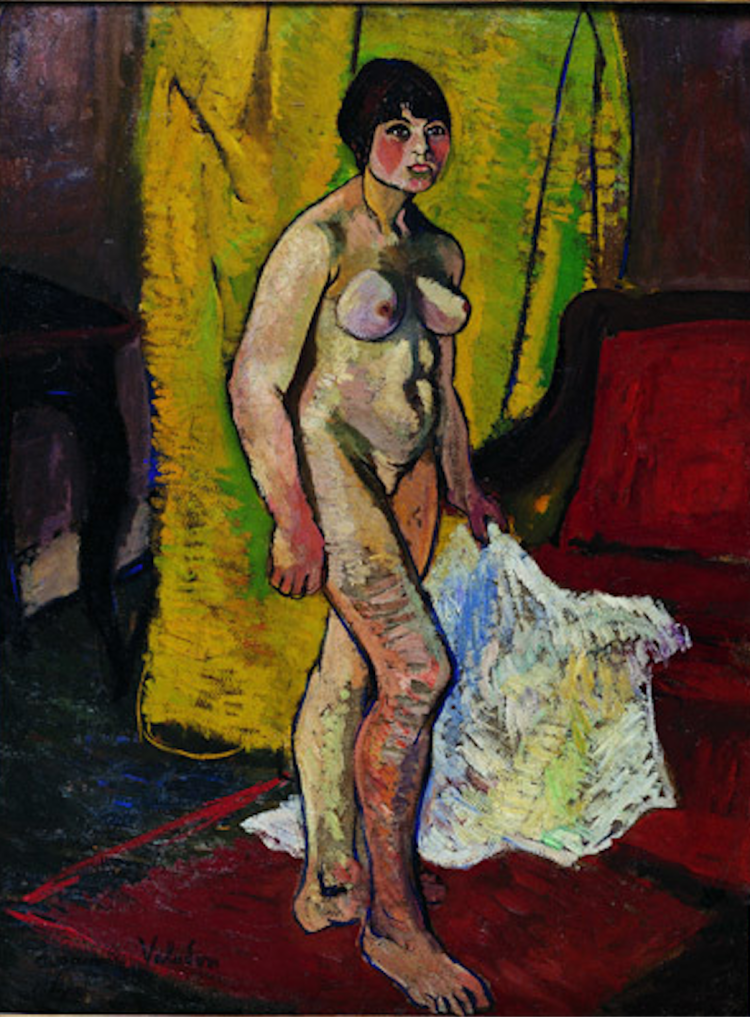
Maurice Utrillo, by contrast, was “a drunk since age 9, in despair because his sexy adventurous mother often left him alone as she pursued her art and her loves.” Valadon also had him “shunted to insane asylums all his life,” mostly at the behest of her rich businessman husband.
His paintings are typically landscapes of edgy stillness: buildings and streets. “The walls of Utrillo have a painful secret,” Jean Fabris, curator and long time-friend of Utrillo’s widow, told me that a critic once told him. “They have the odor of piss.”
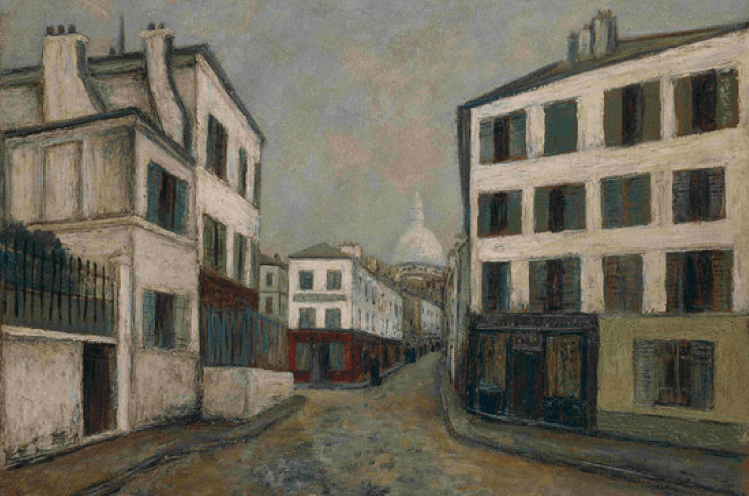
That Pinacotheque exhibit just might have been the closest mother and son ever got.
A few blocks away, the Grand Palais featured the blockbuster exhibit Le Grand Monde d’Andy Warhol, as Joachim Pissarro detailed in Artforum.
With an ingenuous but almost untranslatable title, “Le Grand Monde d’Andy Warhol” expands on two floors of the Galeries Nationales du Grand Palais in Paris. (Translated by the museum as “Warhol’s Wide World,” the English title fails to capture the double entendre of
 “high society” that the phrase “grand monde” entails.) Comprising more than four hundred paintings, photographs, Polaroids, films, and other docu- ments, this vast exhibition brings together the largest number of Warhol portraits ever shown. Portraits of living subjects, almost always commissioned, are seen in the wider context of three other genres: posthumous portraits of figures from the world of cinema (e.g., the “Marilyn” series of 1962, Judy Garland, ca. 1979, or Hitchcock, 1983); portraits of celebrities executed from media sources (e.g., Jackie, 1964, Four Marions, 1966, or the seldom seen Brigitte Bardot diptych, 1974, derived from a Richard Avedon photograph); and portraits of iconic historical or religious figures, such as Mao, 1973 (of which Warhol produced almost innumerable versions) and the monumental Last Supper (Christ 112 Times), Yellow, 1986, which closes the exhibition.
Once again The Guardian provided a wide-ranging gallery of works in the show. That assemblage, however, did not include . . .

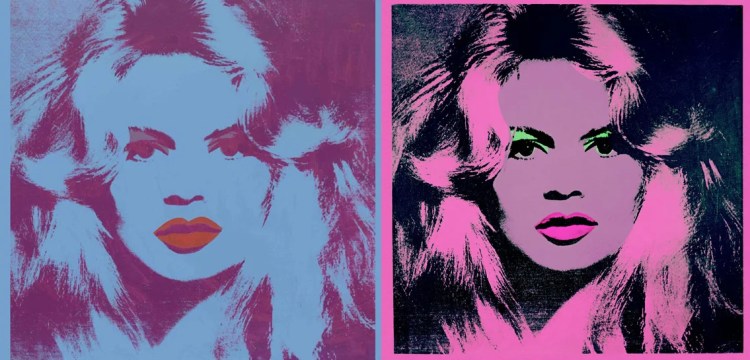
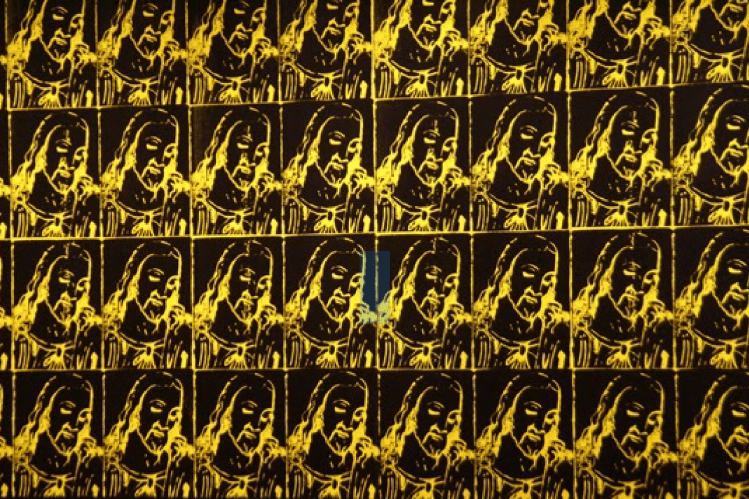
Man, that was one eye-popping trip from start to finish.
• • • • • • •
It would be eight more years before the Missus and I returned for one last springtime in Paris (in the interim we’d gotten sidetracked by two fabulous trips to the Côte d’Azur). What we found in May of 2017 was an amazing bounty of art exhibits around Paris.
Let’s begin at Musée Picasso, since so much of 20th century art sprang from the hand of that larger-than-life Spaniard. On display when we arrived was Olga Picasso, “the first exhibition dedicated to the years shared between Pablo Picasso and his first wife, Olga Khokhlova.”
As the perfect model during Picasso’s classical period, Olga was first portrayed by thin, elegant lines characterized by the influence of the French neoclassical painter Ingres. Synonymous with a certain return to figuration, Olga is often represented as melancholic, sitting, while
 reading or writing . . .
 After the birth of their first child, Paul, on February 4, 1921, Olga became the inspiration for numerous maternity scenes, compositions bathed in innocent softness. The family scenes and portraits of the young boy show the serene happiness which flourishes notably in timeless shapes. These forms correspond to Picasso’s new attention to antiquity and the renaissance discovered in Italy, which was reactivated by the family’s summer holiday in Fontainebleau in 1921 . . .
After the encounter in 1927 with Marie-Thérèse Walter, a 17-year-old woman who will become Picasso’s mistress, Olga’s figure metamorphoses. In Le Grand nu au fauteuil rouge (1929), Olga is nothing but pain and sorrow. Her form is flaccid with violent expression and translates the nature of the couple’s profound crisis.
Here’s how that played out on canvas.


Ouch.
Several outstanding private collections were also on display during our trip, starting with this exhibit at the Musée Maillol.
The 21 rue La Boétie exhibition retraces the unique career of Paul Rosenberg (1881-1959), who was one of the greatest art dealers of the first half of the 20th century. It brings together some sixty masterpieces of modern art (Pablo Picasso, Fernand Léger, Georges Braque, Henri Matisse, Marie Laurencin, etc.), some of which have never been seen before in France and come from major public collections such as the Center Pompidou, the Musée d’Orsay, the Picasso Museum in Paris, or even the Deutsches Historisches Museum in Berlin . . .
Valérie Guédot at Radio France provided this 1914 quote from Rosenberg: “I am soon opening new galleries of Modern Art, 21, rue La Boétie , where I intend to hold periodic exhibitions of the Masters of the 19th century and painters of our time. However, I believe that the fault with current exhibitions is to show the work of an artist in isolation . . . Many people, who are not sure enough of their taste or of the taste of the Artists, taken separately, would see their task facilitated by enjoying an overview of the close union of all the Arts in the atmosphere of a private dwelling.”
The Musée Maillol show certainly reflected that sensibility. Representative samples from Georges Braque, Marie Laurencin, Fernand Léger, and Pablo Picasso . . .


Across the Seine, the Petit Palais was hosting De Watteau à David, la Collection Horvitzt, which Financial Times critic Humphrey Wine described as “a triumph”, although I’m pretty sure we didn’t see it.
We definitely did, however, see From Zurbarán to Rothko. Alicia Koplowitz Collection at Musée Jacquemart André.
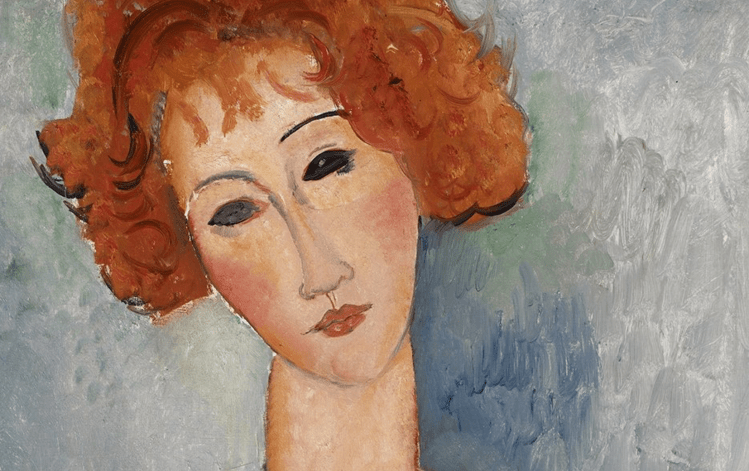
The exhibition pays tribute to one of the most prolific collectors of our time. The fifty-three works shown here retrace her tastes and the choices she has made over a period of thirty years, and invite us to share in the emotion of the collection. Beyond the diversity of technique, epochs and styles, the works in the Alicia Koplowitz Collection – Grupo Omega Capital all share the same artistic sensibility. They bear witness to a subtle but confident, audacious taste, with a certain penchant for female portraits. Whether she is the model or artist, the creator shaping the material or the inspiring muse, woman is at the heart of the majority of these artworks.
Here’s the exhibition’s teaser video. It’s an amazing collection, from “The Virgin and Child with the Infant Saint John the Baptist” (c. 1659), by Francisco de Zurbarán . . .
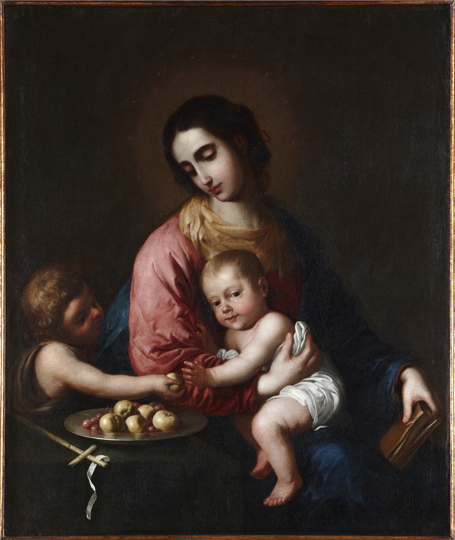
to Egon Schiele’s “Femme à la robe bleue” (1911) . . .
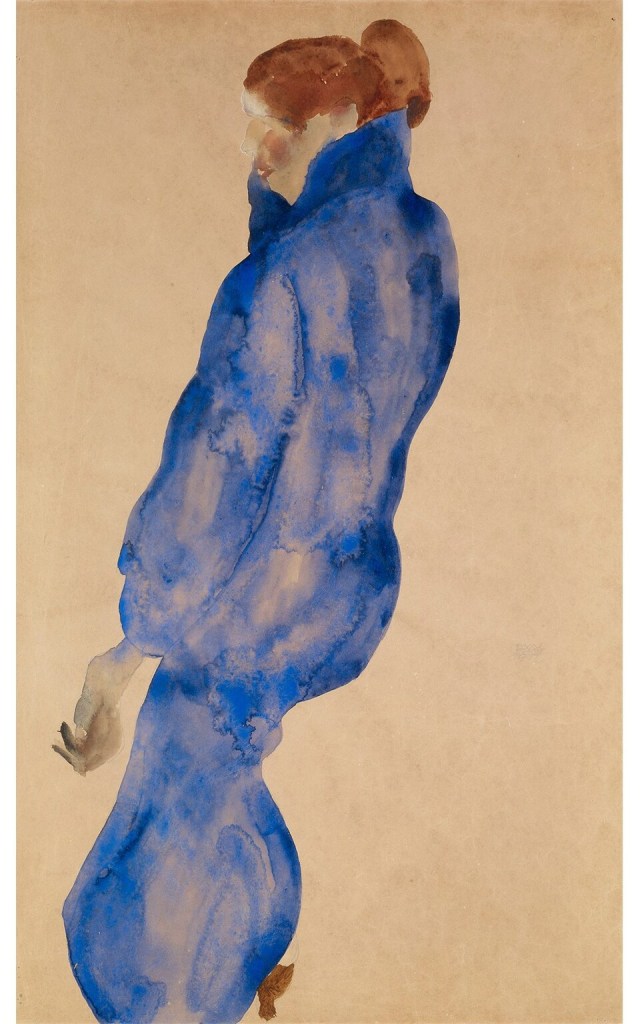
to Mark Rothko’s “N°6 (Yellow, White, Blue over Yellow on Gray)” 1954.
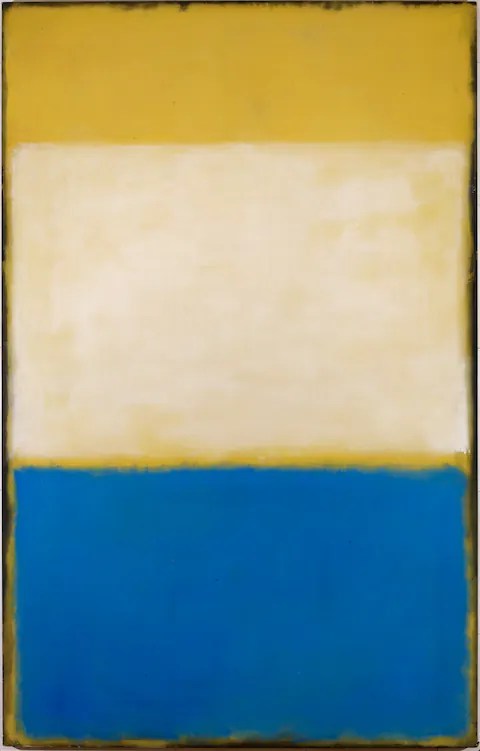
Musée Bourdelle featured a collection of a very different kind: Balenciaga – L’Oeuvre au noir. The Cut’s Sarah Moroz wrote about “the designer’s clever and complex use of the color black.”
Although vivid palettes also characterize the famed designer’s work, Balenciaga was heavily
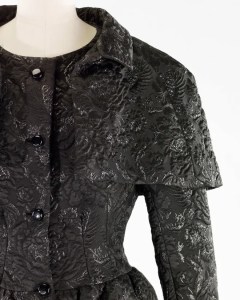 swayed by the folklore of his Spanish origins, from mourning dress to bullfighter costumes to monastic robes. Balenciaga’s mastery of volumes and technique — from the barrel line (1947) to the tunic dress (1955) — made him a pioneer, all the more evident when viewed through a monochrome lens. As Véronique Belloir, director of haute-couture collections at the Palais Galliera and curator of the show, puts it: “Revisiting Balenciaga’s work without the distraction of color enables us to focus our gaze on the essentials, and enter into the subtlety of his materials and execution.” In 1938, Harper’s Bazaar in fact described Balenciaga black as “almost velvety, a night without stars, which makes the ordinary black seem almost grey.”
Haute couture at Musée Bourdelle demanded a haute entry fee, so the Missus went solo to the exhibit and I went down rue Antoine Bourdelle to a café, where I sat at a sidewalk table and read a magazine while I waited for a waiter/waitress to arrive . . . and waited . . . and waited . . . and no one ever did.
Then the Missus came along and we headed to the Metro and our next stop.
• • • • • • •
Now might be a good time to talk about the Paris we encountered in that spring of 2017.
The Missus and I had been to the City of Light Service almost a dozen times from the late ’80s through the Aughts. In all those years, there was exactly one time we weren’t happy to be there – one rainy afternoon in the mid-’90s when we’d run out of things to do and were thisclose to breaking down and going to Euro Disney, which is truly the White Flag of French Tourism.
Instead, we went au cinema and watched The Big Sleep with French subtitles.
Other than that afternoon, Paris had always possessed an air of magic for us.
Until our 2017 trip.
That Paris was different: It had less sparkle, more streets torn up, more panhandlers on the sidewalks, more danger in the air. When we went to sit in Square Jean-XXIII, there were soldiers with Uzis patrolling the gardens. When we went to the Louvre, intending to see the Vermeer show, we were afraid – given the Nice truck attack from a year earlier – to stand in the long line snaking up to the security checkpoint outside the Pyramid. We were never really comfortable on that trip. There was, sadly, never any magic.
If anything, the city was even less hospitable than usual, if hospitality can be measured in negative terms. That freeze-out at the café on rue Antoine Bourdelle was the second time I’d been shunned by a so-called serving staff. A few days earlier, while the Missus was at fine stores everywhere along rue de Rivoli, I sat at another sidewalk café, reading a magazine and being totally ignored by the waitstaff buzzing around all the other tables.
Forget magic – at that point I would gladly have settled for a café crème.
• • • • • • •
Borderline magical, on the other hand, was Beyond the Stars. The Mystical Landscape from Monet to Kandinsky at Musée d’Orsay.
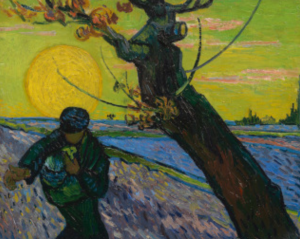
Vincent van Gogh Le Semeur, 1888 Seeking an order beyond physical appearances, going beyond physical realities to come closer to the mysteries of existence, experimenting with the suppression of the self in an indissoluble union with the cosmos… It was the mystical experience above all else that inspired the Symbolist artists of the late 19th century who, reacting against the cult of science and naturalism, chose to evoke emotion and mystery.
The landscape, therefore, seemed to these artists to offer the best setting for their quest, the perfect place for contemplation and the expression of inner feelings.
Many more inner feelings ensued.
Outer feelings were the order of the day for MEDUSA: Jewellery and Taboos at Musée d’Art moderne de la Ville de Paris. The art and design website ITSLIQUID provided a smart introduction to the exhibit.
The Musée d’Art moderne de la Ville de Paris presents MEDUSA, an exhibition taking a contemporary and unprecedented look at jewellery, unveiling a number of taboos. Just like the face of Medusa in Greek mythology, a piece of jewellery attracts and troubles the person
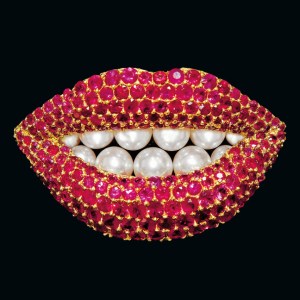 who designs it, looks at it or wears it. While it is one of the most ancient and universal forms of human expression, jewellery has an ambiguous status, mid-way between fashion and sculpture, and is rarely considered to be a work of art . . .
 The exhibition brings together over 400 pieces of jewellery: created by artists (Anni Albers, Man Ray, Meret Oppenheim, Alexander Calder, Louise Bourgeois, Lucio Fontana, Niki de Saint Phalle, Fabrice Gygi, Thomas Hirschhorn, Danny McDonald, Sylvie Auvray…), avant-garde jewellery makers and designers (René Lalique, Suzanne Belperron, Line Vautrin, Art Smith, Tony Duquette, Bless, Nervous System…), contemporary jewellery makers (Gijs Bakker, Otto Künzli, Karl Fritsch, Dorothea Prühl, Seulgi Kwon, Sophie Hanagarth…) and also high end jewelers (Cartier, Van Cleef & Arpels, Victoire de Castellane, Buccellati…), as well as anonymous, more ancient or non-Western pieces (including prehistorical and medieval works, punk and rappers’ jewellery as well as costume jewellery etc.).
Other ornaments from the exhibit . . .


Finally, there were a couple of twofers in town at the time – one modest, one major.
In the case of the former, Camille Pissarro was having a moment in Paris, starting with a retrospective at the Musée Marmottan Monet, as Martin Bailey detailed at The Art Newspaper.
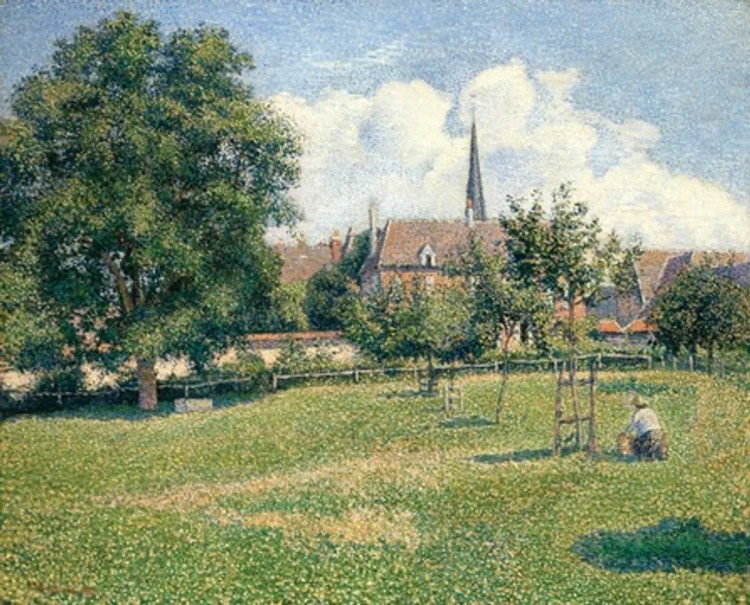
The first career survey of Camille Pissarro in Paris since 1981 opens this month at the Musée Marmottan Monet. It presents 75 of his greatest paintings, beginning with a seascape from his youth in the Danish West Indies, Two Women Talking by the Sea, St Thomas (1856), borrowed from the National Gallery of Art, Washington, DC.
Pissarro was the first of the Impressionists, painting landscapes outdoors using bright colours and a vibrant technique. Although only 43 when he helped establish the Impressionist movement, his grey beard meant that he soon came to be regarded as its elderly leader. Paul Cézanne, although only nine years younger, described Pissarro as “a father for me”. This paternal figure is captured in an evocative self-portrait done in Pissarro’s old age (around 1898) owned by the Dallas Museum of Art. He was the only member of the group to show at all eight Impressionist exhibitions held between 1874 and 1886.
Here’s that 1898 self portrait, for those of you keeping score at home.

And here’s a brisk walk through the exhibit.
Impressionism’s OG was also celebrated at the Musée du Luxembourg with the exhibit Pissarro in Éragny: Nature Regained. Heidi Ellison at Paris Update provided a personal perspective on the show.

I have often been struck by the luminous beauty of a painting by Impressionist Camille Pissarro (1830-1904) when I come across his work in a group show, but “Pissarro à Éragny: La Nature Retrouvée” at the Musée du Luxembourg is the first monographic exhibition I have seen of his work.
The show concentrates on the paintings and drawings he made from the time he moved to the village of Éragny in Normandy in 1884 until he died. The place was a constant inspiration to him, and he never stopped painting the surrounding countryside in every light and every season.
Although Pissarro was an active, card-carrying Impressionist, a couple of years after moving to Éragny, he started working in the Neo-Impressionist style, but after a while gradually returned to Impressionism.
Ellison noted that Pissarro had another calling card as well: “Surprisingly, perhaps, this painter of delicate, peaceful landscapes was politically a fervent anarchist, but his anarchism had nothing revolutionary about it; it consisted mostly of a great empathy for workers and a belief in equality for all.”
Toward that end, Ellison added, “[in] 1889, he made an album of ink drawings entitled ‘Turpitudes Sociales’ illustrating the ‘misery and oppression’ of urban workers, not for publication but just to educate his large family (he had eight children, six of whom survived to adulthood).” The Clark Art Institute in Williamstown highlighted the album in its 2011 exhibition, Pissarro’s People.
Back in Paris, the other twofer revolved around the 100th anniversary of Auguste Rodin’s death. The main event was Rodin: the centennial exhibition at the Grand Palais, featuring over 200 of Rodin’s works along with assorted sculptures and drawings by the likes of Picasso, Matisse, and Giacometti, Here’s a tour of the exhibit, which for the life of me I can’t remember seeing.
I am sure, though, that the Missus and I caught the Kiefer-Rodin exhibit at Musée Rodin, which had undergone a $17 million renovation two years earlier. Anselm Kiefer was given “carte blanche” to install an exhibition that “[demonstrated] the unusual convergence of these two giants, shaped with freedom and liberated from all artistic contingencies.”
The similar backgrounds, sources of inspiration and creative processes between Kiefer and Rodin reveal an instinctive originality. Drawn by the accidental, open to chance, they exploit all domains, manipulate all materials, heading off the beaten path and allow themselves a myriad of arrangements and daring transformations. Drawn by the debris and offcuts directly resulting from Rodin’s sculpture style, which he combines with relics of his own life and other unusual materials, Anselm Kiefer produces a series of entirely unprecedented displays.

The museum posted this overview of the installation. And with that exhibit our viewing was over, and we said au revoir, Paris, very likely for the final time.
-
Barnes-Storming Philadelphia’s Art Museums
By now those of you following our peripatetic adventures might think the Missus and I have traveled exclusively to foreign climes.
Not so!
Interspersed with our European jaunts, we’ve embarked upon periodic journeys all across this great land of ours. There was, for example, that sub-zero weekend in Chicago when the Hotel Knickerbocker was so desperate for business, it gave us not only a bargain-basement room rate, but also a free dinner in its tony restaurant (although we did have to pay for the two bottles of wine we drank). You bet we left a hefty tip that night.
Then there was the Louisiana plantation crawl that the Missus mapped out with military precision (we made one car ferry across the Mississippi River with just two minutes to spare), along with several trips to D.C. during which we visited, among other sites, the Freer Gallery of Art, home to James McNeill Whistler’s extravagant Peacock Room; the Hirshhorn Museum and Sculpture Garden, which features outdoor sculptures by Auguste Rodin, Alberto Giacometti, Henry Moore, Jeff Koons, and Yoko Ono; and The Phillips Collection, which houses more than 5000 works of modern and contemporary art.
Over the years we developed the Rule of Three: If there were three enticing cultural attractions – any combination of art exhibits, historic houses, theater productions – available in one place at one time, we’d consider going there.
And so we drove to Philadelphia in the summer of 1996 to take in 1) the legendary Barnes Foundation, 2) what would become a legendary Cézanne exhibit at the Philadelphia Museum of Art, and 3) the Rodin Museum for a compare ‘n’ contrast with its Parisian counterpart, which we’d visited several years earlier.
Let’s start with the Barnes Foundation, which at that time still occupied its original location in the Philadelphia suburb of Merion. Here’s some background, via ArtDex.
Born to a working-class family, Albert C. Barnes was an American chemist and self-made millionaire. Barnes made his fortune as the co-developer of Argyrol in 1899, an antiseptic compound, consisting of silver and a protein, used to treat gonorrhea infections . . .
As Barnes’ company prospered and he benefited financially, Barnes was able to explore other interests, particularly in the arts and education. He started collecting pieces in the early 1900s, and in 1911, Barnes reconnected with his high school friend William Glackens, who would later become a realist painter and founder of the Ashcan School of American art. Glackens became one of Barnes’ early advisors in art collection and even sent him to Paris to purchase paintings for him.
By 1912, Barnes, who had just turned 40, was already considered a serious art collector as he’d acquired dozens of artwork that cost about $20,000 in total (worth over a half million today). On the heels of Glackens’ buying campaign, which included Van Gogh’s The Postman and Picasso’s Young Woman Holding a Cigarette, Barnes also traveled to Paris where he purchased his first two paintings by Henri Matisse from Gertrude Stein, a leading art collector of modernism and a host of Paris Salon.
Barnes went on to amass this staggering collection of artworks (via Wikipedia).
-
- 181 paintings by Pierre-Auguste Renoir
- 69 by Paul Cézanne
- 59 by Henri Matisse
- 46 by Pablo Picasso
- 21 by Chaïm Soutine
- 18 by Henri Rousseau
- 16 by Amedeo Modigliani
- 11 by Edgar Degas
- 11 by Giorgio de Chirico
- 7 by Vincent van Gogh
- 6 by Georges Seurat
Representative samples:


Getting into the Barnes Foundation was a bit of a production back then. You had to make reservations weeks in advance; the house was only open Fridays, Saturdays, and Sundays; and the number of visitors was restricted to 1200 per week (all of which was mandated by local officials).
But it was well worth it, as you can gather from this 2011 WHYY video tour of the Merion mansion.
Of course, there was nothing like seeing Albert Barnes’s magnificent collection in person. We felt extremely lucky to have done that before the art hit the fan at his foundation eight years later, about which more to come.
• • • • • • •
The other main attraction during that 1996 trip was Cézanne at the Philadelphia Museum of Art, billed as “[an] unprecedented gathering of some 100 oil paintings, 35 watercolors, and 35 drawings from public and private collections.” The exhibit arrived in Philly after stops at Galeries Nationales du Grand Palais in Paris and Tate Britain in London
Chicago Tribune critic Michael Killian submitted a smart, if slightly breathless, review at the time.
PHILADELPHIA — For art museum visitors, all roads this summer are leading to Philadelphia and its neo-classical landmark Museum of Art for what many consider the greatest Cezanne exhibition ever.
Some critics have disputed that assertion as a little hyperbolic, but by any measure this is an extremely significant and already hugely popular show. Organized by the Philadelphia museum, the Musee d’Orsay in Paris and London’s Tate Gallery, it’s the first major career retrospective showing of the artist’s work since the 1930s.
Paul Cezanne (1839-1906) is regarded as no less than the father of modern art, an opinion strongly held by Pablo Picasso, among other major figures of this century and the last.
Cezanne was no Michelangelo or Vermeer. As Washington Post art critic Paul Richard has observed, Cezanne had to work very hard to produce the kind of finished images a Degas could create with a few deft strokes.
Representative samples of that hard work . . .


As Kilian noted in the Tribune, “Cezanne’s genius, uncommon reputation and popular appeal have to do with his mind and eye, his color and line, the power of his brushstrokes. He could perceive and retrieve the very essence of an object or place–his legendary, deathly clock; his verdant French hillside landscapes. To other artists, his composition was akin to God’s.”
Overwrought? Perhaps. But not by much, as the Missus and I would come to see in a subsequent Cézanne exhibit at the Philly museum, which we will detail in due course.
• • • • • • •
During that ’96 trip to The City of Brotherly Love (excepting, of course, the town’s universally acknowledged worst sports fans ever), we also took in the requisite historic Philadelphia attractions, from the Liberty Bell and Independence Hall to the Betsy Ross House to the National Constitution Center.
Then we moseyed over to the Rodin Museum on Benjamin Franklin Parkway.
Philadelphia was the first city in the United States to exhibit works by Auguste Rodin. In 1876, the French artist sent eight sculptures to the Centennial Exposition held in Fairmount Park. His work was awarded no medals and the press made no mention of the young sculptor, leaving Rodin disappointed by his American debut. He had no idea the city would one day house one of the greatest single collections of his work outside of Paris.
The Rodin Museum and its vast collection are the legacy of one of the city’s great philanthropists, Jules E. Mastbaum (1872–1926) . . .
Although he had a long-standing interest in art, Mastbaum did not become a serious collector until the 1920s. In September 1924 he visited the fledgling Musée Rodin and left Paris after acquiring a small bronze bust by Rodin. By 1926 Mastbaum had amassed over two hundred sculptures by the artist, demonstrating Rodin as a sculptor of intimate works and great monuments.
Here’s a quick tour. Its Parisian counterpart at the time looked very similar.
Since then, the Paris Rodin Museum has undergone a major renovation, as Artnet’s Henri Neuendorf reported in 2015.

The Rodin Museum in Paris is set to reopen on November 12 following a three year, €16 million ($17.4 million) renovation. The reopening coincides with what would have been Auguste Rodin‘s 175th birthday.
The French artist created some of the best-known sculptures in art history, including The Thinker (1902), The Burghers of Calais (1884-1889) and The Kiss (1882-1889).
The 18th century Parisian mansion which Rodin used as his studio was already in a bad state of disrepair when the artist bequeathed the building—along with his entire estate—to the French state after his death in 1917.
The Missus and I toured the renovated museum in 2017 and it’s a knockout. But the Philly version is still well worth visiting.
• • • • • • •
In 2003 we returned to Philly on a trip about which I recall two things only: 1) our accommodations, and 2) the killer Degas exhibit at the Philadelphia Museum of Art.
First, the hotel: As it happened, in the time between our reservation and our arrival, the property was sold to . . . no one seemed quite sure who, leaving the place largely devoid of both guests and staff.
But not us. While we were there, the hallways had this sort of eerie twilight quality, and the parking lot two blocks away was even more unsettling. Luckily, though, we escaped with our persons and property intact.
What made it all worthwhile in the end was tripping the light fantastic through the luminous Degas and the Dance exhibit.
Edgar Degas and the ballet are virtually synonymous. Dancers—shown in every phase of their complex and demanding art form—make up more than fifty percent of his abundant output.
A season ticket holder from his late teens, Degas haunted the corridors of the ballet school as well as the rehearsal halls and the stage itself. His insights into this closed, artificial, and finally enchanting world of female beauty and art reveals every aspect of the ballet, not just the accomplished public performance which, surprisingly, has a rather small role in his overall production . . ,
Through over 140 works in a variety of media the show explores Degas’s investigation over some forty years of the dance world that was central to the culture of Paris in his day.
It was a corker, and well worth the trip all by itself.
• • • • • • •
Six years after that we were back in the City of Batherly Love for Cézanne and Beyond at – you guessed it – the Philadelphia Museum of Art.
Paul Cézanne’s posthumous retrospective at the Salon d’Automne in 1907 was a watershed event in the history of art. The immediate impact of this large presentation of his work on the young artists of Paris was profound. Its ramifications on successive generations down to the present are still in effect.
Artists take from other great artists when they need to become more themselves…
This exhibition features forty paintings and twenty watercolors and drawings by Cézanne, displayed alongside works by several artists for whom Cézanne has been a central inspiration and whose work reflects, both visually and poetically, Cézanne’s extraordinary legacy.
Here’s a smart tour of the exhibit. New York Times critic Karen Rosenberg dug even deeper in her review.
PHILADELPHIA — In the family of 20th-century art Cézanne’s patriarchal status is unquestioned. His “Bather” is, traditionally, one of the first paintings you see in the Museum of Modern Art’s permanent-collection galleries. The statement “Cézanne is the father of us all” has been attributed to Picasso and to Matisse.
“Cézanne and Beyond,” at the Philadelphia Museum of Art, refines that lineage for the 21st century. It builds on the museum’s 1996 Cézanne blockbuster, interspersing the works of 18 modern and contemporary artists among some 40 paintings and 20 drawings and watercolors by the prolific master of Aix-en-Provence.
Many of these artists knew Cézanne (1839-1906) primarily through his paintings and writings (and sometimes, as was the case with the Italian still-life master Giorgio Morandi, through printed reproductions). But they shared an almost monotheistic faith in his art. As Matisse said, “If Cézanne is right, then I am right.”
Sounds about right.
Picasso and Matisse weren’t Cézanne’s only fanboys: “The exhibition takes a nonlinear form,” Rosenberg wrote, “with several smaller galleries branching out from a showstopping central room of Cézanne, Picasso and Matisse. Some artists (Fernand Léger, Liubov Popova) make brief appearances; others (Marsden Hartley, Jasper Johns, Ellsworth Kelly) are recurring characters.”
For example, Marsden Hartley’s New Mexico Landscape . . .

. . . or Ellsworth Kelly’s Apples.

As Rosenberg concluded, some of the works inspired by Cézanne “come to seem almost slavish. The Cézannes, meanwhile, remain inscrutable.”
As Matisse said of the “Three Bathers”: “In the 37 years I have owned this canvas, I have come to know it quite well, though not entirely, I hope.” Or [Brice] Marden, on another version of the “Bathers”: “It is one of the most complex, weird paintings I have ever seen, and I can never deconstruct it: I get it and I still just don’t get it.”
The Missus and I just felt grateful we got to see it at all.
We also revisited the Barnes Foundation, which would soon exit its original home in Merion (more on that dreary, dragged-out domestic dustup below). We found the old Barnes [checks notes] exactly the same, which was just as it should have been.
Last and – no offense – least was the Pennsylvania Academy of the Fine Arts, which made virtually no impression on me beyond an introduction to the paintings of Thomas Eakins, such as this portrait of Walt Whitman.

And then there was Eakins’s Portrait of Dr. Samuel D. Gross (The Gross Clinic), which Aline Cohen wrote in Artsy “may be the most important American painting.”
Most important? Or maybe just the most surgical. Then again, what do I know.
• • • • • • •
Now to the finale of the protracted tong war over relocating the Barnes Foundation (see here and here for all the gory details). Nutshell version: In 2012 the collection went kicking and screaming from its Renaissance-style home in Merion . . .
. . . to this blocky behemoth on Benjamin Franklin Parkway.

The reviews were decidedly mixed. The Barnes, for its part, touted Paul Goldberger’s Vanity Fair piece, which sported the headline “The New Barnes Foundation Building: Soulful, Self-Assured, and Soaked with Light.”
Drive the Merionites nuts graf:
This building won’t please the absolutists, the people we should probably call Barnes fundamentalists, because nothing would please them short of a return to the way things were. But it really ought to please everybody else, because—to cut to the chase—the new Barnes is absolutely wonderful. The court order allowing the foundation to relocate the collection to Philadelphia specified that the pictures were to be hung exactly as they had been in suburban Merion, in galleries that had to duplicate the configuration and the proportions of Paul Cret’s. It was a requirement that could have been stifling, a prescription for trite replication, as if the court, seeking to mollify the people who were arguing against any changes to the Barnes, had ordered up a Barnes theme park.
But that is not what Philadelphia has gotten.
New York Times art critic Roberta Smith also lauded the Barnes-burning in her review headlined, “A Museum, Reborn, Remains True to Its Old Self, Only Better.”
Drive the Merionites even nutser graf:
Against all odds, the museum that opens to the public on Saturday is still very much the old Barnes, only better.
It is easier to get to, more comfortable and user-friendly, and, above all, blessed with state-of-the-art lighting that makes the collection much, much easier to see. And Barnes’s exuberant vision of art as a relatively egalitarian aggregate of the fine, the decorative and the functional comes across more clearly, justifying its perpetuation with a new force.
To recap: The new digs are purportedly a) not a Six Flags Over Barnes theme park, and b) so much easier on the eyes!
Other art critics, however, were having none of it. Start with Christopher Knight’s Los Angeles Times jihad.
PHILADELPHIA — Saturday the Barnes Foundation opens its new museum here on the busy Benjamin Franklin Parkway. With hundreds of Renoirs, Cézannes, Matisses and Picassos, it’s just up the street from the Philadelphia Museum of Art, whose officials were instrumental in pulling strings to make it happen.
Anticipation has been running high. Eight years ago a local judge granted permission for the incomparable art installation to relocate from its unique home out on the Main Line, available to anyone who wished to visit. And 17 years after the idea of moving was hatched, the deed is done.
Deed is perhaps too mild a word. (The New Yorker magazine called the plan “an aesthetic crime.”) A deeply personal, eccentric installation of often jaw-dropping art in a specially designed building within a 12-acre garden, the ensemble was a total artwork. Once the nation’s greatest cultural achievement pre-World War II, it has now become America’s weirdest art museum.
The New Republic’s art critic Jed Perl went even further, calling it “a disastrous new home” for the Barnes Foundation.
THE BARNES FOUNDATION, that grand old curmudgeonly lion of a museum, has been turned into what may be the world’s most elegant petting zoo. I am not surprised that the members of the press, after touring the Foundation’s new home on Benjamin Franklin Parkway in Philadelphia, have by and large been pleased. We live in a period when everything is supposed to be easy, whether preparing dinner, accessing the news, or looking at art. And the old Barnes, for three quarters of a century a splendidly ornery landmark in Merion, a suburb of Philadelphia, was not easy. It was a bit hard even to get there. And once you arrived you were confronted with a fearsome onslaught of masterworks and, at least in recent years, pretty much left on your own.
The sensory overload at the Barnes could be daunting, with seminal paintings by Cézanne, Renoir, Seurat, Matisse, and Picasso competing for a visitor’s attention with a great many other extraordinary things . . .
The new Barnes tiptoes around the unruly power of the old Barnes, approaching the wild beast with an excess of solicitude. By the time museumgoers actually arrive in the galleries, they feel so coddled and cared for that the vehement visions of Cézanne, Seurat, Renoir, Matisse, Picasso, and a host of others are most likely not going to register, at least not in the way that Barnes hoped they would. The sink-or-swim intensity is gone. The new Barnes is nice to museumgoers. “Nice” was not a word that came to mind after a visit to Merion.
One last whack from Lee Rosenbaum in The Huffington Post.
The bizarre project (memorialized in a 2004 court decision) to replicate in Philadelphia the galleries of the original 1925 facility in Merion, Pa., flagrantly disregards a primary mission of art institutions to defend the glory of the original against the taint of the spurious. The Barnes once upheld that principle to the point of fanaticism, not even allowing copies of its artworks to be made. Now the institution itself is counterfeit.
As night follows day, once the Movers had picked the lock of the Merion mansion, it was Albert, bar the door, as Rosenbaum subsequently noted in her CultureGrrl blog.
I guess it was just a matter of time before the Barnes Foundation, once an intimate, inviting setting for enjoying art and nature in bucolic surroundings, took the (once unthinkable) step of making temporary art loans to other institutions—a deviation from the late Albert Barnes’ trust indenture, which set forth specific strictures governing the operation of his eclectic, eccentric treasure trove in the purpose-built, Paul Cret-designed mansion where he had explicitly stipulated that everything should always remain exactly as he left it.
Regardless, here’s the Barnes Foundation’s virtual tour of its new digs.
About five years after the museum’s relocation, the Missus and I were back in Philly for a wedding and we visited the relocated Barnes, about whose new home I gingerly weighed in afterward.
Now, I am nowhere near as smart as the aforementioned art critics, but it seems to me that if the Barnes Foundation had to be moved (the question at the very heart of that whole rumpus), what now sits on Benjamin Franklin Parkway (cost: north of $150 million) is about the best we could have expected.
There. That should tick off both sides.
And then, we were all done with the Barnes-razzing.
-
-
Four Starry Tours of the Côte d’Azur
Not long after our Loire Valley Château Crawl, the Missus and I thought we should once again venture beyond Paris into the French countryside. One early trip took us to Aix-en-Provence in the south of France.
After we had settled into the beautiful Hotel Negrocoste, another excellent find by the Hotel Booking Goddess, we wandered through Vieil Aix, a charming warren of antique buildings and narrow side streets dotted with café-lined public squares.
Here’s a nice tour of the Vieille Ville, if you’re so inclined.
We also visited the nearby Atelier de Cézanne. (The Office de Tourisme kindly provides this brief tour.)

Paul Cézanne (1839-1906) is an impressionist painter who made Provence and the surroundings of Aix his favorite source of inspiration. In 1901, he bought a piece of land on the Lauves hill to establish his studio, close to the Verdon Canal. The ground floor is fitted out for its daily life, while the first floor forms a real workshop, lit by large windows to the south and by a canopy to the north. It is here that he paints his last paintings: «Les Grandes Baigneuses», «Le portrait du jardinier Vallier», or «Vues du jardin». On rainy or cold days, unable to go out to look for a model, he used objects cluttering his workshop as models for his still lifes.
Cézanne might have spent only five years in that atelier, but it was still something special to be there ourselves.
Venturing farther afield, we drove on a rainy day to Avignon, home of the fourteenth-century Roman Catholic papacy-in-exile, as summarized by the Encyclopedia Britannica.

Avignon papacy, Roman Catholic papacy during the period 1309–77, when the popes resided at Avignon, France. Elected pope through the machinations of Philip IV of France, Clement V moved the papal capital to Avignon four years later primarily for political reasons. All seven popes of this period were French, as were most of the cardinals, which aroused English and German animosity. During the Avignon papacy the cardinals began to play a stronger role in church government, church and clergy were reformed, missionary efforts were expanded, and popes tried to settle royal rivalries and establish peace. The heavy French influence damaged the prestige of the papacy, however, and in 1377 Gregory XI returned to Rome.
Undaunted, the French cardinals continued to play dress-up in Avignon for the next four decades, but their big dance was pretty much over.
With that backstory, we had to visit the Palais des Papes.

Listed as a World Heritage Site by Unesco, the Popes’ Palace is one of the 10 most visited monuments in France with 650,000 visitors per year. A true symbol of the influence of Western Christianity in the 14th century, this 15,000m2 masterpiece of a monument is the largest medieval fortress and biggest gothic palace of Europe.
Built in less then 20 years starting in 1335, the Popes’ Palace is the amalgamation of two palaces built by two popes: Benedict XII, who built the Old Palace to the east and north, and his successor Clement VI who built the New Palace to the south and west.
In the 14th century, the Popes’ Palace was occupied by 7 popes and 2 popes of the Papal Schism before the return of the papacy to Rome.
Here’s some of the inside scoop . . .


Then again, what we most cared about was walking onto Le Pont d’Avignon and singing, which was the highlight of our afternoon there. (Forget that I knew only the first two lines of the song.)
The lowlight of our afternoon in Avignon was taking a baguette and some brie back to our car in a garage that had just been painted to have a fume-infused pique-nique dans voiture.
Quel fromage!
From Aix-en-Provence we also ventured to Marseille, also on a rainy day. As we sat in a café in the Old Port, the proprietor shared his approach for couples in the rain: “Always have one big umbrella that you can share, so you are closer on a dreary day.”
The Missus and I have had a Marseille Umbrella ever since. Here’s a sunny Marseille walkabout, for those of you keeping score at home.
Among Marseilles’ many cultural attractions, we especially appreciated the Palais Longchamp , which was “built to bring water to the city and is a true architectural achievement.”
The architecture was certainly impressive, but it was the museums at Palais Longchamp that we most wanted to see.
On the left-wing, the Museum of Fine Arts displays 17th and 18th century paintings, drawings, and sculptures. Founded in 1801, it is the oldest museum in Marseille.
On the right-wing, the Natural History Museum gathers several collections of curiosity displays from the 18th century given by the city and the state. It was rewarded with the title of first-class museum in 1967 together with nine other major museums, thanks to its exhibitions.
Representative samples . . .

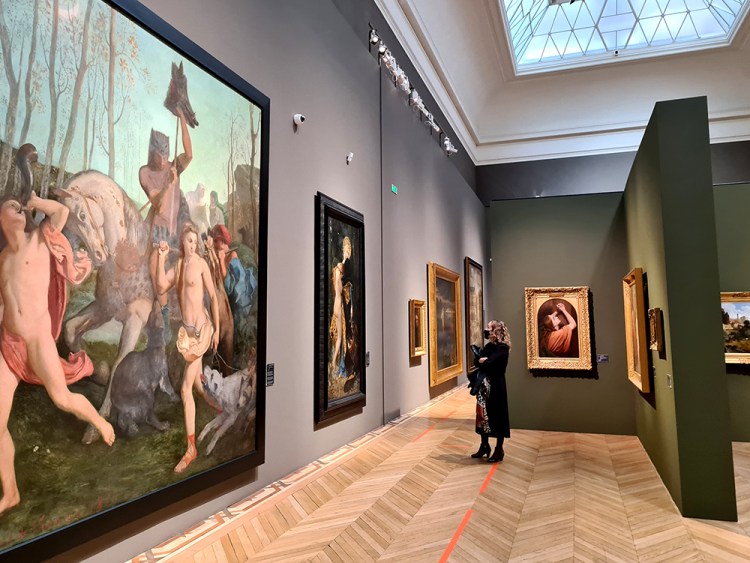
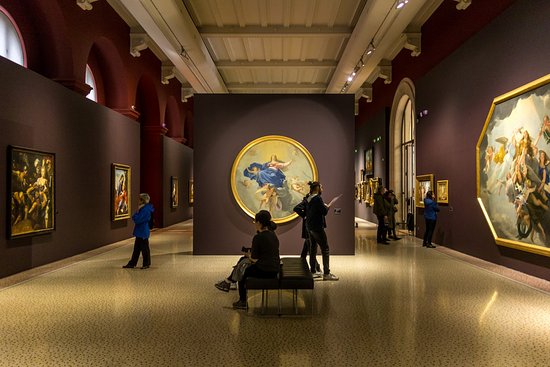
We then vaulted into the 20th century at Musée Cantini, which hosts a collection that includes works by Henri Matisse, Pablo Picasso, Jean Arp, Alberto Giacometti, Balthus, and Francis Bacon.
Two views of the Port of Marseille, first from Paul Signac, then from Oskar Kokoschka.


Also part of the Musée Cantini collection – André Derain’s Pinède à Cassis . . .

. . . and Librarie Toebeart by Balthus.
On that trip, Aix marked the spot. It was the French Riviera, however, that kept pulling us back over the next decade.
• • • • • • •
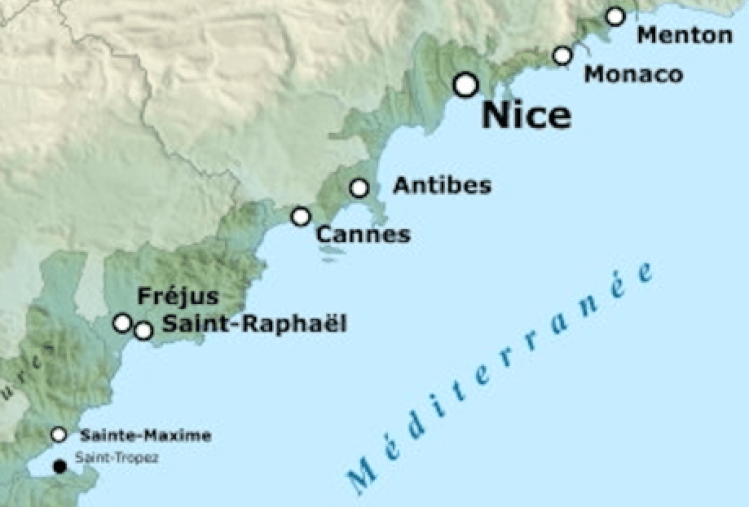
Given the passage of time, the first two trips the Missus and I took to the Côte d’Azur have kind of blended together (the next two I extensively chronicled here and here), but I’ll try to sort out the earlier ones as best I can.
Our first trip began with a stay in Antibes at L’Auberge Provençale, which apparently is no longer in operation according to Fodor’s Travel, but at the time was described this way: “Overlooking the largest square in Antibes’s Old Town, this onetime abbey now has seven rooms complete with exposed beams, canopy beds, and lovely antique furniture.”
All true of the room we stayed in at the time.
From there we ventured out on the town, which is nicely captured in this video.
Two highlights of our time in Antibes: First, the Picasso Museum in the old Grimaldi Castle . . .

The birth of the Picasso museum
In 1923, Romuald Dor de la Souchère began his archaeological field work in Antibes, and in 1924, he founded the society “Amis du musée d’Antibes”, whose goal was to establish a History and Archaeology Museum, and worked to make sure that the Past of the region gained some renown.
In 1925, the castle was bought by the city of Antibes and became the Grimaldi Museum, with as its first curator, Romuald Dor de la Souchère himself. It became a historical monument on August 28th, 1928.
In 1946, Dor de la Souchère offered Picasso part of the castle as a studio.
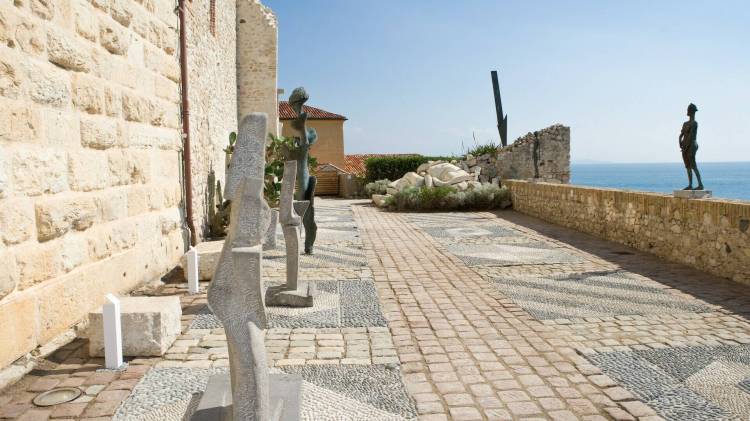
Picasso, very enthusiastic, worked at the castle for two months straight, and made a great many works, drawings and paintings. After his stay, he left to the city no fewer than 23 paintings and 44 drawings. And among them, the famous:La joie de vivre, Satyre, Faune et centaure au trident, Le gobeur d’oursins, La femme aux oursins, Nature morte à la chouette et aux trois oursins, la Chèvre…
On September, 7th, 1948, Picasso gave to the collection 78 ceramics that he had made at the at the Madoura studio in Vallauris.
Eighteen years later, “the Grimaldi Castle officially became the Picasso Museum, the first ever museum dedicated to the artist. And finally, in 1991, Jaqueline Picasso’s gift in kind enabled the enhancement of the Picasso collections.”
Here’s how it looks nowadays.
Our other highlight in Antibes was a spectacular dinner at Oscars, a restaurant we would revisit during a subsequent trip to the Riviera, even though we had to drive an hour to get there.
We also ventured west of Antibes a couple of times, with decidedly mixed results. There was, for instance, our photo finish with the Mistral in St. Tropez, a day so cold the first thing we did upon arrival was find a shop where the Missus could buy the biggest shawl they stocked, which allowed us to wander the narrow streets of the town for a good half hour before heading back to Antibes.
On a much sunnier day, the Missus and I took a ride to Cannes, where we sat along The Croisette (“Temple of idleness, parties and shopping“) and drank the most expensive cups of coffee we’d ever encountered. But at least it was warm.
• • • • • • •

From Antibes we decamped to St. Paul de Vence, where we stayed at a hotel about which I remember two things only: 1) The ferkacte garage spots were so narrow, I mangled the side-view mirror of our rental car (always take the collision, right?), and 2) The owner proclaimed that breakfast at his hotel featured “the best croissants in all of France.”
He was mistaken.
But St. Paul de Vence itself was swell. Even sweller was Henri Matisse’s luminous Chapelle du Rosaire a short distance away.
Nutshell backstory: Dominican nuns ran a nursing home across the street from the Villa Le Rêve, where Matisse moved in 1943 from Nice to escape the threat of German bombardment. The nuns needed a chapel and reached out to Matisse: One of the nuns, Sister Jacques, showed him sketches she had made for a stained-glass window.
On December 4, 1947, Brother Louis-Bertrand Rayssiguier who was passionate about modern art and convinced of its positive impact on religious art came to visit Matisse. He persuaded him not only to decorate but also design the entire chapel which would prove the synthesis of his past experimentations and research.
The results were spectacular (plenty more images here).

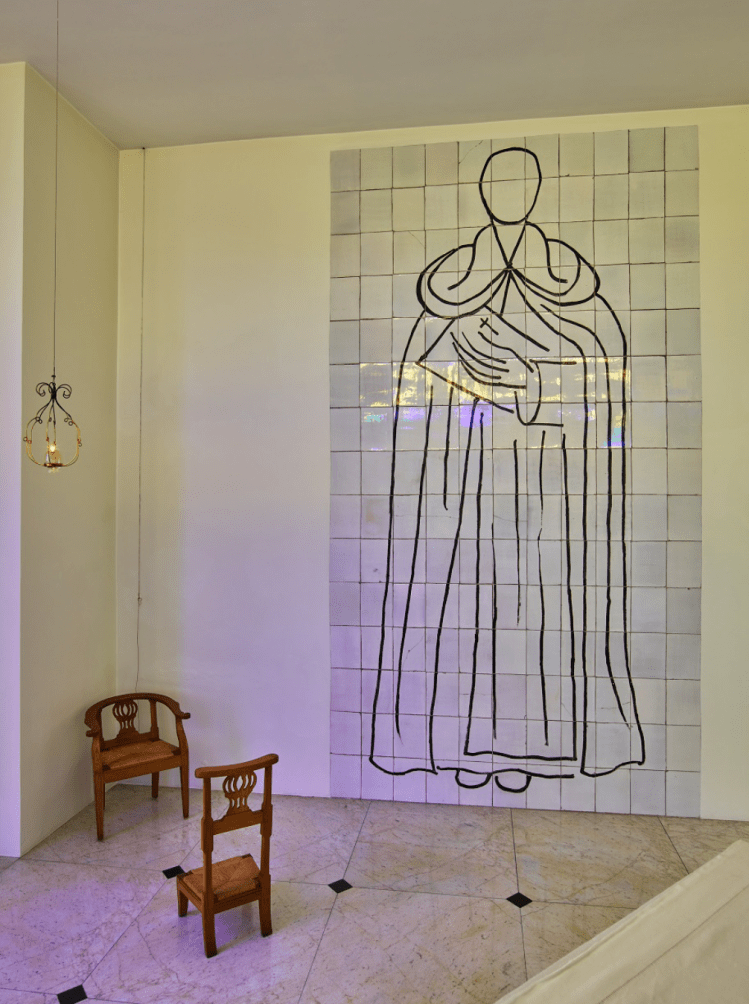
While the Missus and I have long loved Matisse, we’ve been much less fond of his contemporary, Auguste Renoir, whose work – with a few exceptions – is far too treacly for our taste.
We liked his house in Cagnes-sur-Mer real well, though.

The painter discovered Cagnes-sur-Mer in 1903, on his way to Italy. Falling under the spell of the gardens composed of olive and orange trees, he bought in 1907 “Domaine des Collettes”, a vast property of several hectares. As the small farmhouse on site did not find favor with Aline, his wife, Auguste Renoir had a vast néo-provençal style bourgeois house built to the plans of the architect Jules Febvre. He moved into his new house which had two artist’s studios, in the autumn of 1908. Surrounded by his family, his wife and his three children Claude, Jean and Pierre, he never left the French Riviera. The artist painted and sculpted there for eleven years, until his death in 1919 at the age of 78.
Yeah, painted until his death with a brush strapped to his hand, probably put there by his family, the Missus and I initially figured, to keep the gravy train going for as long as possible.

Then again, maybe not, given Renoir’s obvious animation at the age of 74 in this 1915 film. Regardless, we remain unfond of Old Strap-Hand.
We also ventured on that trip to the perfume factories of Grasse, about which the Missus wrote a piece for the Travel section of the Boston Herald. That was when the Herald was still a going concern, before Death By A Thousand Paper Cuts came for the newspaper industry.
Our final stop was Villefranche-sur-Mer, a colorful fishing village that has a storied history as home to, among others, Aldous Huxley, Tina Turner, Keith Richards and his longtime paramour Anita Pallenberg (the Rolling Stones recorded their 1972 album Exile on Main Street at Villa Nellcôte in Villefranche). It’s also been a magnet for moviemakers – To Catch a Thief, An Affair to Remember, The Bourne Identity, and many others have featured scenes from Villefranche.
Villefranche is most celebrated, though, as the home of Jean Cocteau’s legendary Chapelle Saint-Pierre.
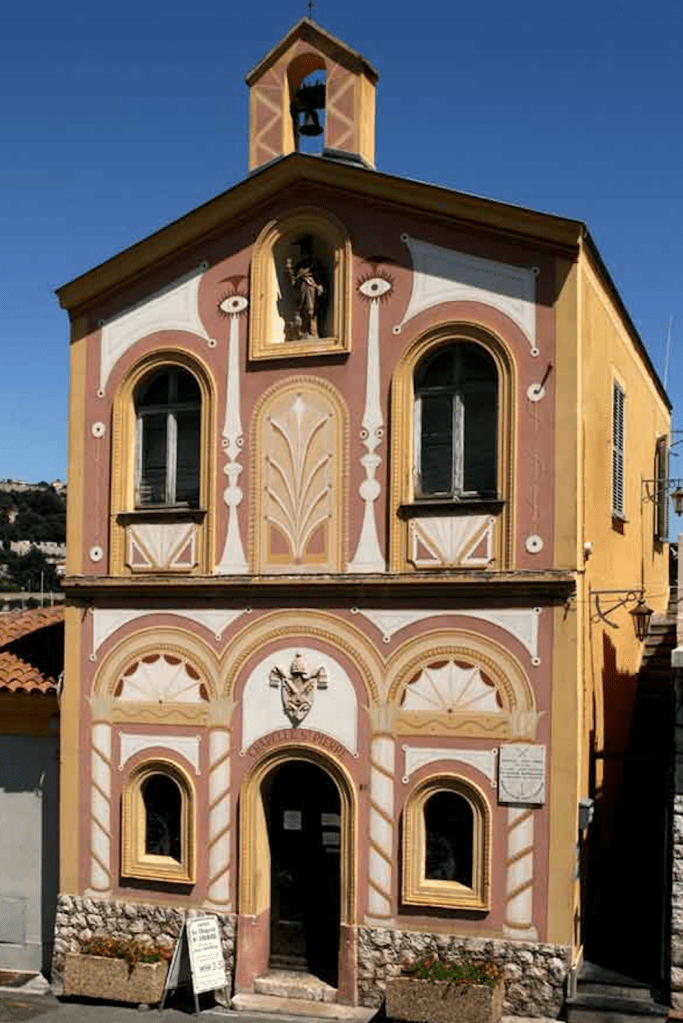
Built in Romanesque style, it dates from the second half of the 16th century. Inside is a superb decoration, five fresco panels in two parts: one profane and one sacred. Jean Cocteau himself painted the decor on all the interior surfaces as well as the exterior facades. His friend, the famous actor Charlie Chaplin, visited the chapel along with the artist in 1957.
Representative samples (more here if you like – and you definitely should) . . .


It came to our attention that the nearby Welcome Hotel – which has quite a history of its own – also had a Cocteau Room.
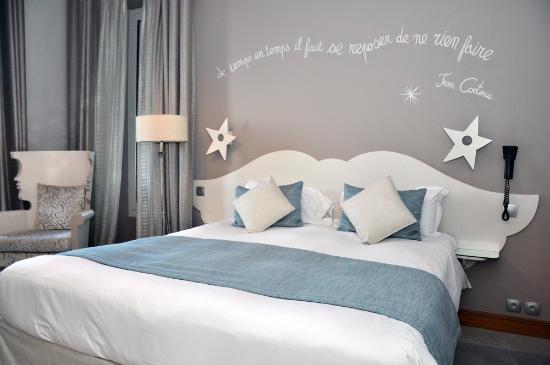
So we stopped in, the Missus chatted up hotel manager Claude, and we got a tour of the Cocteau room, which we would occupy during our next trip to the Riviera. Before we could do that, though, there was more than a little unwelcome drama during our return to the Côte d’Azur.
• • • • • • •
Our second visit to the French Riviera got off to a less than auspicious start. After flying from New York to Nice, we headed for Villefranche-sur-Mer, where we planned to stay for several days before moving on to Paris.
We’d been on the highway out of Nice for several miles when our rental car suddenly went Chernobyl – smoke pouring from under the hood, lights flashing all over the dashboard, the car barely limping along. We were lucky to make it over to the voie de dépannage, where a bon samaritain came to our rescue with enough radiator fluid to get us to the nearest halte routière, where he was also kind enough to call the rental car company and arrange for a replacement vehicle.
To this day he remains, in our minds, the greatest French sauveur since Marquis de Lafayette.
No such acclaim for the rental agent, however, who eventually showed up and said he’d take us to St. Tropez for a new car.
St. Tropez, for those of you keeping score at home, happened to be an hour and a half away and host to the frigid Mistral winds, which a) we’d already experienced on our previous trip, and b) had forced the Missus to buy a super warm shawl that I’m not sure she ever wore again.
So the Missus told the rental agent in no uncertain terms to pick a closer pick-up venue, which turned out to be Antibes, a half hour away.
Eventually we arrived in our non-meltdown vehicle at the Welcome Hotel.
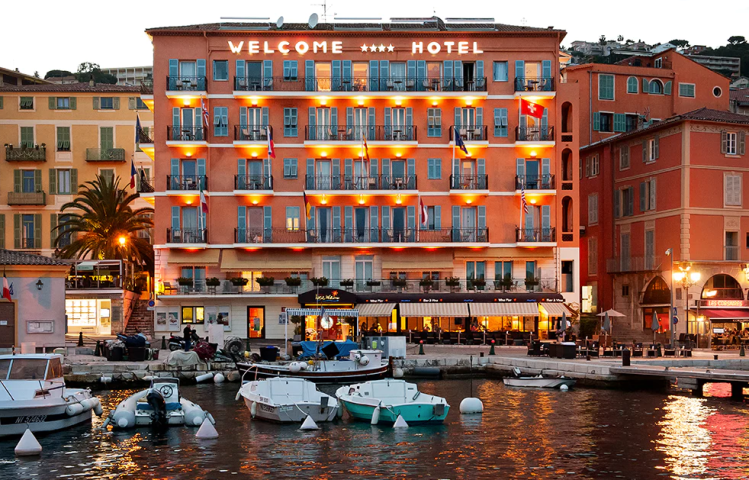
Our old pal Claude not only welcomed us but gave the Missus an extensive interview for another Boston Herald feature. Claude also gave us the Cocteau room, which we could afford for only a couple of nights, but that was fine.
Our first foray was to St. Jean Cap Ferrat to check out the Ephrussi de Rothschild Villa & Gardens, dubbed by me and the Missus Béatrice’s Amazing House of Stuff. It includes beautiful rugs from Versailles, furniture that Marie Antoinette once owned, and wall panels from The Crillon in Paris (before it was a hotel).
 Born in 1864, Béatrice was the daughter of the banker and major art collector Baron Alphonse de Rothschild. At 19 years old, she married Maurice Ephrussi, a Parisian banker originally from Russia who was a friend of her parents and 15 years her senior. The marriage quickly turned to disaster for Béatrice, as she caught a serious illness from Maurice which prevented her from having children.
You can guess what that “serious illness” might have been.
Anyway, after Maurice had racked up 40 million of debt (in today’s dollars), the Rothchilds crowbarred Béatrice out of the marriage. The following year three things also happened: 1) Her father died, 2) She inherited his fortune, and 3) She dropped a bunch of it on the fabulously excessive Villa Ephrussi.
Work began in 1907 and took five years. Béatrice Ephrussi appears to have been a particularly difficult client. She refused projects proposed by a dozen major architects, believing them to be “idiotic”. And so, projects by Claude Girault, the architect of the Petit Palais in Paris, and even Henri-Paul Nénot, winner of the Prix de Rome and most famously architect of the new Sorbonne, were dismissed. Thus, the project came to be placed in the hands of the architect Jacques-Marcel Auburtin, who scrupulously satisfied all of Béatrice’s requirements.
Here’s a stately tour of the final result.
The villa’s gardens were charming in a big-bucks sort of way, especially the fountains that went off every 20 minutes and “danced” to classical music, as illustrated here.
Although Béatrice couldn’t have children, she totally had pets. The wildly eccentric heiress kept a whole menagerie – poodles, monkeys, gazelles, a mongoose – and treated them like the children she never had. She even provided chairs for the dogs and the mongoose.
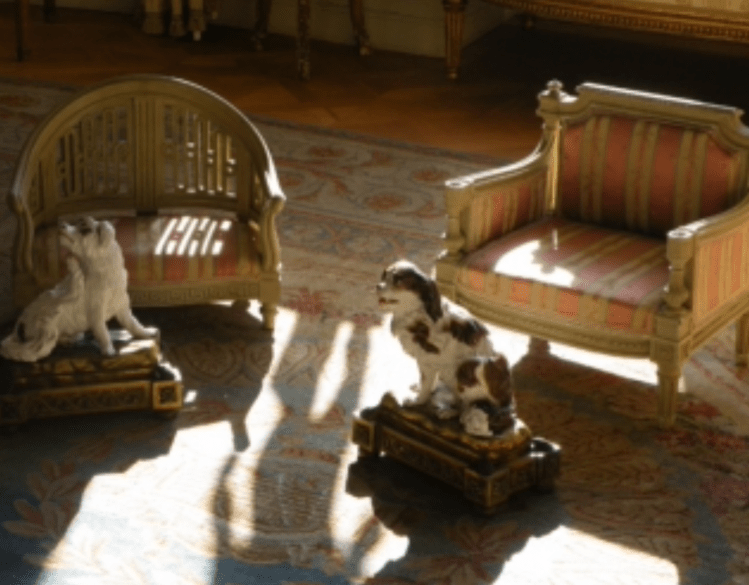
But the best animal act was the wedding Béatrice threw for Diane, her favorite female poodle, and a male poodle called Major.
Here’s how the Boston Daily Globe described it in January of 1897, when Béatrice was in her 30s.

“Hundreds of invitations were sent out, addressed to canine guests and their owners. All the men, of both the two- and four-legged variety, showed up during the day in formal evening dress: tails, wing collars and bow ties. […] At the sound of the wedding march, three little poodles appeared in tails to begin proceedings. Canine “bridesmaids” and “best men” escorted the betrothed couple. At the other end of the room, a good and loyal bulldog waited for them wearing a top hat and a red, white and blue sash. […] The bride had a gold ring set with diamonds slid onto her paw.”
All that pet talk made us long for the real thing, so the Missus and I went to the nearby Zoo Cap Ferrat, which was a total hoot, as you can see in this guided tour.
What that video, however, did not capture:
• The billy goats who eyed us indignantly as we ate our lunch on a nearby bench.
• Hamster Village, which featured a cardboard Main Street with a variety of storefronts the little guys could duck in and out of. Our favorite: Le Gendarmerie.
• The lemur who somehow got loose and wandered about holding out one hand as if looking for tips. We tried to figure out how to alert zoo officials to the jailbreak, but failed utterly. So the lemur marched on.
Sad to say, the zoo itself did not. It was shut down in 2010 to make way for some swanky spa.
Bad tradeoff, enfants de la Patrie. Very bad tradeoff indeed.
The Missus and I also took a couple of vertiginous drives to the medieval towns of Peille and Peillon.
Here’s the former.
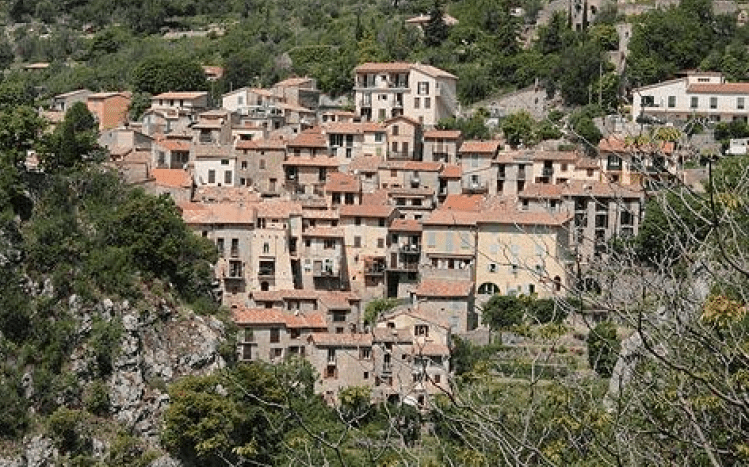
Perched 630m in altitude, PEILLE is a characterful village clinging to the mountain side. Strolling through the village, you will come across cobbled lanes and grand residences dating back to the Middle Ages, gothic fountains and vaulted passages. On elevated ground stands the old parish church, and to the south of the village, the communal olive mill where once stood the Chapel of Mercy. The Chapel of St. Joseph (18th Century), located in the middle of the village was the seat of the white-robed penitents.
Another highlight: The Peille Terroir Museum, “dedicated to the village’s history, ways and customs, and ancient professions. Objects collected from here and there, from local residents’ cellars, wardrobes and attics form the museum’s collection.”
Gotta love objects collected from here and there, right?
Nearby Peillon has rightly been dubbed The Perched Village.

At 10km from Peille, along a narrow twisting road is the village of Peillon dangling on a vertiginous mountain peak, 376m in altitude. All its houses look like they are stuck together, typical of the architecture of fortified mountain villages. At the top of the village, dominating the landscape, is the 16th century parish church of St. Sauveur. The Chapel of the White-robed Penitents (15th and 16th centuries), houses one of the village’s treasures: the remarkable Jean Canavesio frescoes, one the famous painters of the Primitive Nicols School.
(Can’t spit without hitting a white-robed penitent up there, eh?)
Those Canavesio frescoes are indeed remarkable, at this French Moments post illustrates.


Then we said à bientôt to Claude de Welcome and moved on to Paris.
• • • • • • •
Third time on the Riviera (to celebrate our 30th wedding anniversary) was a total charm.
Eventually.
But first we . . .
a) inadvertently booked our Paris flight into Charles de Gaulle Airport and our flight to Nice out of Orly Airport;
b) endured an endless wait at passport control followed by an interminable delay at baggage claim, which led to our missing the bus to Orly for our connecting flight;
c) were told the next bus would arrive in 10 minutes (ha!) and take an hour to reach Orly, thereby assuring that we would miss our connection;
d) stupidly had no cellphone with us to contact the livery driver who was scheduled to pick us up at Nice Côte d’Azur Airport;
e) miraculously made the flight thanks to our bus’s early arrival at Orly and the flight’s late departure;
f) were shuttled to a quiet side street in Villefranche-sur-Mer by our most agreeable driver Frederique.
The Missus, in her infinite wisdom, had found this apartment in Villefranche for us to rent.


But this was the best.

We sat on that terrace every morning watching an acrobatic airshow of birds endlessly wheeling against a brilliant blue sky.
It was beautiful to behold.
Upon our arrival, however, there was one more obstacle to overcome.
I had forgotten to pack a converter plug, and there was no BNP Paribas ATM in town (contrary to what we’d been told in advance) which would have linked to our bank cards.
So we were powerless and euroless.
Until we met Julia at the Villefranche-sur-Mer Office du Tourisme. A lovely blonde woman in a crisp white shirt and gold lamé jeans, she directed us to a hardware store and a BNP ATM in neighboring Beaulieu-sur-Mer, where we bought a converter plug, converted dollars into euros, and stumbled upon a bakery that featured some killer salade niçoise sandwiches.
The Missus subsequently dubbed Julia our heroic Bond Girl (Goldie Lamé?).
After that, it was the two of us who were golden.
• • • • • • •
The Missus had another brilliant idea on that trip: Given the auto de fou that marked our previous foray to the Riviera, she suggested we forget about renting a car and travel around by bus and rail, a decision that had two salutary effects: 1) It saved us a bundle of money, and 2) It allowed me to actually observe the scenery on our travels instead of watching the road while I drove.
Excellent!
We started at Place Garibaldi in Nice (named after Nice homeboy and Italian freedom fighter Joseph Garibaldi), adjacent to the Vieille Ville.

After wandering around the Old Town for a spell – interrupted by a leafy picnic lunch in a charming pocket park – we stumbled upon Palais Lascaris, a mid-17th century manor and modern-day museum that’s a little worse for wear, but hardly a handybaron special.
Especially noteworthy: The museum’s amazing collection of over 500 historic musical instruments, some of which this video highlights.
We then visited the Musée D’Art Moderne et D’Art Contemporain, whose stunning architecture caused quite a rumpus when it was built in 1990.
The courtyard facades were equally striking, from Sol LeWitt’s colorful cascade . . .

. . . to Arman’s jumble of blue chairs . . .

. . . to Alain Jacquet’s take on Manet’s Dejuneur sur l’herbe.

Beyond that, the museum features a riotous collection of modern and contemporary art from Yves Klein and the one-name brigade of the École de Nice (Arman!, César!, Ben!) to works by American artists from Claus Oldenburg to George Segal.
A thoroughly eye-popping experience, from the art to the architecture.

The next morning we took the train to Antibes and wandered about until we found the bus to Biot so we could visit the Musée National Fernand Léger, whose exterior is just flat-out fun – a colorful tile façade with reproductions of Léger’s work.
Inside is even better – a collection of Léger’s art that ranges from the 1910s to the 1950s. Léger started as a neo-impressionist (he later burned most of his early work), then turned to cubism, latching onto Cézanne’s proclamation that “Everything in nature takes its form from the sphere, the cone and the cylinder.” Léger saw man, nature, and objects all in the same way – “for their plastic value.”
Contrastes de formes (1913) is a good example.

Léger allied himself with fellow cubist Robert Delauney until a color war broke out between them – Delauney favored shades of color that interacted with one another (color simultaneity); Léger chose flat primary colors that contrasted with each other.
Eventually Léger went one step further and evolved from a cubist to a “tubist.” From Azur Alive:
Leger worked extensively with primary colors and geometric shapes. As a painter, Léger greatly influenced the Cubism movement but expanded beyond the artistic style. He developed a personal version of cubism with dynamic cylindrical shapes. The art critic Louis Vauxcelles called (with a touch of sarcasm) this particular style “Tubism”.
Representative sample (“The Lunch,” 1921) . . .

Back in Antibes, our lunch was slightly less artistic, given that it once again confirmed our belief that in the average French restaurant, Americans (or at least these Americans) always come second to everything and everyone else. The Missus and I have long been resigned to that treatment in Paris, the City of Light Service. Apparently the same indifference had spread to Antibes as well.
Whatever. After lunch we revisited the Musée Picasso-Antibes, which featured a collection of work – such as this one – that Picasso created at Château Grimaldi.
The next day the Missus and I returned to the nothing-succeeds-like-excess Rothschild mansion for a second look, then made our way to Beaulieu-sur-Mer and Villa Grecque Kérylos, which is the cosmic opposite of Béatrice’s House of Stuff.

On the Mediterranean coast, between Nice and Monaco, the Greek Villa Kerylos is one of the most extraordinary monuments on the Riviera. Built between 1902 and 1908 in the period the French call the “Belle Epoque”, it is a unique reconstruction of an ancient Greek home. “Kerylos” means Halcyon, often identified as a kingfisher, a poetic mythical bird, considered to be a bird of good omen.
This is a tribute to Greek civilisation by two lovers of Ancient Greece, Théodore Reinach, an archaeologist and patron of the arts and Emmanuel Pontremoli, an inspired architect.The villa is “a faithful reconstruction of Greek noble houses built on the island of Delos in the 2nd century B.C. . . . the aim was not to produce a pastiche but to create an original work by ‘thinking Greek’.” Which they did great job of – it’s a beautiful reincarnation of a Hellenic home, with the accent on hell if you appreciate any creature comforts introduced after 200 B.C.
Here’s a lovely walk through the villa. Amazing place, but pauvre Mme. Reinach, non?
Back in Nice the next morning, our first stop was the Jardin Maréchal Juin, “deemed one of the most stunningly beautiful flower gardens in Nice.” Indeed, when we arrived, the flowerbeds were being replanted by a dozen gardeners doing what in America would be a two-man job. That’s what happens when 21% of your country’s workers are civil service employees.
Anyway, we really liked Sacha Sosno’s La Tête Carrée, or the Square Head, which loomed over the flower gardens.

We were less impressed, however, by the Muséum d’Histoire Naturelle de Nice, where one guidebook said we’d find “a collection of 7000 mushrooms” but which actually displayed about seven of them. There were, to be fair, some stuffed animals and a diorama of the museum’s founders with recorded dialogue about mollusks ‘n’ stuff, if you’re into that kind of thing.
Underwhelmed but undaunted, the Missus and I trundled over to the Cimitière du Château, a Catholic/Christian/Jewish graveyard bursting with outsized statues and stately monuments overlooking the city.

The Château de Nice cemetery is clearly one of the most beautiful cemeteries in France. It recalls nearby Italy and the splendor of the monumental cemeteries of Genoa, Milan and Turin. Covering an area of 14,000 square meters, it offers a panorama of the entire city. Its 2,800 tombs are placed on terraces, their style being quite varied.
We wandered all through the cemetery, which is quite remarkable, searching in vain for the Jewish section. Finally we found it – on the other side of a high wall, with its own separate entrance and a handmade sign.
La Communauté Israelite de Nice
Aux Héros de la Patrie de la Résistance
Aux Martyrs de Persécution
Inside, graves were strewn about haphazardly, lacking the grid pattern that the Catholic/Christian sections featured, so that you almost had to step on the graves to move about. The whole cemetery was unkempt and overgrown – very much like an afterthought. A second, newer level seemingly wanted to compensate for the disarray of the original one: It had uniform headstones, a clear grid, and a large sculpture of a menorah in what would be the middle of the section when it filled up.
Overall, it was a sad reminder of the neglectful (at best) treatment far too many French Jews experienced during the war – and after.
The Missus and I then headed for the Musée des Beaux-Arts via the celebrated Promenade des Anglais, favorite of Matisse and tourists alike. It’s the latter, of course, that turn this stretch of seaside into La Comédie Humaine, with every type of stroller, bicycler, eater, drinker, and sunbather imaginable, including some people who shouldn’t even be in the same room as a Speedo, never mind actually wear one.
Regardless . . .
The following comes from a Lonely Planet post that apparently no longer exists.

In a resplendent 1878 belle époque villa, the Musée des Beaux-Arts displays works by Fragonard, Monet, Sisley and Rodin, as well as an excellent collection of Dufy works.
Fauvist appreciators will relish a roomful of Raoul Dufy’s works. Also impressive are sculptures by Rodin, and some late impressionist pieces by Bonnard, Monet and Sisley. Local lads Jules Chéret (1836-1932), the ‘Father of the Poster’, and Alexis Mossa (1844-1926), who painted truly hideous symbolist works, also feature. The latter is more famous for adding wildly decorated floats to the Nice Carnival than for his watercolours.
Sad to say, virtually none of that was on display when we visited. The second floor was closed, the first floor mostly closed, and what artwork was visible lacked a certain je ne sais quoi.
Actually that’s not accurate. I know exactly what the artwork lacked: Anything at all interesting about it.
The following day the Missus and I went for the trifect-art: Musée Matisse, Musée Chagall, and Musée Masséna.
Located in a suburb of Nice, Musée Matisse inhabits a charming house that’s been renovated to showcase a collection of Matisse’s handiwork donated mostly by the artist himself and his descendants.

The Matisse Museum is situated on the hill of Cimiez, not far from the Franciscan monastery with its Italianate gardens, the Hotel Regina where Matisse used to reside, and the Gallo-Roman ruins. Since the 5th of January 1963 the Museum has been welcoming vistors to its collection of works left by the artist (and his heirs) to the city of Nice where he lived from 1918 until 1954.
The collection is small but cherce – a nice array of paintings, some sculptures, a smattering of cutouts, and several of Matisse’s personal effects, such as the chair this painting was based on.

Especially interesting are the “remnants” – cut-out shapes that never made it into Matisse’s compositions. The family donated over 400 of them, many of which are on display.
The grounds of the museum are, well, jazzy – dotted with busts of Louis Armstrong and Lionel Hampton, lined with paths named after Miles Davis and Duke Ellington. Who knew the great French artist was an American jazz lover?
Down the hill from the Matisse museum is Musée Nationale Marc Chagall, whose home could not be more different from Matisse’s residence.
The architect chosen to build the museum was André Hermant (1908-1978), who formerly worked with Auguste Perret and Le Corbusier and was a member of the UAM (French Union of Modern Artists). He projected himself as a defender of an architectural design in which function determined form. The social purpose was also a key consideration in his approach.
The idea of a “home”, a spiritual abode, as sought by Chagall, required a peaceful setting in which the building itself does not make its presence felt.
Not sure the building actually does fail to make its presence felt, but why get technical about it.
Architecture aside, it’s the whole spiritual thing I can’t get past with Chagall – too much biblical stuff and people flying over rooftops. I do like this painting, though.
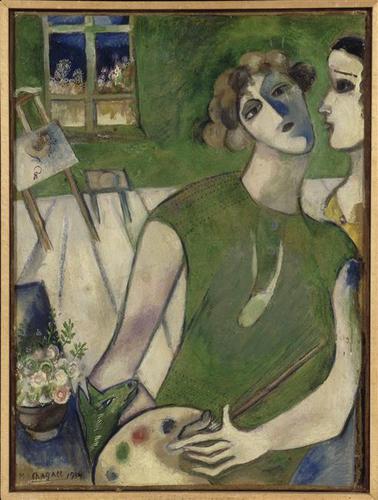
That’s Bella, Chagall’s fiancée at the time and later his much beloved wife. Chagall’s paintings might have been allegorical, but his devotion to Bella was as real as it gets.
Last but far from least, Musée Masséna.

The Masséna Museum, an architectural gem on the Promenade des Anglais, evokes, through its collections, the art and history of the Riviera from Nice’s attachment to France until the end of the Belle Epoque.
All the works evoke this theme through a scenography that combines graphic arts, furniture and objects from this period and more particularly history.
Among other things presented are Napoleon’s death mask made by Doctor Arnolt, Joséphine’s diadem in mother-of-pearl, gold, pearls and colored stones offered by Murat to the Empress and the book written by Prefect Liegeard.
(Stéphen François Emile Liégeard, for those of you keeping score at home, was a French lawyer, writer, and poet who gave the name “Côte d’Azur” to the French Riviera.)
The museum is devoted to showcasing the city’s history, but the building itself is the main attraction. Renovated in 2008, it’s simply spectacular.


And with that, we said au revoir to Nice, a thoroughly, er, nice town to explore.
On our last day we decided to go to Éze Village, which seems to be a favorite among the tourist set. The Missus and I jumped on a bus, transferred at Gare d’Eze-sur-Mer, and wound up in Éze about 45 minutes later.

Legendary adman David Ogilvy once said, “people travel to collect clichés.” That’s Éze all over. It’s been called a “medieval hilltop masterpiece,” but we called it something else: a tourist trap. Any charm Éze possesses is largely sucked out of it by an endless series of overpriced shops filled with junk.
Unfortunately, the next bus home wasn’t for an hour, so we wandered around a bit, finally ending up in the chapel overlooking the town. It’s a good-looking church, but the best part of it is the pulpit. Extending from its side – honest to God – is an arm holding a crucifix in its hand.
Me: If only there was a leg hanging off the other side.
The Missus: Arms for the poor?
Best thing in Éze – hands down.
And then . . . it was our last night in Villefranche, which I wrote about afterward.
 After dinner I walked down to the bay one last time. I stood in a soft rain next to the bust of homeboy Jean Cocteau alongside the chapel he renovated in the 1950s, and looked one last time at the dark Mediterranean and the bright lights burned into the hillsides surrounding it.
The bust has a plaque underneath it, which reads:
Quand je regarde Villefranche je vois ma jeunesse, fassent les hommes q’ elle ne change jamais.
“When I see Villefranche, I see my youth again. Pray Heaven it may never change.”
Amen to that.
When we got home, the Missus and I agreed: Perfect trip. We’d be nuts to ever go back, because it could never be as good. But man, perfect trip
• • • • • • •

Four months later we looked at one another and said, “I wanna go back to Villefranche.”
And so we did.
And found ourselves back on that same birdwitching terrace, this time without all the travel travails.
Our first day, having mastered the mysterious mechanics of the Billetterie SNCF, the Missus and I
 took the train to Cagnes-sur-Mer, where we headed to the Office de Tourisme to purchase a couple of Côte d’Azur Cards (nouveau! merveilleuse!), which provided free entry to 160 French Riviera venues. Luckily, they had exactly two left, something we took as a good sign. Then we moseyed down to Square Bourdet to catch the 11:30 bus to Fondation Maeght in Saint-Paul-de-Vence, which arrived at precisely 12:30.
At the Fondation Maeght stop, we proceeded to walk straight uphill for 15 minutes. Halfway to the top, we saw a sign for Hotel Messugues, although I was thinking maybe it was really the Hotel Meshugge.
Finally, leg-weary, we collapsed onto the counter of the admissions booth, where we flashed our nifty Côte d’Azur cards and a very nice young woman said, yes, but if we wanted to take photos inside we needed to pay an extra – at which point we cut her off and said we have no cameras or iPhones and she said she’d never met an American without at least one and smelling salts all around.
Before we headed into the Fondation itself, we swung by Le Café F for a nice lunch of salade Niçoise and saumon fumé.
But then came the Great Euro Standoff.
L’addition was 24 euros, which included the mandatory 15% tip. I produced 25 euros, and waited . . . and waited . . . and asked for my one euro change, which continued not to be forthcoming. And I realized that Monsieur Le Garçon thought he could wait me out – that any American would just leave rather than linger for a single euro.
He was mistaken.
Several minutes later and one euro fatter, I wandered up to The Fondation, wondering whether service compris might be more corrosive to national character than legalized gambling or capital punishment.
Somewhere in the middle, I’d venture.
Anyway, the Missus said that we’d been to the Fondation Maeght on a previous trip, although I didn’t remember it at all. Regardless, we both agreed this time that it’s a bit of a mishmash, although that’s not how it describes itself.
The Marguerite and Aimé Maeght Foundation is one of the major international institutions dedicated to innovation and creation. This private foundation of modern and contemporary art Is located near the town of Saint-Paul de Vence, 25 km from Nice. The Maeght Foundation owns one of the largest collections of paintings, sculptures and graphic works of the twentieth century in Europe.
Mishmash or not, the joint has some knockout sculpture from the likes of Alexander Calder, Alberto Giacometti, and, especially, Joan Miró.

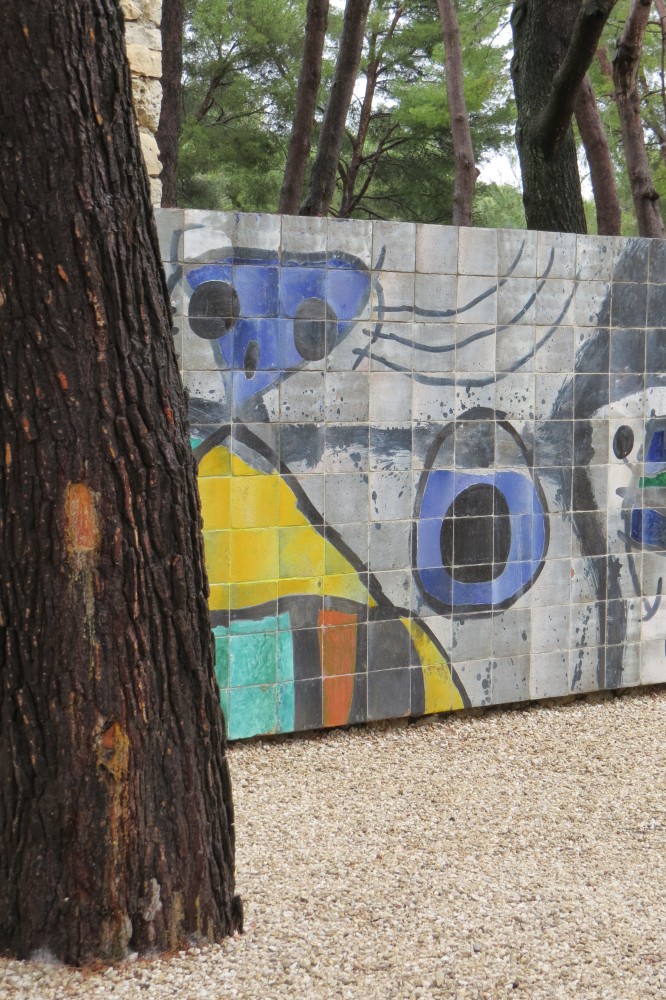
Next stop: Château-Musée Grimaldi. a total mashup of the old, the odd, and the newish, as the Nice Office de Tourisme notes.
Built in 1309 for Rainier Grimaldi and converted into an Italian-style residence in around 1620, Château Grimaldi was bought by Cagnes Council in 1937 and became the municipal museum in 1946.
Situated at the heart of the medieval village of Haut-de-Cagnes, the château is home to the “Musée de l’olivier”, the Solidor donation (forty portraits of Suzy Solidor painted by famous artists such as Foujita, Lempicka, Laurencin, Picabia, etc.), an outstanding painted baroque ceiling and a number of contemporary art exhibitions.
The Solidor room is a hoot. Here’s just part of it.
Everything you didn’t know you wanted to know about the cabaret owner/singer Suzy Solidor can be found in this Modern Art Consulting post (along with most of the other portraits of her), if you’re so inclined.
Our next quest was to reach the Jean Cocteau-decorated Villa Santo Sospir in Saint-Jean-Cap-Ferrat. We took the bus to the town’s Nouveau Port and then embarked on 45 minutes of squirreling, largely uphill, to get to the villa. Saint-Jean-Cap-Ferrat is the second-richest community in the world (Monaco is first) and it shows: Every home is gated and named. Walking along Avenue Prince Ranier III de Monaco, I pretty much expected les gendarmes to be summoned at any moment. But no. The locals probably thought we were someone’s housekeeping staff.
The villa itself is spectacular, with a great (if grammatically challenged) backstory.
In 1949, the poet Jean Cocteau during the filming of Enfants Terribles, directed by his famous novel [sic] by a young filmmaker of the time, Jean Pierre Melville, made the acquaintance of Francine Weisweiller. Nicole Stéphane (real name Nicole Rothschild), the leading actress of the film, cousin Alec Weisweiller, presented the poet Francine; there was among them a
 stroke of lightning friendship.
In Spring 1950, after mounting Enfants Terribles, Francine invited Jean Cocteau and his adoptive son Edouard Dermit (interpreter of the role of Paul in the film), to spend a small holiday week at his home in St Jean Cap Ferrat overlooking the bay of Villefranche.
The villa Santo Sospir, built shortly after the war, was bought by Alec and Francine in 1946. Used as a holiday home, the walls of the villa remained empty. A few days after his arrival, Jean Cocteau say: “idleness tired … I myself dry. “. He asked if he could draw Francine charcoal head of Apollo above the living room fireplace. Little by little, he tattooed frescoed the walls of the house. Matisse had said: “When we decorate a wall the other is decorated, he was right.” Cocteau also said: “Picasso opened and closed all doors, left to paint on doors, that’s what I tried to do. But the doors open in the rooms, the rooms have walls and if the doors are painted the walls look empty … “
Cocteau wound up staying for 11 years, as he relates in this 1962 video.
Among the amazing “tattooed frescoes” (all the artwork was done freehand – no sketches) is Le Mythe du Soleil ou Tête d’Apollon.
And here’s La salle à manger Judith et Holopherne.
Cocteau even painted some of the furniture.

As for the name of the villa, Santo Sospir (or “Saint Sigh”) comes from Saint Jean’s previous name, so designated because when fisherman returned to port there, they would invariably sigh at the town’s beauty.
We totally got that.
The next day we ventured to the Festival de Cannes and immediately left – to visit Musée Bonnard in Le Cannet, the “first museum in the world dedicated to the work of Pierre Bonnard, a leading figure of the art of the nineteenth and twentieth centuries. The museum is naturally at the heart of the city of Le Cannet, which inspired the artist by its landscapes and light of the South. It was during this time that he painted his finest works.”
None of which, unfortunately, were at Musée Bonnard. But it was a pretty place, compact and sparkling new. Here’s a sampling of the quite nice work that was there.


An altogether lovely visit to a place with an interesting, if modest, collection.
Neither of the latter two adjectives applied to the crowds walking around Cannes during its annual film festival, where not just the movies but everyone seemed on offer.
It was one big Keister Parade, an endless tide of tight white jeans, short skirts, even shorter shorts. And everyone on the lookout for celebrities, of which they had seen exactly none so far that day because why in the world would, say, Sean Penn ever go some place we would?
At midday, it was pretty much the unimportant in pursuit of the self-important. The problem was, no one with any juice would be out and about at that hour.
So we wandered up – and up – and up – and . . . finally arrived at the impressive, if grammatically tangled, Musée de la Castre.

LOCATED ON THE HEIGHTS OF SUQUET, THE HISTORIC DISTRICT OF CANNES, IN THE REMAINS OF THE MEDIEVAL CASTLE OF THE LÉRINS MONKS HISTORICAL MONUMENT, THE MUSEUM OF CASTRE DOMINATES THE CROISETTE, THE BAY AND THE LERINS ISLANDS.
The museum presents the prestigious collections belonging to the city of Cannes: primitive arts Himalaya-Tibet, Oceania, Ancient America and Mediterranean antiquities world music instruments (Africa, Asia, Oceania and America) and also landscape paintings 19th century. Its square tower of the twelfth century (109 steps) offers an exceptional 360 ° panorama over Cannes and its region.
Here’s one-quarter of that panorama.
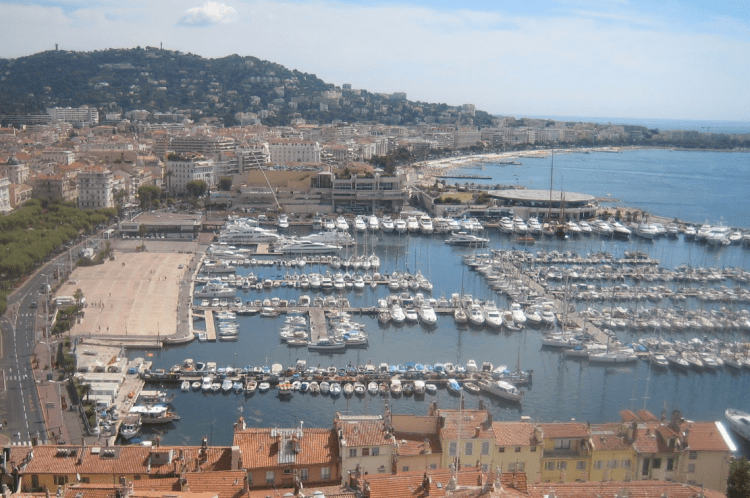
As for the collection, it might well be “prestigious,” but there’s no question it’s odd. You can poke around it here if you like.
What we preferred to do was head back to Nice for a return visit to the Museum of Modern and Contemporary Art, where we encountered an army of museum personnel and a huge crowd waiting for – this is true – Sylvester Stallone. We had no idea why he’d be showing up there; we just wanted to get into the museum and see artworks by the likes of César, Yves Klein, Niki de Saint Phalle, and Arman.
But . . .
We had stumbled upon a gallery opening that featured the painterly endeavors of the aging American movie star, as Le Huffington Post reported.

CULTURE – Le Musée d’art moderne de Nice accueille jusqu’à fin mai une rétrospective des oeuvres de Sylvester Stallone, plus connu pour ses rôles au cinéma que pour ses talents de peintre. A cette occasion, l’acteur américain est venu présenter sur la Côte d’Azur, ce samedi 16 mai, l’exposition qui lui y est consacrée.
“La peinture touche les sens, la vérité est immédiate”, a expliqué l’acteur-peintre au cours d’une conférence de presse aux côtés du député-maire UMP de la ville Christian Estrosi. “L’écriture peut aussi toucher tous les sens mais je pense que la peinture est la forme la plus authentique, la plus honnête de tous les arts, parce que c’est simple, ça ne pardonne pas”, a ajouté l’interprète de “Rocky” et “Rambo”.
Sylvester Stallone! The Mayor of Nice! A retrospective! Could it get any more French than that?
It could.

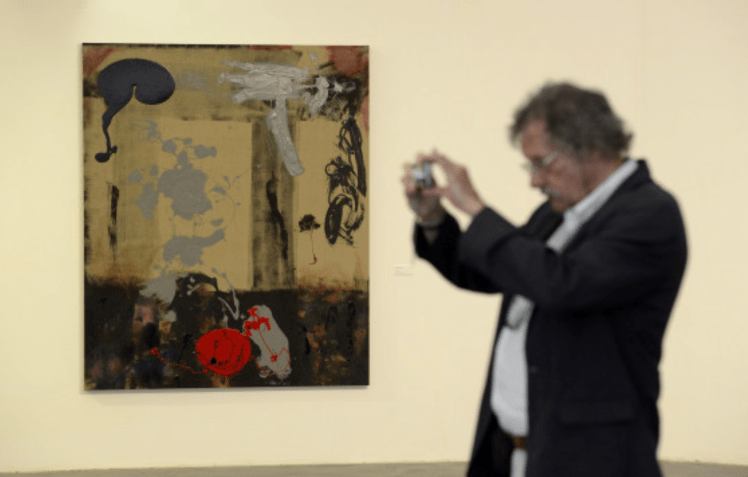
Back in Villefranche, we sat on our terrace and watched the birds wheel and bank and dive like some fly-by homage to Tippi Hedren and listened to Frank and Billie on a local jazz station and saw the horizon turn from light blue to pink to dark blue and heard the incessant coo of the doves down below and then the lights along the hillside began to wink on – there there there there – and, man, it was swell.
A couple of days after that, we embarked upon the Menton Death March.
After getting off the train in La Perle de la France, our first stop was Musée Jean Cocteau Collection Séverin Wunderman, which was at that time hosting Les Univers de Jean Cocteau, whose description was slightly less than informative.
 As of November 22, 2014, and until 2 November 2015, the museum will be dedicated to the obsession of the place and backwards and figure twice in the work of the artist.
The proposed route is organized into seven sequences which each represent one of the world of “Prince of Poets”: Perception or the “inner theater” of Jean Cocteau Location / Envers and poetry, Intermediate or figures as the angel Heurtebise that we find in his work, Cupids, with death is a major theme of his artistic work, spirituality and echoing the magic, astrology and parapsychology, and finally Space-time or “degravitation” by which means the detachment Cocteau philosophies that take the man and the earth to the center of the universe. A seventh sequence, the museum’s Bastion nearby, gives studying monsters and myths of artistic work of the poet.
We had no idea what any of that meant, but the building itself is a knockout.
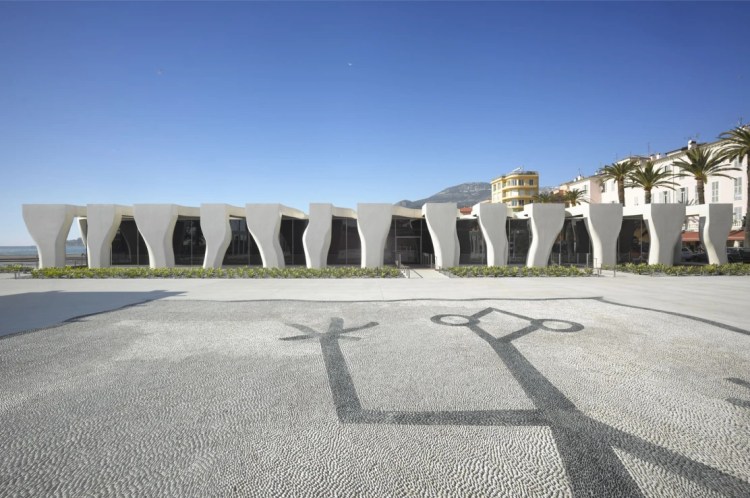
Cocteau was a sort of Jacques-of-all-trades – writer, artist, designer, filmmaker – each of which was represented in the exhibit. (The entire collection was eventually available at Videomuseum – the mother lode of French art.)
From there we marched – wait for it! – straight uphill to Basilique Saint-Michel, which of course was closed, as was the adjacent chapel, which was either the Chapelle des Pénitents Noirs or the Chapelle des Pénitents Blancs, no idea which.
Undaunted (we had visited the church a decade earlier on a previous trip), we traipsed even farther uphill to Cimitière du Vieux Château, which Guy de Maupassant called “the most artistic cemetery in Europe.”
We were looking for the grave of the artist Aubrey Beardsley who, like many consumptives of the time, went to Menton to die. Unfortunately, we had failed to consult Find a Grave beforehand, so we wandered around for half an hour but never did see Beardsley’s tombstone.
Here it is now.
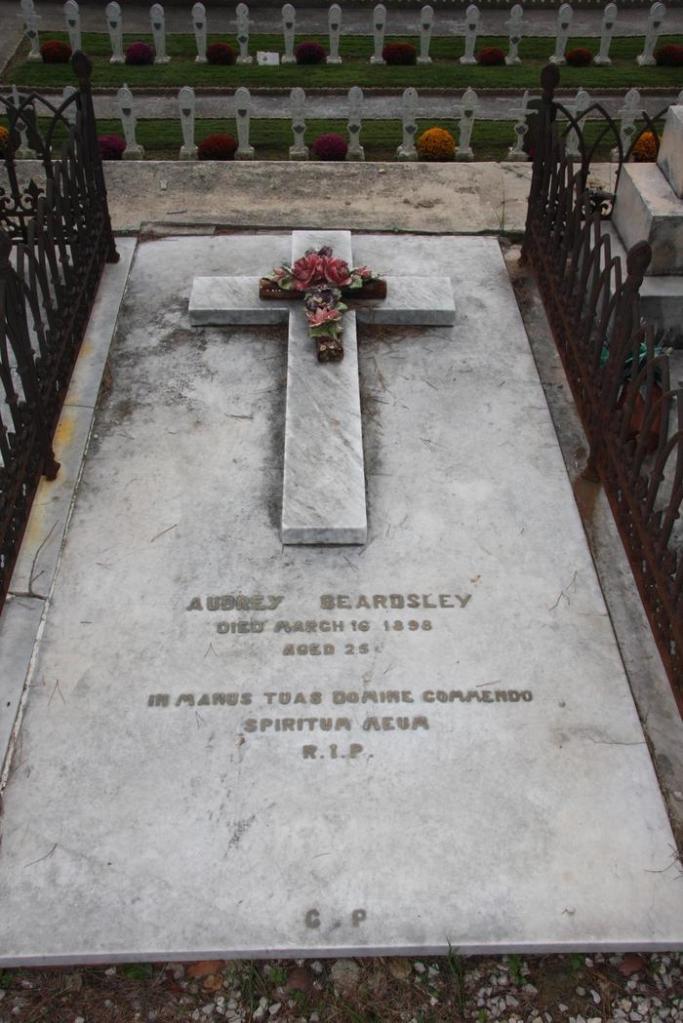
We then trundled back down to Menton centre to the Cocteau-decorated Salle des Mariages at the Hôtel de Ville, a creative endeavor the artist described as a monumental struggle with . . . himself.
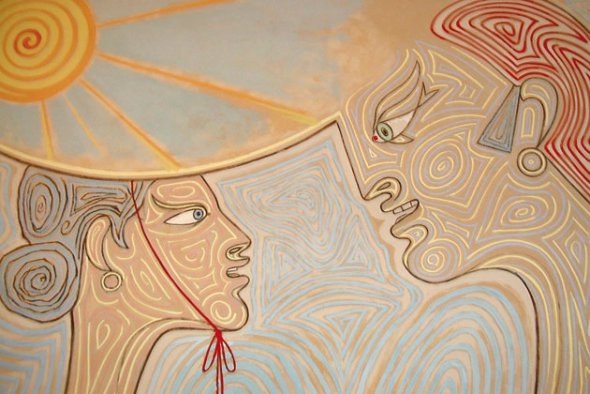
This Mariage Hall was designed and decorated by Jean Cocteau, in 1957 and 1958. Everything you see in this room was signed by the artist: the lamps, the chairs, the panther-skin rugs, the doors, the curtains…
All mariages of Menton residents take place in this hall since a wedding ceremony performed in the town Hall is the only one legally recognised in France . . . “Tired of pen and paper – wrote Cocteau – I undertook a mountain cure on the scaffolding so that through bodily tiredness I would restore my mind. My impulsive acceptance came from my embracing the motto: «à I’impossible je suis tenu» – in face of the impossible I go on.
“The Town Hall struck me as rather unsympathetic. I needed to play tricks with it, to try to adapt the style of the turn of the century on the Riviera, with its villas mostly now gone, painted with sheaths of iris, algae and heads of waving hair. Such was my point of departure, from which I was carried far at the command of that “other self” which dictates what we must do.”
When we got there, of course, it was closed. But here’s a good look at what we didn’t get to see.
At that point the Missus and I headed to Monaco, which we figured would not be closed. First stop: the Palais Princier de Monaco, which some consider a yawn but which we liked, except for the insufferable British guy narrating the audio guide.
Take your own tour here.
We also popped into the cathedral where Grace Kelly is buried in a tomb inscribed Gratia Patricia Principis Ranierii III Uxor.

More impressive was Musée Océanographique de Monaco, founded in 1910 by Prince Albert 1er, who “sank all of his casino profits into a passion for deep-sea exploration.”
For starters, it’s a beautiful building.

Inside, there was plenty to explore: the aquariums, the sharks (especially the video On Sharks and Humanity), and a bunch more videos here.
We also swung by Le Jardin Animalier de Monaco, which we do not recommend, mostly because they hid the hippopotamus somewhere, somehow. That’s just not right.
By then we’d had pretty much all the excitement we could handle, so we headed back to Villefranche. Later, around 10 pm, we heard a lot of booming so we went out on the terrace and – lo! – there was a big fireworks display somewhere in the general vicinity of Cap Ferrat.

Very sparkly.
Next to last day of the trip, we headed back to Nice, walking through Vieille Ville, strolling along the Promenade des Anglais, doing our best imitation of the classic French flâneur – something made slightly more difficult by the myriad selfie sticks surrounding us.
We also walked through the delightful Promenade du Paillon, a new park stretching from Place Masséna to Garibaldi Square. Best part: all the stuff that was there for kids to climb on.
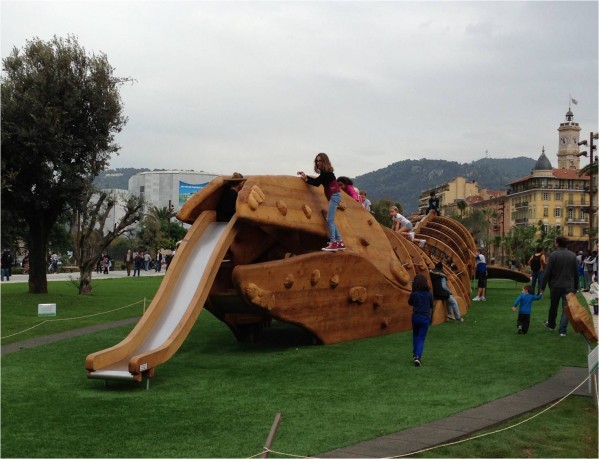

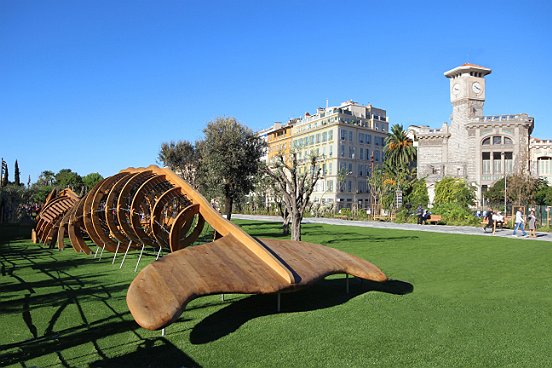
On our last day we headed to Citadelle Saint-Elme, the 16th century fortress that looms over Villefranche and houses the Town Hall, the Volti Museum, Goetz-Boumeester Museums, and the Roux Collection.
Also the Chapelle Saint-Elme, where there was an exhibit dedicated to the artist (and Holocaust victim) Charlotte Salomon.
Charlotte Salomon was a prolific painter who produced over 1,300 gouaches. A luminous
 work, like a cry, as the only escape from the darkness of the world.
The author of “Delicacy” [David Foenkinos] has reconstructed the life of this artist in a very beautiful novel “Charlotte” , hailed by critics. In honoring [her], he lifted the mystery about this work that the French will be able to discover in Villefranche after several international exhibitions in Europe and the United States.
The work of Charlotte Salomon is unique, conceived as an opera scenario: gouache each door on the back of musical references (classical, opera or popular) intended to highlight the action suggested by the drawing.
The U.S. exhibit mentioned above appeared at the Jewish Museum in New York in 2001.
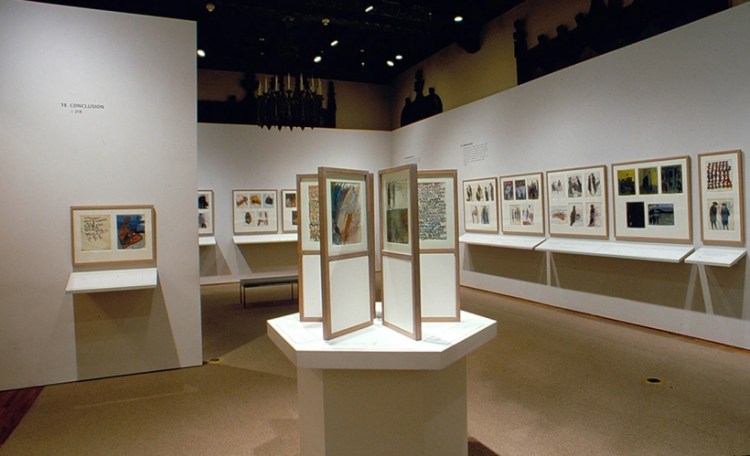
During World War II, while living in exile in France, the young German-Jewish artist Charlotte Salomon (1917–1943) created Life? or Theatre?: A Play With Music, comprising almost eight hundred small gouache paintings. In this work, Salomon combined painting with text and musical cues to tell a compelling and autobiographical coming-of-age story set amid increasing Nazi oppression and a family history of suicide. Although the artist died in Auschwitz—a fact that deeply affects our view of the work—Life? or Theatre? survived and stands as a testament to Salomon’s life and singular artistic vision.
The exhibit in Villefranche was more modest but just as moving.
Unfortunately the Goetz-Boumeester Museum, with its hundreds of works by contemporary artists including Picasso, Miró, Picabia, and Hartung, was closed. We did, however, catch the Roux Collection, which “features several hundred figurines which take visitors through the daily lives of men and women in the Middle Ages and Renaissance.”
Comme ça . . .

And last but not least, Fondation Musée Volti.

Museum of sculptor Volti combining local architecture and sculptures. Nestled at the bottom of the casemates of the Citadel, a people of bronze women, copper and terracotta, display their voluptuous curves in a green gemstones.
(Don’t you just love Google Translate?)
• • • • • • •
Two years earlier, on the last night of our stay in Villefranche, I walked down to the port, stood alongside the bust of Jean Cocteau, and took what I believed to be my last look at the Mediterranean Sea.
But I got a mulligan.
So I went back down, stood in the same spot, and took what likely will be my last look at the Mediterranean. And said goodbye to the blue-green water, the clinkaclanka tympani of the boat tackle, and the triple strand of lights that adorn the hills stretching from Villefranche to Beaulieu to Cap Ferrat.
Then I walked up the 100-odd steps to the apartment, and the Missus and I got ready to go home again.
-
Our Rain-Drenched Return to Munich
At some point the Missus and I thought we might make a couple of return visits to European cities in which we had spent only a couple of days during previous trips.
First up was Florence, where we’d had un caffè as part of our four-city Italian blitz in 1986. This time the Missus scored a fabulous Alitalia package: Round-trip airfare and six nights hotel for a mere $700.
Eccellente!
Except when we arrived at Logan Airport’s international terminal, one of the perks we had been promised was not forthcoming. The Missus, who had been working at a breakneck pace for many months and was understandably frazzled, got kind of emotional at that point.
The Missus:
“Kind of emotional” is an understatement. A client, who shall remain nameless, had suddenly decided to make unnecessary changes to a completed project requiring me to drive to their office the morning of our flight. Needless to say I was looking at the clock the whole time and freaking out when I hit traffic driving home. Nevertheless, we got to the airport over two hours early, as I had been told that would guarantee confirmation of my booking seats in an exit row with lots of legroom.
But when we checked in, the very polite gentleman at the Alitalia check-in counter told me those rows were always reserved for families with babies. I was so over-tired and over-worked at that point that tears started running down my face. In a very low, trembling voice I said I completely understood the rules but wish the airline booking representative hadn’t misinformed me. Then I really started to cry. I kept trying to stop while profusely apologizing for being so over-emotional, explaining I had just had a bad week. If we could have an aisle and window I’d appreciate it. I barely raised my voice above a whisper the whole time as I didn’t want to seem like an ugly American.
The Alitalian at the check-in counter said “Let me have your tickets” and promptly disappeared for a nail-bitingly long time. Minutes before our flight’s departure, he returned with two first-class boarding passes, at which point the Missus got a different kind of emotional.
Our room at the Hotel Martelli in the heart of the city was almost equally dramatic.

As for Florence itself, it looked like this at the time (via ThamesTV).
We started out with some Greatest Hits reruns, from the stately Cathedral of Santa Maria del Fiore (Duomo di Firenze) to the lavish Pitti Palace, which houses the Palatine Gallery, the Silver Museum, the Museum of Modern Art, the Costume Gallery, the Porcelain Museum and the Museum of Carriages.
Best of all, the Missus, in her infinite wisdom, had purchased advance tickets for the Uffizi Gallery, allowing us to skip the line and gain early entry.
This is what the Botticelli Room normally looks like.

This is what it looked like when the Missus and I waltzed in.
We spent a blissful half-hour alone with the luminous works of Sandro Botticelli, including this one.
Primo indeed.
In contrast to our soggy Munich encore (details below), it rained all of 90 minutes while we were back in Florence, but we didn’t care because we were inside the marvelous Museo Galileo the entire time.

Since 1930 the seat of the museum is in the old palace, restored several times down the centuries, that takes its name from its last owners, the Castellanis. The museum displays a very accurate and important collection of scientific instruments, the proof that interest of Florence in science from the 13th century onwards was as great as its interest in art.
Representative samples . . .


An amazing place (lots of videos here).
The nice weather made our forays into the Tuscan countryside that much more pleasant. In Siena, we sat at a cafe in the sun-drenched Piazza del Campo, just across from the Torre del Mangia (Tower of the Eater – really) and the Palazzo Pubblico (Town Hall).

Nearly every major room in the palace contains frescoes. These frescoes are unusual for the time in that they were commissioned by the governing body of the city, rather than by the Church or by a religious fraternity. They are also unusual in that many of them depict secular subjects instead of the religious subjects which are overwhelmingly typical of Italian art of this era.
The most famous of the secular frescoes are three panels in the series on government in the Hall of the Nine (also known as Sala della Pace) by Ambrogio Lorenzetti. These frescoes are collectively known as Allegory and Effects of Good and Bad Government.
Here’s the Allegory of Good Government, for those of you keeping score at home.

Yeah – no idea, then or now.
We also took a day trip to Lucca, “Italy’s most impressive fortress city, encircled by a perfectly intact Renaissance wall,” as Rick Steeves describes it. I recall walking around the walls of the city, but not much else.

Pisa, on the other hand, I remember vividly. And yes, the Missus did take the obligatory trick photo of me holding up the Leaning Tower, which is – thankfully – now lost to history. (The photo, that is, not the Tower, which is – thankfully – still standing.)
Consolation prize: This photo of someone else’s slice of Pisa.
Another journey to the outskirts of Florence took us to the Etruscan town of Fiesole, with its breathtaking views of the city below.
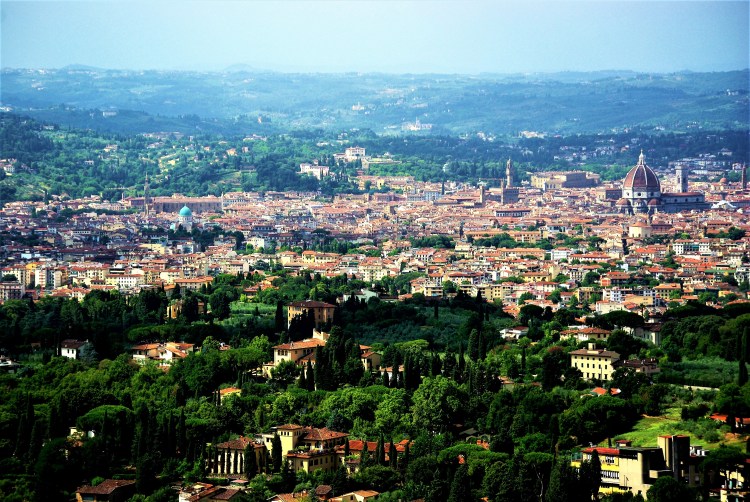
We also stopped by the remains of the Roman amphitheatre there.

Our last foray out of Florence landed us in Charming Medieval San Gimignano.
San Gimignano, a small walled village about halfway between Florence and Siena, is famous for its fascinating medieval architecture and towers that rise above of all the other buildings offering an impressive view of the city from the surrounding valley.
At the height of its glory, San Gimignano’s patrician families had built around 72 tower-houses as symbols of their wealth and power. Although only 14 have survived, San Gimignano still retains its feudal atmosphere and appearance.
We especially wanted to see the fully frescoed Duomo di San Gimignano, which according to Discover Tuscany “has NEVER actually needed ‘restoration’ throughout the centuries. The colors you see are the original ones painted in the 1300s and their vividness and brightness is awe-inspiring.”
Their vividness and brightness is also costly: To actually see the frescoes, you had to keep feeding liras into coin-operated spotlights.

The Missus and I, respectful tourists that we were, allowed others to precede us in triggering the lights.
And then it was time to say, Ciao, Firenze.
Upon our arrival at Amerigo Vespucci Airport to return home, the Missus, in her infinite wisdom, showed the Alitalian at the ticket counter the first-class boarding passes from our flight over there. “They said in Boston you might be able to bump us up again,” she told him sweetly.
And just like that, he did.
Saluti!
• • • • • • •
After the Florence trip, it was back to Bavaria.
During our worldwind tour of four Eurocities in the early ’90s, the Missus and I had a tasse kaffe in Munich, which looked like this when we arrived by train from Salzburg.
We spent our two days in the Bavarian capital immersing ourselves in the fabulously extravagant Residenz München; stopping for a drink – dummkopfs that we were – at The Hofbräuhaus, site of Adolf Hitler’s failed 1923 beer hall putsch; and trundling out to Neuschwanstein Castle, the mothership of King Ludwig II’s mad reign.
Not bad for 48 hours. Some years later, though, we decided to go back for a longer look.
At the time, the Missus had a hairdresser who hailed from Germany, and she told us that the place to stay in Munich was the Schwabing district, which was originally the bohemian quarter of the city but had since been gentrified with all the requisite shops, restaurants, and art galleries that go with the upscaling of urban areas. Adding to the appeal: The Schwabing is home to the Englischer Garten, one of the world’s largest public parks.
The neighborhood is also home, not coincidentally, to the Hotel Gästehaus Englischer Garten, a “lovingly restored historic building next to the English Garden” that the Missus wisely chose for our stay.
We scheduled our trip for August, normally the warmest month of the year in Munich.
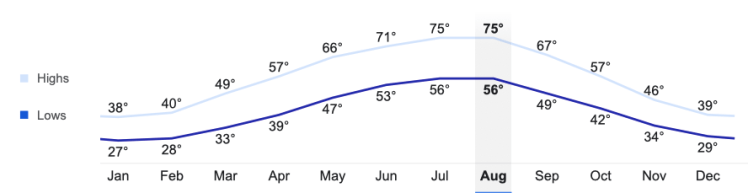
On the other hand, August is also one of the rainiest months there.

We wound up with the worst of both worlds: six days of low-50s, six days of torrential rain. That’s over one-half of Munich’s entire monthly allotment of rainfall in one-fifth of the days, for those of you keeping score at home.
Consequently, the first thing we did after settling into our charming hotel room was to visit one of Schwabing’s smart shops to buy the Missus something warm to wear – a sweater, a shawl, something.
Of course, the Missus and I were back in Munich to soak up more than Biblical downpours, so we set out – umbrellas flapping in the wind – to visit Bayerisches Nationalmuseum, which Inside Munich calls “a true treasure chest of Bavarian Art, Culture and History and even the building itself is breathtaking.”
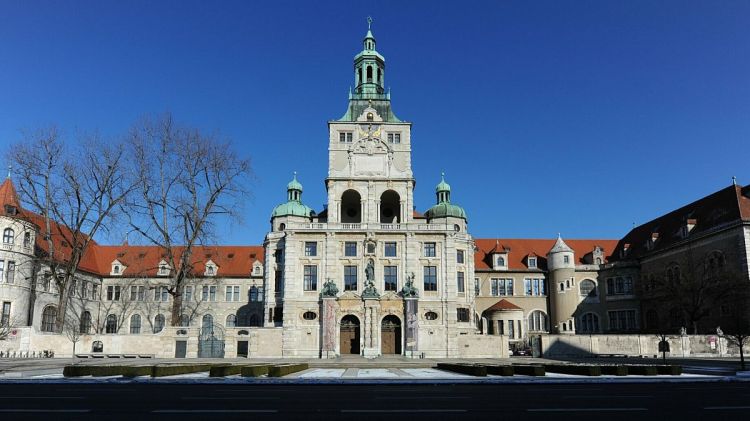
The “Schatzhaus an der Eisbachwelle” is one of the largest museums in Germany. It displays exceptional art from late antiquity up to art nouveau, and explains European cultural history in Bavaria in a unique way. With the successive renewal of its display collections and exciting special exhibits it creates bridges between the past and the present.
Here’s a quick tour. (The museum’s online collection is here, but forewarned is forearmed: It’s tougher to navigate than the IRS at tax time.) What the video does not include are pieces such as these from the museum’s art nouveau gallery.


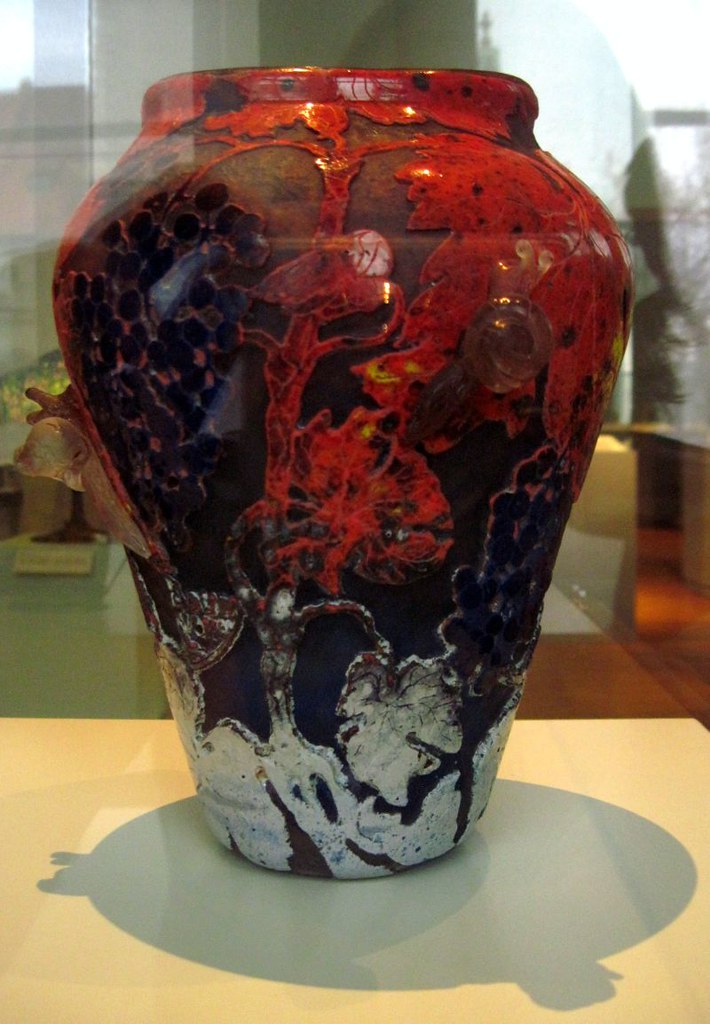
Marching forward in time, we wandered over to the Neue Pinakothek, founded in 1853 by King Ludwig I as Europe’s first public museum dedicated solely to contemporary art.

“Rediscover the 19th Century” is the motto of the Neue Pinakothek. A richly varied tour provides an opportunity to view paintings and sculptures of the Neoclassical, Romantic, Impressionist, Art Nouveau and Gründerzeit periods and to encounter masterpieces by major pioneers of Modern art: Max Liebermann, Edouard Manet, Claude Monet, Vincent van Gogh and Paul Cézanne . . .
After its complete destruction during the Second World War, the architect Alexander von Branca was entrusted with the design of the current building, which opened its doors in 1981.
Here are a few examples – by van Gogh, Ernst Ludwig Kirchner, and Wassily Kandinsky – from the museum’s online collection.


And here’s how the museum looks nowadays.
As much as we appreciated the legacy of Ludwig I, we were even more interested in the lunacy of his heir aberrant, grandson Ludwig II. So we headed off to Linderhof Palace, the country retreat of the mad Bavarian.
Ludwig II, who was crowned king in 1864, began his building activities in 1867/68 by redesigning his rooms in the Munich Residenz and laying the foundation stone of Neuschwanstein Castle.
In 1868 he was already making his first plans for Linderhof. However, neither the palace modelled on Versailles that was to be sited on the floor of the valley nor the large Byzantine palace envisaged by Ludwig II were ever built.
Instead, the new building developed around the forester’s house belonging to his father Maximilian II, which was located in the open space in front of the present palace and was used by the king when crown prince on hunting expeditions with his father. Linderhof Palace, the eventual result of a long period of building and rebuilding, is the only large palace King Ludwig II lived to see completed.
The finished product is a total knockout.


Some hunting lodge, eh? (If you’re so inclined, you can take this Haswell Travelled tour of the palace’s equally spectacular grounds.)
It’s Linderhof’s dining room, though, that takes the cake.
This room is famous mainly for its table, known as the “wishing table” after the table that sets itself in the Grimms’ fairy tale, “The Wishing Table, the Golden Ass, and the Cudgel-in-the-Sack.”
By means of a crank mechanism, the table can be lowered downstairs to the kitchen. It is
 an 18th-century French invention that allowed court society to remain unobserved during their amorous suppers. Ludwig picked up the invention for a different reason. What mattered to the lonely king were not gallantry and erotic adventures but undisturbed reverie when he had his imaginary court society assembled around him.
Theodor Hierneis, one of the king’s cooks, reports on this habit in his memoirs: “He (the king) wants no one around him (at meals). Nevertheless, the dinners and suppers always have to be large enough to serve at least three or four people. This way, although the king always sits down to eat alone, he does not feel alone after all. He believes himself in the company of Louis XIV and Louis XV and their lady friends, Madame Pompadour and Madame Maintenon. He even greets them now and then and carries on conversations with them as though he really had them as his guests at table.”
Talk about your moveable feast . . .
• • • • • • •
The time has come to speak of food in foreign climes – uncharted waters for most tourists, with the notable exception of those who sail only into McDonalds and Pizza Hut (of which there are many).
For everyone else, of course, it all starts with breakfast. According to Mon Panier Latin, the typical French petit déjeuner “consists of a croissant or bread with butter and jam and sometimes a sweet pastry. Fresh fruit juice and hot beverages, like coffee or tea, are also included.”
Our first time in Paris, the Missus and I stayed at Le Régent, a swanky Left Bank hotel where each night we would order room-service breakfast and they’d ask, “Would monsieur and madame like orange juice with that?” – never mentioning that each glass cost an extra 40 francs (equal at that time – April 1985 – to roughly four bucks). So when we checked out, there was a knee-buckling 400 extra francs on la note d’hôtel. You bet I recalled some choice French phrases at that point.
Immediately afterward, we got into a dustup with a cabdriver who arrived at the hotel with 30 francs already on the meter. (We would later learn that when you call for a cab in Paris, the meter starts running right away.) As we argued with the chauffeur de taxi, we also learned that our requested destination – Paris-Orly Airport – didn’t handle international flights. We needed to go to Charles de Gaulle, the driver said as he kicked us and our luggage to the curb. So there we were on rue Dauphine trying to flag a passing taxi, which we only succeeded in doing by hiding the Missus and our bags until one pulled over. That made two ticked-off chauffeurs de taxi in under 30 minutes, for those of you keeping score at home.
As The German Way relates, “a German breakfast consists of hearty Brot (breads) and Brötchen (rolls), decorated with butter, sweet jams and local honey, thinly sliced meats, cheese and even some Leberwurst. Top that off with a pot of coffee or tea, or get fancy with Saft (juice), gekochtes Ei (boiled egg) and yogurt or Quark topped with Obst (fruit) and muesli.”

Oy. We felt kind of bad – 90% of what was delivered to our room each morning at the Hotel Gästehaus Englischer Garten, the Missus wouldn’t eat at gunpoint. The other 10% we split before splitting for the day.
And then there was eating out . . .
In Munich, as in Paris, every restaurant meal was an adventure, except for entirely different reasons. For an American in a Parisian bistro, it’s always a coin flip whether the waiter will consider you worth the effort, given that his 15% tip is compris – that is, built into the tab. The answer is usually non. For tourists, Paris might as well be nicknamed the City of Light Service.
The Missus and I rarely passed the waiter’s test, leaving us to endure many long lonely meals interrupted by spasms of surly service. Eventually the Missus fixed that problem by ditching hotel stays in favor of rental apartments, where the dining experience proved vastly superior.
The challenge in Munich was not the waiters but the menus – in particular, which entrée might be chicken, given that German has at least 15 different words for the barnyard basic, depending on the season, the seasoning, and God knows what else. Then again, the waiters and waitresses we encountered around Munich were unfailingly friendly and helpful, a great improvement over the Paris pouters.
That contrast is nicely illustrated by a tale of two dinners.
On one of our early trips to Paris, we went to a small neighborhood restaurant where I navigated the entire dinner in what I thought was passable French. At the end I said to the waiter, “le reçu, s’il vous plaît,” to which he replied with a sneer, “check?” (A few years later, a less contemptuous waiter would tell me, “votre français est brave,” which I took as a compliment, backhanded though it might have been.)
At a small neighborhood restaurant in the Schwabing, by contrast, I stumbled my way through the meal but managed to say at the end, “die rechnung, bitte.” The waiter looked me in the eye and replied, “die rechnung, jawohl!”
Exzellent!
• • • • • • •
During our previous visit to Munich, one thing the Missus and I didn’t have time to explore was the city’s splendid array of churches, so we decided to rectify that by entering every ecclesiastical edifice we encountered upon our return.
The one I remember best is St. Michael’s Church, here described by Spotting History.
St. Michael’s Jesuit church in Munich is the largest Renaissance church north of the Alps. The style of the building had an enormous influence on Southern German early Baroque architecture.
The church was built by William V, Duke of Bavaria between 1583 and 1597 as a spiritual center for the Counter Reformation. In order to realise his ambitious plans for the church and the adjoining college, Duke William had 87 houses in the best location pulled down, ignoring the protests of the citizens.
Payback of sorts came when “the [church’s] tower . . . collapsed in 1590, destroying the just completed quire. Duke William V took it as a bad omen and so planned to build a much larger church.”
Not sure about the logic there, but it certainly worked out in the end.
The interior is equally impressive.

Even more impressive was Nymphenburg Palace, “one of the best examples in Europe of a synthesis of the arts.”

The decoration of the main palace . . . represents a variety of styles ranging from Baroque and Rococo to Neoclassicism.This long tradition is reflected in the Baroque ceiling paintings from the epoch of the palace’s founder, the apartments decorated with exquisite paintings and furniture . . .

But wait – there’s more: “Among the attractions of Nymphenburg is the famous Gallery of Beauties of King Ludwig I of Bavaria, for which Joseph Stieler painted 36 beautiful women from all sections of society.” (This video gallantly calls the roll of the fairest three dozen in the land.)
Other rooms at Nymphenburg Palace are beauties in their own right.


We then went from the sublime to the subterranean: The Deutsches Museum’s Mining Exhibit.
Descend into the depths of the earth as the miners once did. In our exhibition, you can experience the extraction, transportation and refinement of raw materials.
So we descended, and here’s some of what we experienced.

Right about the Pitch Coal section, the Missus and I started to get the willies, because it felt like the mining exhibit was never going to end. And we were kind of right: We still had Bituminious Coal of the 1950s, Processing, and Modern Mining in front of us. So we doubled back through the exhibit and bolted for the street.
A miner meltdown, you might say.
(This intrepid visitor, however, made it all the way through.)
After all that grim ‘n’ grime, the Missus and I needed something more, well, uplifting. So we trundled off to visit Mad Ludwig’s third castle, Herrenchiemsee.

In 1873 King Ludwig II of Bavaria acquired the Herreninsel as the location for his Royal Palace of Herrenchiemsee (New Palace). Modelled on Versailles, this palace was built as a “Temple of Fame” for King Louis XIV of France, whom the Bavarian monarch fervently admired.
The actual building of this “Bavarian Versailles”, which was begun in 1878 from plans by Georg Dollmann, was preceded by a total of 13 planning stages. When Ludwig II died in 1886 the palace was still incomplete, and sections of it were later demolished.
What little remains, though, is a corker, as illustrated by this helpful tour.
Having thus hit the trifecta of Palaces of Ludwig II of Bavaria, the Missus and I returned to our lovely hotel room and started packing for home.
• • • • • • •
Murphy’s Law being what it is, on the day we were to leave Munich, the rains subsided – of course – and the sun emerged in all its glory. Happily, our flight was scheduled for late afternoon, so we moseyed for the first (and last) time into the Englischer Garten, which burst into view like The Wizard of Oz shifting from sepia tones to Technicolor.


As we wandered about, we thought how nice it would have been to sit in the Englischer Garten enjoying our one-tenth of a standard German breakfast each morning. Another lifetime, perhaps.
And with that, we said auf Wiedersehen to Munich and headed back to Boston.
-
A Jolie Château Crawl Through the Loire Valley
After the Missus and I reached our rapprochement with Paris, we thought the time might be right for a ramble in the French countryside. And so we embarked upon a Folie des Grandeurs Tour of the great châteaux of the Loire Valley.
Once we had painstakingly secured a rental car at the eternally chaotic Charles de Gaulle Airport, we drove south to Amboise and checked into the entirely charming Château de Pray.
(A word here about the Missus, who was a Hotel Booking Goddess way before the Internet made travel planning a piece of cake. She consistently found the most amazing places for us to stay throughout our many journeys. The Château de Pray was just one more among them.)
The Missus:
It wasn’t easy finding the ideal hotel prior to the internet. You were basically going by single-paragraph descriptions in guidebooks with no guest reviews or hotel websites with photos. I always bought at least three guidebooks for every country in Europe so I could compare their suggestions. All three suggested the best place to stay in the Loire Valley was the centrally located Tours, with loads of inexpensive accommodations and restaurants catering to tourists, no pun intended. A town full of tourists? I scratched that one right away.
Instead, as I researched all the châteaus, I read up on the surrounding villages to see which was considered the most picturesque. Amboise sounded perfect and was also in a convenient location for all our sightseeing. As we were traveling off-season, I chose the 4-star Château de Pray, as they offered great rates for staying in such a beautiful, historic building.

Perfectly located on the south bank of the Loire, the castle has watched over the valley for centuries and holds the secrets of some of the finest chapters in French history. A stone’s throw from Amboise, the castle, a 4-star hotel and Michelin starred restaurant, is nestled in a wooded 5 acre park home to traditional French gardens, patios, a market garden and heated pool.
Inside, the cosy lounges, refined rooms, gastronomic restaurant… invite you to enjoy a charming stay next to the Loire.
The Missus:
I’m always nervous checking into a new hotel, hoping it lives up to its glowing description.
The Château de Pray was above and beyond my expectations! As seen in the photo above, the magnificent manor house, grounds and gardens were a big Wow, and we had high hopes for our accommodations. On checking in, a charming desk clerk insisted on escorting us to our room, passing a life-size suit of armor on the way. She opened the door and we entered a huge room decorated with period furniture, fabrics and antiques, with an elegant desk positioned by a window overlooking the gardens. Our complimentary room service breakfast would be served there, she explained. She smiled and left us to unpack as we stood stunned. We generally do not stay in such luxurious places, and certainly not for the low nightly rate I had gotten.
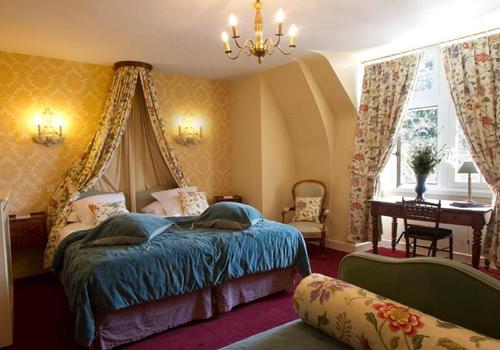
I opened the door to the bathroom, and though lovely, it contained just a small tub. As John never takes baths and our reservation said room with shower, I VERY reluctantly returned to the front desk to ask if there was a similar room with shower. I felt like a total ingrate and I really loved our room and didn’t want to change it. The desk clerk smiled once more saying, “Madame, you have two bathrooms.” Stunned, I muttered “Merci,” and “Je suis désolé” (I’m sorry) and wandered back upstairs. Sure enough, a door we thought led to a closet contained a huge second bathroom with shower. I never wanted to leave.
Amboise, with its central location, turned out to be the ideal launching pad for our château crawl.

Our first stop – no surprise – was Château d’Amboise,

The chateau was built on the foundations of an old fortress, its position perched high on a promontory over looking the Loire, offering a solid defence against any intruders. The chateau was seized by Charles VII in the mid 1400’s after its owner, Louise d’Amboise was involved in a plot against the monarchy. He was later to be pardoned but the chateau remained in the hands of the king.
In 1429 Joan of Arc passed through the town on her way to defeat the English at Orleans.
In the late fifteenth century, following his marriage to Anne of Brittany at Langeais, Charles VIII decided to turn the old castle of his childhood days into a luxurious palace but not long after the work was completed, Charles met his death here – not in the defence of his kingdom – but by banging his head on one of the many low doorways!
Ouch.
As we discovered in our foray through the French countryside, the Loire Valley contains two generations of châteaux: Medieval fortresses designed to ward off rivals, and Renaissance castles designed to show up rivals.
Château Royal de Blois, as it happens, provides a combination of both, as Visit European Castles details.

Chateau Royal de Blois is a former Royal castle in Blois, built between the 13th and the 17th century. This unique castle in the Loire valley consists of four wings, each in their own architecture style. There are remains of the 13th-century Medieval fortress, a Louis XII Gothic-style wing, a Francis I Renaissance-style wing, and the Gaston of Orléan Classical-style wing.
At the castle you can visit the Royal apartments and a Fine Arts Museum with works by Ingres, Rubens, Boucher and more. All this is set in architectural splendor.
A taste of the royal apartments . . .
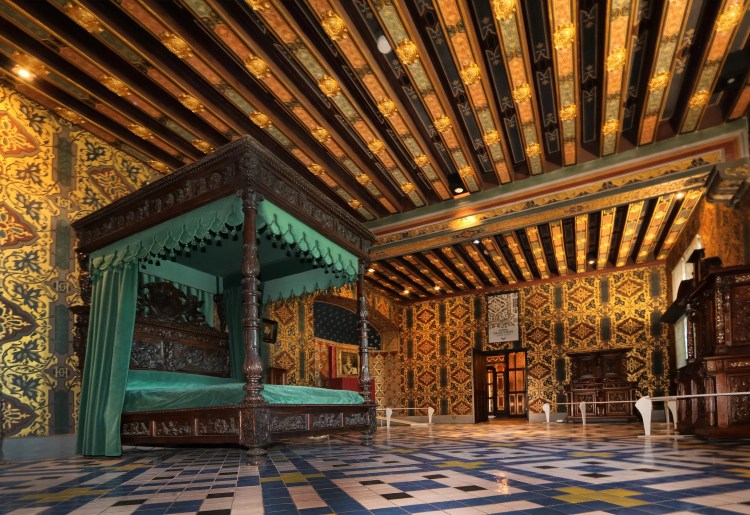
The Missus:
This particular room was at one point a rather un-royal apartment, as in 1588 Catherine de Medici, former Queen and wife of King Henri II, was exiled to Blois by her son, King Henri III. She would die in this bed one year later at age 69. Prior to that was a lifetime of marital, political and power-grabbing drama. The battle with her husband’s beloved mistress Diane de Poitiers played out in many of the châteaux we visited. Stay tuned for some amazing historic shenanigans.
And a smattering of the royal artwork . . .


Those royals were flush, yeah?
Not far from Blois sits Château de Chambord, the largest castle in the Loire Valley and another twofer of medieval and Renaissance design.

The Château de Chambord is one of the most widely recognised of the Loire Chateau with its distinctive French Renaissance architecture which, in the 16th century, blended French medieval design with classical Renaissance structures. The chateau which was constructed by King Francis 1 of France as a hunting lodge is surrounded by 13,000 acres of wooded park which is a game reserve. The chateau is most noted for its extraordinary roofscape and open double-spiral staircase [inspired by Leonardo Da Vinci!].
The roofscape . . .

The staircase . . .

Superb!
Also nearby is Le Château de Cheverny, which is home to lots of history.
The domain of Cheverny belonged to the Hurault family for more than six centuries. Financiers and officers in the service of several kings of France, their château is one of the largest in the Loire Valley and is still inhabited by the descendants of the Huraults, the Marquis and Marchionesse of Vibraye.
Of the first château, built in the sixteenth century, only a few signs remain, visible in the common areas. In the middle of the sixteenth century the title became the property of Diane de Poitiers, mistress of King Henry II, who sold the château and grounds to the son of the previous owner and his wife.
Their son, Henri Hurault, and his wife Marguerite Gaillard of La Morinière, built the current château between 1624 and 1630 . . . Élisabeth, Marquise de Montglas, daughter of Henri and Margérite completed the interior decoration around 1650 with the help of the painter Jean Mosnier.
Cheverny is also heralded as the most magnificently furnished château of the Loire.


Lots more magnificently furnished rooms here.
Given that the Missus is a planner so gifted she could have organized the D-Day invasion (except with more stylish uniforms), it’s no surprise that our château crawl was a model of geographic efficiency. Our second castle cluster began with the Gothic and Renaissance Château Chenonceau, here described by Visit European Castles.
The castle was built in 1513 and houses many tapestries and an impressive art collection including Old Masters. After the Palace of Versailles, it’s the most visited castle in France.
Chenonceau is a castle built by women, many famous French women have left their mark on this castle including: Katherine Briçonnet (the first owner), several Queens and Royal mistresses, and heiress Marguerite Pelouze. During the First World War the castle was a military hospital. The Menier family, who have lived here since 1913, helped to smuggle out people escaped the Nazi tyranny.
The castle has several gardens, including a Renaissance garden, an English-style garden, a maze, and a flower garden.
This pinkies-up tour comes courtesy of History Tea Time with Lindsay Holiday.
One of the aforementioned royal mistresses was – wait for it – Diane de Poitiers, who “[helped] to transform Chenonceau from a simple country house to the jewel of the Renaissance that it is today.”
The Missus:
In case you have no time for the wonderful “pinkies-up-tour,” here are the highlights: When King Henri II inherited Chenonceau, his wife, Catherine de Medici was delighted as she had always wished to live there. That was not to be (not yet . . .) when Henri instead gave the sumptuous castle to his beloved mistress Diane de Poitiers, interestingly, 23 years his senior. (They began their lifelong affair when he was just 15 and she 38.)
And get a load of this from a Royal Rivalries travel blog:
As all great kings do, Henri II created an insignia in order to mark his contributions to France and display his omnipresence over his realm. At first glance, the symbol appears to be two interwoven C’s overlapping to form an H—a notation of the reign of King Henri II and his queen, Catherine. However, Henri II cheekily encrypted a sort of double sens in his mark: it also can be interpreted as two interlaced D’s with a line through the middle forming an H. The King, who openly attested his love to his “favorite,” even went so far as to sign documents and letters under the name “HenriDiane,” seeing himself and his mistress as one being.
Ah, but as soon as Henri dies in 1559, Catherine finally got her wish when she took over as regent on behalf of their 10-year-old son, Francis II. From the Lock-Keeper Blog:
Catherine found herself with an increasing amount of political power when her husband died, and she used it to strike against Diane de Poitiers, who had caused her much jealousy and embarrassment during her marriage. Catherine forced Diane to exchange the Château de Chenonceau for another Loire valley residence, Château de Chaumont, and expelled Diane from court.
A happier Catherine de Medici From Chenonceau we were off to the Castle of Loches, “a favorite retreat of Charles VII of France who gave it to his mistress, Agnès Sorel, as her residence.” (Charles VII, for those of you keeping score at home, was the grandfather of Charles the Headbanger.)
The Château of Loches is located in the Loire Valley in France. It was constructed in the 9th century, 500 meters above the Indre River, and dominates the town of Loches. The château was designed and occupied by Henry II of England and his son, Richard the Lionheart during the 12th century. The castle withstood the assaults by the French king Philip II in their wars for control of France. It was eventually upgraded into a huge military fortress. Later kings enlarged the building in the Renaissance style converting it from a fort to a hunting lodge.
Later still, it was converted into a state prison. Nowadays, though, it looks pretty good.
We were in the Loire Valley during an unusually warm October and had all the wrong clothes for it. I remember standing outside Loches sporting a raincoat, a sweater, and a sincere desire for a totally different wardrobe.
No chance of that, though, so we wandered back to Amboise to prepare for our final castle cluster of in-your-face Renaissance châteaux.
First stop: The Château de Villandry, the last of the great Loire Valley châteaux to be built during the Renaissance.

The Château de Villandry is a magnificent structure that has evolved over the centuries amidst spectacular greenery. It was built starting in 1532 under the impetus of Jean Le Breton, finance minister of François I. Based on the experience he had acquired in Chambord, the monarch decided to have erected a sumptuous monument characterized by distinctive sobriety and dignified elegance. As for Le Breton, he decided to privilege a medieval heritage by conserving the massive keep that still proudly overlooks the three 16th-century main buildings with their French Renaissance style. From atop the tower terrace, visitors will enjoy a superb panoramic view, appreciate the explosive colors of the gardens and try to figure out the message drawn on the plants of the “gardens of love”.
The Villandry gardens are totally amazing and amazingly varied, as this tour nicely illustrates.
We then motored to Ussé just in time for lunch at a charming café in the shadow of the Sleeping Beauty Castle, described this way in Visit European Castles.

The Chateau d’Ussé is located next to the Chinon forest and overlooks the Indre valley. The castle is designed partly in a mixture of Gothic and Renaissance style. The castle was one of the castles that inspired Charles Perrault’s “Sleeping Beauty” castle. It has been a family home in the last two centuries for te Dukes of Blacas.
The castle offers richly decorated rooms with 16th and 17th century tapestries, paintings of the Great Masters and impressive architectural features. Surrounding the castle are formal French gardens designed by Le Nôtre, who also designed the gardens of Versailles.
Representative sample of richly decorated rooms.

 The Missus:We never actually saw any of the above rooms as every guidebook I read said most of the “richly decorated rooms” were undergoing various stages of restoration at the time and the entrance fee was too high for what you actually were able to visit. However, they also all agreed that the outside of the fairy-tale castle and beautiful grounds were well worth a trip.So we decided to use what would have been the rather pricey entrance fees for a delicious meal in a lovely outdoor cafe at the foot of Ussé. Both the view and the Salade Niçoise were delectable. And fun fact: Walt Disney was so charmed by Ussé that it partially inspired the design for his “Sleeping Beauty Castle” at Disneyland.
Château d’Ussé 
“Sleeping Beauty Castle” at Disneyland The final stop on our château crawl turned out to be our favorite: Château d’Azay-le-Rideau.
Set on an island in the Indre River stands the Azay-le-Rideau castle. The castle that was built in 1518 by King Francis I is one of the finest early French Renaissance castles in the country. The castle is well known for its water mirror, which is a beautiful sight.
The interiors are influenced by the Italian Renaissance style and many rooms display 16th- and 17th-century Flemish tapestries. Surrounding the castle is an English landscape-style garden.
This was the one, the Missus and I agreed, we would definitely want to call home.Our living room . . .

Our breakfast room . . .
Our billiards room . . .

The Missus and I could have been truly happy there.
But in real life, we had to go back to Paris. On the way we stopped by Chartres Cathedral, which is totally amazing, with legendary stained glass windows.


We took what was supposed to be a tour of those windows, but it turned out to be a tour of a single window, and not all that interesting a one either.
Regardless, we then had to sprint back to Paris to return our rental car in time to avoid an extra day’s penalty, as I recounted some years later.
We started in the Loire Valley, stopped off in Chartres to check out the Cathedral, then booked it to Paris, got there right around rush hour, and soon hit the mother of all rotaries at Place de la Concorde.

Immédiatement I decided to go Full Boston by busting into the Darwinian maze of traffic (hey – that’s why you take the collision on a rental car, right?), thereby setting off a cacophony of car horns that was très formidable.
Tout suite I was barreling up the Champs-Élysées toward the Arc de Triomphe (the mother-in-law of all rotaries).
Flush with collision insurance, I adopted the same approach as before, muscling my way into the automotive scrum to the audible displeasure of les habitants.
Quel dommage.
And then – miraculeusement – we were at the car rental place with five minutes to spare.
I never drove in Paris again.
The Missus:
I can’t begin to tell you how proud I was of John for driving like all the other French maniacs in the most absurd of all roundabouts, which clearly did not live up to their designation as “an intersection with a circular configuration that safely and efficiently moves traffic.” I was checking my watch the whole time, because if we were even 5 minutes late returning the car, we would be charged for another day – not an insignificant sum. Did I feel our lives were at risk to save $50? Mais non! To paraphrase the movie “Rain Man”: Of course John is an excellent driver.
-
The Saga of Our Bartered European Holiday
In 1989 I happily ditched the five-and-dime ad agency I had helped keep afloat for ten years and opened my own company.

Thankfully, most of what I produced back then has been lost to history, but you can find one example here, if you’re so inclined.
As luck would have it, in the early ’90s I had a couple of cash cow clients for whom I wrote catalogue copy. One was Bits and Pieces (“Your Puzzle Authority”), whose marketing philosophy at the time boiled down to “All the puns that fit, we print.” Alas, no longer.
The other was international travel company Saga Holidays, which had established a Boston branch a decade earlier.
In their wisdom, the sages at Saga decided I should be compensated for my labors with complimentary travel accommodations. Soon thereafter the Missus and I were off on a worldwind tour of London, Vienna, Salzburg, and Munich.
First stop was St. James’s Hotel in the Mayfair section of London. Sounds swank, but what the Missus and I discovered over time was that virtually all London hotels – The Cumberland, The Waldorf, St. James’s – were essentially the Strand Palace (“Preferred by four out of five UK soccer hooligans”), only with higher room rates.
I don’t recall much of what we did in our couple of London days, but I’m pretty sure we visited Leighton House in Kensington.
(By then we had been to London so many times, the Missus was deep into Page 3 of the Google search for London cultural attractions, except there was no Google in those days. The Missus did it all by hand.)

From its first construction in the 1860s up until shortly before [Frederic, Lord] Leighton’s death, his studio-house on the edge of Holland Park was a constant preoccupation. Absorbing large amounts of his time, money and effort, the house combined spaces for living, working and entertaining and the display of Leighton’s collections. Regularly featured in the press, his home came to embody the idea of how a great artist should live.
The Leighton House collections of paintings, sculptures, photographs, drawings, and furnishings were equally impressive. Afterward, we headed to the High Street Kensington tube station, where we watched a train pull in to the opposite platform with a rampaging gang of street thugs punching, kicking, and slamming the heads of passengers against the car windows.
And then they were streaming down the stairs of the station, possibly headed up to our platform to wreak more havoc.
The Missus and I crouched behind a booth halfway down the platform and hoped for the best, which amazingly was what we got: The thugs never did come our way. Regardless, we were more than happy to exit London and head for the continent.
• • • • • • •

I don’t recall which Vienna hotel we stayed in, but I remember that Wolfgang the desk clerk (Vulfie to the Missus) was extremely helpful in our exploration of the city, which looked like this back then.
We especially gravitated toward the Kärntner Strasse (around 12:10 here), where we went to a cafe for lunch upon our arrival. As we surveyed the sandwiches and salads on display, I did my best to muster up enough German to place our order, but failed miserably. The Missus stood by, remarkably patient but extremely hungry, until a kindly waitress took pity on us and said “point.” And so we did.
We returned to the Kärntner Strasse that night for dinner at a restaurant where the theme from The Third Man was playing as we entered.
Excellent!
We also took in all the attractions that the Missus had Vienna-fingered for us, starting with the obligatory Lipizzaner Stallions. (We actually caught a rehearsal – the regular show was a bit pricey for us.)
We also dutifully attended a Vienna Mozart Concert in Historical Costumes at the Musikverein.

Soak up Vienna’s rich music culture with a performance from the Vienna Mozart Orchestra at the Musikverein. Take your seat in the historic venue and travel back to the 18th century, as the orchestra performs Mozart’s famous works while dressed in period costumes.
As best I can recall, we either a) fell asleep at the performance, or b) left early so we would not fall asleep at the performance. (We’ve come to appreciate Mozart far more nowadays.)
The Missus:
Two things of note here. First, 1991 was the 200th anniversary of Mozart’s death and Vienna was all Mozart, all the time. Everywhere we went we were offered little chocolates with wrappers featuring colorful depictions of the genius composer who sadly died age 35. Men in period costumes also seemed to appear out of nowhere on the streets handing out brochures featuring the numerous events celebrating the year of his death. (Is celebrating someone’s death really such a good idea?) Second, we were still suffering from jet lag having had to rise at the crack of dawn in London for our flight to Vienna – another reason we were nodding off. Apologies to Mozart.
Next stop was the Vienna State Opera House.

Vienna State Opera, German Staatsoper, theatre in Vienna, Austria, that is one of the world’s leading opera houses, known especially for performances of works by Richard Wagner, Wolfgang Amadeus Mozart, and Richard Strauss. The original theatre, located on the Ringstrasse, was built in 1869 to house the expanded operations of the Vienna Court Opera (Hofoper), by which name it was originally known. Particularly famed during the conductorship of Hans Richter (artistic director 1880–96) were productions of Wagner’s cycle Der Ring des Nibelungen. The directorship of the composer Gustav Mahler (1897–1907) was one of the artistic high points of the opera’s history . . .
Wartime bombing destroyed the building in 1945. Its reconstruction, completed in 1955, was financed by taxes, contributions, and U.S. Marshall Plan aid.
We definitely wanted to see the renovated interior, but decidedly did not want to take the costly tour. So we bought a couple of $3 tickets to the standing room section behind the third balcony.
The Missus:
Amazingly, while tickets to attend the opera cost hundreds of dollars, I read in a guidebook you could buy standing room for only a few dollars. (That’s still true today.) What the guidebooks didn’t say was buying those shockingly discounted tickets was a three-hour ordeal going from a slow-to-open box-office line, to two different corralled waiting areas before you were let in.
It was first-come first-stood, so we got there early and the Missus staked our claim by tying her scarf around the padded railing in front of the nosebleed ghetto, the same way the other cheapskates had reserved their spots.
Then we wandered around on our own tour of the Opera House.
The whole place was luminous, beauteous, glorious.
We returned to the nosebleed section, where 1) a kindly standee told the Missus that “someone tried to nick your scarf” but she had warded the thief off, and 2) we listened to the overture to The Barber of Seville while channeling Bugs Bunny (a.k.a. The Rabbit of Seville).
After which, we left.
The Missus:
Ok – another two things. First, we were trying really hard not to giggle when we immediately recognized the Bugs Bunny connection – yes, we were Warner Brothers versus Opera aficionados – and didn’t want to offend the music lovers next to us. Second, we were starving, having originally assumed we could buy the standing room tickets and go get something to eat prior to the performance. We hadn’t known once you enter the cheap ticket line you aren’t allowed to leave the theatre. Lesson learned and apologies to any opera fans we have offended.
The next day the Missus and I visited the magnificent Schönbrunn Palace.

Schönbrunn Palace is one of Europe’s most beautiful Baroque complexes and has been in the possession of the Habsburgs since 1569. The wife of Emperor Ferdinand II, Eleonore von Gonzaga, had a pleasure palace built on the site in 1642 and called the property “Schönbrunn” for the first time. The palace and garden complex created from 1696 onwards following the siege of Vienna was complete redesigned under Maria Theresa after 1743. Today, due to its historical significance, its unique layout and magnificent furnishings, the palace is a UNESCO World Heritage site.
Indeed, the interior is quite spectacular.


After we toured the palace, we had a lovely lunch at its outdoor cafe. As we waited for the check, we tossed pieces of bread to the ducks hovering nearby, which drew disbelieving looks from the other patrons. We had no idea the cafe charged for each of the rolls the waiter had blithely delivered to our table when we sat down.
We knew better next time.
The Missus:
Thus fortified – and a bit poorer – we took a walk through the beautiful palace gardens to the fabulous Tiergarten Schönbrunn, the oldest working zoo in the world. Who knew? Created in 1752 by the husband of Empress Maria-Theresa, Hapsburg‘s only female ruler and mother of Marie Antoinette, the menagerie was arranged in a huge circle with pathways radiating out from a charming octagonal pavilion in the center. When touring the palace, we learned that the Empress (who reigned for 40 years and had 16 children!) ate her breakfast in the pavilion most mornings, sitting at a different window each day so she could enjoy all the assorted animals in turn. The original circular design and Octagon building are still intact.
What’s new is the amazing assortment of well-cared-for animals – over 700 species – most in their own habitats. Elephants made their first appearance in 1770, shortly followed by polar bears, lions and kangaroos, with giraffes strolling the grounds by 1828.
Today the Giant Pandas and koala bears are visitor favorites.

Walking around the magnificent palace, stunning grounds and spectacular zoo, you can see why 14-year-old Marie Antoinette was reluctant to leave home as the politcal pawn in her mother’s negotiations for marriage with the Dauphin of France. Of course Versailles was nothing to sneeze at, but we all know how that turned out in the end.
While in Vienna we also visited The Prater, home of the giant ferris wheel immortalized in – wait for it – The Third Man.
Here it is today.

The Giant Ferris Wheel in the Prater is one of Vienna’s symbols. Almost 65 meters tall, it offers a breathtaking view of the city. Since very recently, the particularly courageous have been able to get an extraordinary shot of adrenalin here.
According to the unwritten rule for all visitors to Vienna, if you haven’t done a round on the Giant Ferris Wheel, you haven’t been in Vienna. The Giant Ferris Wheel was erected in 1897 to mark the 50th year of Emperor Franz Joseph‘s accession to the throne. It has been an enduring features of the city’s skyline ever since.
Unwritten rule or not, we were in Vienna even though we did not get to “do a round” on the Giant Ferris Wheel, given that The Prater was closed the day we were there.
Rain check, yeah?
The Missus:
As I am terrified of heights, John would have been on his own had the Ferris Wheel been open. I would instead be one of the “dots” on the ground that Orson Welles would have been happy to make disappear for the right price.
As our short stay in Vienna was sadly up, we moved on to our next destination, Salzburg.
• • • • • • •
Here’s what Salzburg looked like back then.
I totally remember our hotel in Salzburg – the Hotel Pitter – because it had a decidedly Behind the Iron Curtain vibe to it.
From the January, 1990 edition of Ski Magazine.

Since then, apparently, they’ve gussied up the place quite a bit.
The IMLAUER Hotel PITTER welcomes you in the heart of the city of Salzburg.
Here, you can feel the pulse of this town of Mozart and of the famous festival.
This family-run, 4-star superior hotel has a long tradition, and yet is in tune with modern times.They’ve also goosed up their room rates quite a bit. (Fifty-five dollars in 1990 equals $130 now, while 210 euros now equals $221, for those of you keeping score at home.)
During our time in Salzburg, budget was indeed the operative word, especially after our first night when we encountered severe sticker shock at a neighborhood restaurant where a salad cost the equivalent of $20, which was real money back then ($47 today). After that, it was all Pizza Hut all the time. Added bonus: Pizza Hut menus were printed in German and French, a language we actually understood, we knew what we were ordering.
The Missus:
Before we left on our trip, I had read that Salzburg was then the most expensive city in Europe. I found that hard to believe, but figured since our hotel and transportation were already paid for, I wasn’t planning on doing any shopping, and we always dined at neighborhood rather than upscale eateries, how bad could it be? Turns out, pretty bad. The salad John mentions above was basically just greens, although a lot of them. But since the total calorie count was under 100, we were starving and had already spent over $60 including wine, we declined to order anything else, tipped and left.
Wandering down the street we came across a Pizza Hut – the kind of American chain we normally avoided – and with stomachs growling, eagerly went inside.
Our non-dining activities began at Hohensalzburg Fortress, home to the legendary archbishop immortalized as The Turnip.

In the 1500s, the castle began to take its modern shape, and gained a very strange coat of arms – depicting a lion holding a turnip. There are two explanations for the choice of vegetable: and both relate to Archbishop Keutschach, who commissioned the construction of much of the fortress between 1495 and 1520.
According to popular legend, the turnip symbolises an important moment in Keutschach’s life: when he was a boy, he shied from working in the fields, which prompted someone to lob a turnip at him. It’s said that the turnip knocked him on the head – and knocked some sense of social responsibility into him.
It’s a nice story, but it’s more likely that the turnip represents the agricultural heritage of the Keutschach family.
There are two ways to get to the castle – by foot (not fun) or funicular (totally fun). The Missus and I chose the latter.

Here’s an engaging tour of the fortress (interiors here) if you’re so inclined.
Less majestic but a lot more fun was Hellbrunn Palace & Trick Fountains.

Salzburg’s prince-archbishop Markus Sittikus planned Hellbrunn Palace as a never-before-seen oasis of enjoyment and leisure. This summer residence sprang up in virtually record-setting time, with construction taking only from 1612 until 1615. Master architect Santino Solari, who was also given the commission for Salzburg Cathedral, created one of the most magnificent Late Renaissance buildings north of the Alps . . .
The idyllic location in the south of Salzburg was ideal in many regards: The teeming waters flowing down from Hellbrunn mountain essentially predestined water to become a central design element. At the heart of the ground are the Mannerist “Trick Fountains”, which are quite unparalleled in the world today.
Representative interior . . .
When we were there, our tour guide seemed to take a shine to the Missus, repeatedly referring to her as “young lady” and directing several streams of water in her direction. It was all very third-grade-during-recess.
(Here’s how the Trick Fountains normally work.)
The Missus:
Unlike many tourists, I try to pay rapt attention to guides and ask a lot of questions as it’s a great way to find out fun or surprising stories. That particular guide clearly found this unusual as most of our group were chattering among themselves or admiring the scenery. Unfortunately in this case, the elderly gentleman directed both his talk and trick fountain displays at me.
But it was worth getting wet as I learned the most fun fact. Prince-archbishop Markus Sittikus turned out to be a bit of a sadist. His dinner guests, presumably being honored by the invitation, were each seated on stone chairs with narrow slats in the middle. Unbeknownst to them, Sittikus had levers at his head-of-the-table throne that made spurts of water shoot up through the chairs on command. As protocol demanded that no one get up before the Archbishop, he found it highly amusing to have all his dining companions forced to endure unexpected squirts throughout the meal. That brings a whole new meaning to “wet” one’s appetite.
In our less liquid Salzburg moments, we also dropped by Mozart’s birthplace, where we definitely did not fall asleep.

W.A. Mozart was born in 1756 in the “Hagenauer Haus” at No. 9 Getreidegasse in Salzburg. Today, Mozart’s Birthplace is one of the most visited museums in Austria and is an absolute highlight, above all for Mozart fans.
One certain house in the Getreidegasse always draws particular attention: No. 9, the house in which Wolfgang Amadeus Mozart was born. Salzburg’s most famous son came into this world on 27 January 1756. His family actually lived here for 26 years, from 1747 on, occupying an apartment on the third floor. With parents Leopold and Anna Maria as well as sister “Nannerl”, Mozart spend his childhood and much of his youth there. In 1773, the family moved to the house we know today as the “Mozart Residence”, on the Makartplatz Square.
(Feel free to roam around inside if you like.)
From that modest home we ascended to the spectacular Mirabell Palace and Gardens.
Mirabell Palace was built in 1606 by prince-archbishop Wolf Dietrich for his beloved Salome Alt. Today, it serves as the backdrop for the most romantic weddings you could possibly imagine . . .
The Marble Hall, the former banquet hall of the prince-archbishops, is generally regarded as one of the “most beautiful wedding halls in the world”. In former times, the likes of Leopold Mozart and his children, Wolfgang and Nannerl, made music here. Nowadays, it regularly hosts weddings, conferences and awards ceremonies. The Marble Hall also provides an atmospheric venue for the SchlossKonzerteMirabell concerts. The “Angel Staircase”, which leads up to the Marble Hall, is decorated with numerous cherubs.
The interiors are indeed fabulous, as are the gardens.

The Mirabell Gardens were completely redesigned under archbishop Johann Ernst von Thun in 1690. The underlying geometrical form, which is typical for the Baroque period, is still clearly recognizable. The visual orientation towards the cathedral and fortress adds to the grandeur of the gardens – simultaneously incorporating them into the overall historical ensemble of the city.
On that note, the Missus and I left The Turnip behind and headed to Munich.
• • • • • • •
Here’s what the town of München looked like when we arrived there by train.
Our first stop, of course, was the fabulously extravagant Residenz München.
The Munich Residence served as the seat of government and residence of the Bavarian dukes, electors and kings from 1508 to 1918. What began in 1385 as a castle in the north-eastern corner of the city (the Neuveste, or new citadel), was transformed by the rulers over the centuries into a magnificent palace, its buildings and gardens extending further and further into the town.
The rooms and art collections spanning a period that begins with the Renaissance, and extends via the early Baroque and Rococo epochs to Neoclassicism, bear witness to the discriminating taste and the political ambition of the Wittelsbach dynasty.
Much of the Residence was destroyed during the Second World War, and from 1945 it was gradually reconstructed. Today, with the museums of the Bavarian Palace Administration (the Residence Museum itself, the Treasury and the Cuvilliés Theatre) along with other cultural institutions, this is one of the largest museum complexes in Bavaria.
Not to mention one of the most spectacular museums we had ever seen. Here’s a smart guided tour from a few years ago.
I’m not sure why we went straight from the Residenz to The Hofbräuhaus, site of Adolf Hitler’s failed 1923 beer hall putsch, but it was definitely a passage from the sublime to the ridiculous.
For starters, the Hofbräuhaus was crowded with men of all ages waving around huge steins filled
 with watery yellow beer that I’d rather not characterize further. Once we’d settled into a table, I noticed a waitress passing by with a weizen glass of dark amber lager, so I ordered one of those while the Missus asked for a glass of white wine. At that point our waitress gave us a very strange look, but we figured she just thought we were a couple of average dopey Americans.
We underestimated ourselves: Apparently no one ever ordered white wine in the beer hall, and the weizen glasses were solely for female customers, who seemed smartly allergic to steins.
We felt even more out of place when the assembled masses started singing, probably not the outlawed Nazi anthem Horst Wessel Song, but a Teutonic tune nonetheless. Beyond that, whenever large numbers of Germans begin acting in unison, we’ve found it more than a little . . . disconcerting (as the Missus is Jewish and I’m Jewish by attraction). So we made a hasty exit from what hands down was our least favorite place in Europe.
Early the next morning we ventured out to visit Neuschwanstein Castle, the mothership of Mad King Ludwig. The desk clerk at our hotel told us we didn’t need to make a reservation (no Vulfie she), but the Missus in her wisdom ignored her.
The Missus:
In several guidebooks I purchased (remember, this was before the internet), they all said to make sure you make a reservation for the Neuschwanstein Castle tour as it always books up. Since we didn’t speak German, I had asked the desk clerk to please make the phone reservation for us. She declined – not because she was too busy or wasn’t nice – but as she assured me that on a weekday they’re never full. I tried to talk her into phoning to play it safe, but she just kept smiling and repeating we shouldn’t worry.
Nice as she was, I didn’t believe her. So I insisted we get up at the crack of dawn and arrive at the bus not the required half-hour ahead of time, but over an hour early. (John was a real sport about this.)
Sure enough, when we arrived at 7:00 AM, the tour director said they were already fully booked, but if two people didn’t show up, we were first on the waiting list. This was our last day in Munich and every guide said Neuschwanstein was unmissable. I spent the next hour miserably watching ticket holders show up and board the bus.
Five minutes before departure, the tour operator told me there were indeed two openings left. I was over the moon – not so much John when he saw we weren’t being led to the nice cushioned seats with wonderful views, but rather two tiny openings on the hard bench in the very back of the bus between the aforementioned rotund, man-spreading tourists. I didn’t care. Yes we were uncomfortably squashed, but we were going to Neuschwanstein!
Arriving at the castle – which is spectacular even from the outside – we got in line for the inside tour. While waiting, I took out a few pages that I had cut out of the giant Frommer guide on Germany, detailing what we were about to see. As I started reading to John, a young guy in front of me suddenly began yelling at his girlfriend while pointing at me: “Look – she was fine with cutting those pages out of their guide book. But you wouldn’t let me. Now I have to lug this ridiculously heavy book around all day.” The girlfriend glared at me, like this was all my fault.
Then the two turned their backs on each other, fuming. Not my monkey, not my circus, though I did hope the guide book, rather than the couple, would end up permanently ripped apart.
The Missus was right. The seat discomfort and lack of view was well worth it to take in the magnificent castle Ludwig built.

Ludwig II, King of Bavaria since 1864, addressed the following lines to the man he so greatly admired, Richard Wagner:
«It is my intention to rebuild the old castle ruin of Hohenschwangau near the Pöllat Gorge in the authentic style of the old German knights’ castles, and I must confess to you that I am looking forward very much to living there one day (in 3 years); there will be several cosy, habitable guest rooms with a splendid view of the noble Säuling, the mountains of Tyrol and far across the plain; you know the revered guest I would like to accommodate there; the location is one of the most beautiful to be found, holy and unapproachable, a worthy temple for the divine friend who has brought salvation and true blessing to the world.
It will also remind you of “Tannhäuser” (Singers’ Hall with a view of the castle in the background), “Lohengrin’” (castle courtyard, open corridor, path to the chapel); this castle will be in every way more beautiful and habitable than Hohenschwangau further down, which is desecrated every year by the prose of my mother; they will take revenge, the desecrated gods, and come to live with Us on the lofty heights, breathing the air of heaven».
Pretty heady stuff, no?
It didn’t come together overnight, though. “The foundation stone of the ‘New Castle’ was laid on 5 September 1869. The Gateway Building was constructed first, and Ludwig II lived here for a number of years. The topping-out ceremony for the Palas was not until 1880, and the king moved in in 1884.”
Neuschwanstein Castle was, to say the least, well worth the wait, as its official video briskly details.
More of the inside story . . .

Totally fantastic.
The Missus:
Touring the nothing-succeeds-like-excess interiors, you can see why Ludwig was nicknamed “The Fairytale King,” although it turned out to be more Grimm than Disney. By 1885, the profligate monarch could no longer pay his debts to foreign banks that were threatening to seize all his properties, resulting in the government having him declared insane. He was then illegally deposed and quickly interned in Berg Palace. The worst was yet to come, as detailed here by England’s Cambridge University Library.
The day after his imprisonment, Ludwig II was found dead in Lake Starnberg. He disappeared while out for a walk with his physician Dr. Gudden and his corpse was discovered a few hours later. The death was officially declared to be suicide by drowning, but the circumstances of his death remain open to question. Ludwig was a strong swimmer, the water was less than waist-deep where his body was found and there was no water found in his lungs at the autopsy. Nor does the suicide theory explain the mysterious death of Dr. Gudden.
King Ludwig II was often quoted saying: “I wish to remain an eternal enigma to myself and to others.” Unfortunately, that was true in life and death.
Back at the hotel, we turned on the TV and there was the movie Tootsie, dubbed in German. The Missus, who had seen the film umpteen times, started echoing the dialogue in English, so I went down to the bar to have a beer and read that day’s International Herald Tribune.
Bright and early the next morning, the Missus and I ended that worldwind tour.

 Travels With The Missus