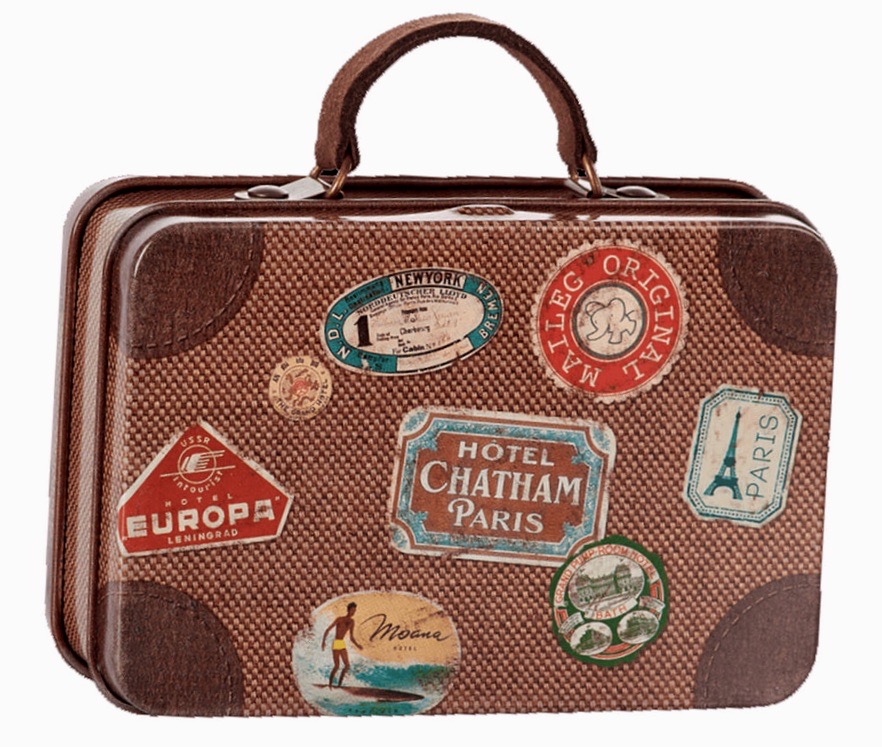
The Missus, as you splendid readers have no doubt realized by now, has a variety of superpowers, not least among them an uncanny ability to win any number of sports-related Invitational Championships across multiple continents.
Beyond that, I’ve long been amazed by the endlessly creative birthday parties the Missus has thrown for me during the past 40 years, nicely encapsulated in this festive gathering.
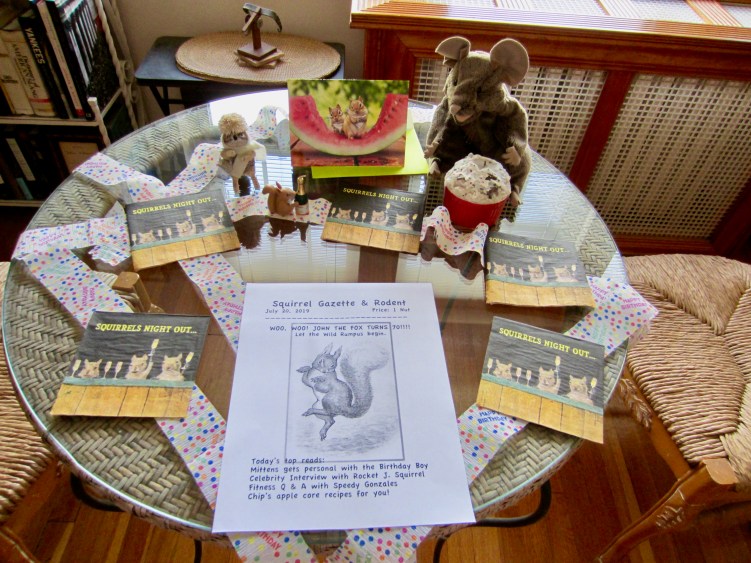
Brilliant!
(Do yourself a favor and zoom in on the Squirrel Gazette & Rodent. It’s a corker.)
Her most impressive superpower, however, has always been an otherworldly ability to predict American fashion trends well in advance of their appearance in the marketplace, which during a long stretch of her illustrious career allowed the Missus to advise pretty much every shoe manufacturer in New England – Stride Rite, Keds, Lowell Shoe, Bass, Timberland, Reebok, your kicks go here – about what colors and styles they should feature 18 months from then, which was the normal production cycle in the U.S. footwear industry.
The Missus:
John is clearly a biased commentator of my gifts, which quite embarrasses me here. But I do want to add that the 18-month shoe production cycle was many decades ago, prior to today’s tech inventions and wildly, sped-up timetable.
Part of her secret sauce in that process was an ecumenical media diet that ranged from the New York Times and the Wall Street Journal, to Women’s Wear Daily and every magazine under the sun, to urban street fashions and current and upcoming major museum exhibits.
And then there were the twice-yearly European fabric shows.
Colors that were promoted in Europe for upcoming fashion seasons would routinely migrate to the U.S. a year or so later. The trick was to determine which ones would go mass market and which would not.
The Missus, no surprise, turned out to be the Sigmund Freud of psycolorgy.
Consequently, starting in the late 1980s we ventured to London every six months so the Missus could take in the city’s semi-annual fabric expos. (I tagged along in my capacity as Chairman of the Board of Fashion Services, Inc – a strictly ceremonial position that consisted almost entirely of carrying luggage through international airports.)
The Missus would go to the fabric shows and I would – I dunno, wander around London, I guess. Or more likely sleep in.
But when her textile touring was over, the Missus and I would go to the theater as often as we could. Here’s what London’s West End theatre district looked like back then, via Kinolibrary.
And so it came to pass that the Missus and I were at a matinee performance of (I’m pretty sure) “Man of the Hour” (totally sure the production featured a swimming pool at the front of the stage) on the last Saturday in March of 1990 when all hell – a.k.a. the Poll Tax Riots – broke loose. The London edition featured thousands of protestors rampaging through the West End, smashing windows, looting shops, and setting cars on fire.
Here’s just a taste from an ITN Newsflash.
And here’s what I wrote a few weeks later.
From all the evidence, everyone in Britain who isn’t Margaret Thatcher has gotten pretty lathered up about the poll tax. Here’s an example to help you understand why: Our friends John and Nina Pucci, who manage a lov-e-ly pub in the West End, used to pay £500 a year in property tax on their flat in Chelsea. Now, because the poll tax is figured on the number of adults in the household, their tab is closer to £2,000. Much like Queen Victoria, they are not amused.
Of course, there are other reasons people are ripped about the new tax. One that springs immediately to mind is that Margaret Thatcher now pays £1,500 less in taxes than she did before.
Light up another Jaguar, Nigel. We don’t have to be home till dawn.
Thankfully, in the following days we attended theatrical productions that were more dramatic and less traumatic, most notably the musical Miss Saigon, with Jonathan Pryce in the lead.
The original soundtrack is here. And here’s the Overture, just to get you started.
Honestly, it was worth the Pryce of admission for the helicopter scene alone.
And then it was chop-chop back to Boston.
• • • • • • •
Upon our return to the State Formerly Known as Taxachusetts, I filed this piece for Adweek.
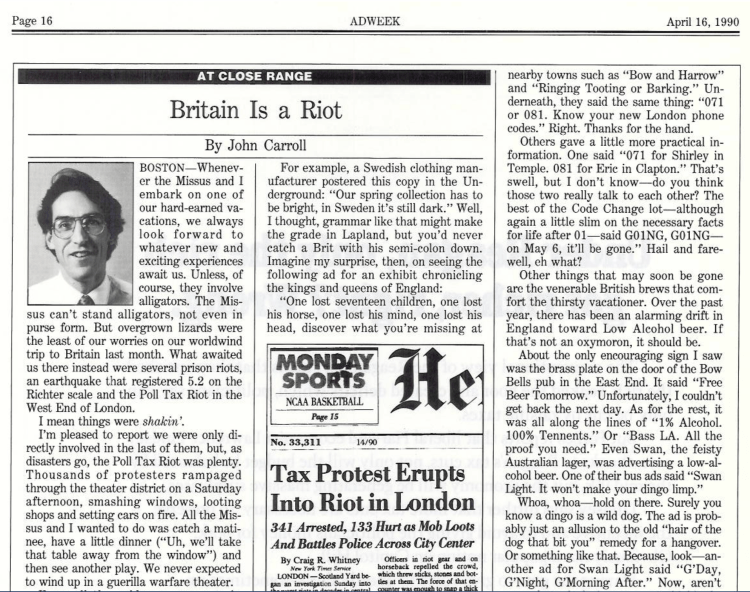
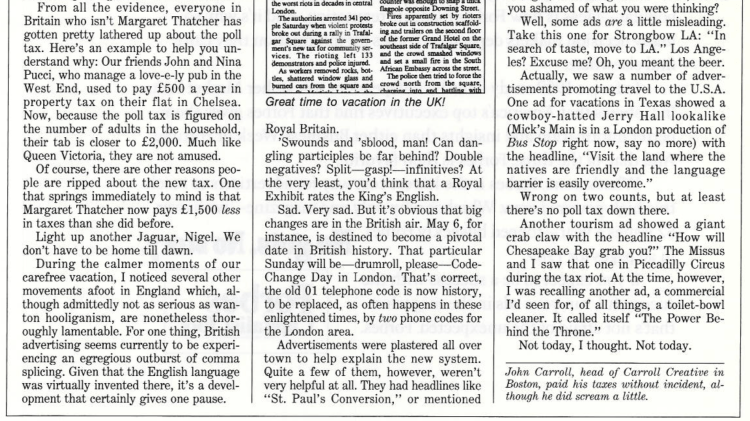
Favorite passage:
About the only encouraging sign I saw was the brass plate on the door of the Bow Bells pub in the East End. It said “Free Beer Tomorrow.” Unfortunately, I couldn’t get back the next day.
Never did afterward, either.

